And they’re like 2 dollars guys this is the best pen ive ever owned in my life
AND ITS WATER PROOF I PUT SOME WATER ON SOEM LINES AND IT DIDNT BLEED GUYS THESE PENS
I have used these pens! They are, indeed, awesome. Very good for drawing outlines and then using watercolors over. One of these, a water brush, and a tiny set of watercolor pans and you have an awesomely portable art kit. Like so (though that one has a different black brush pen).
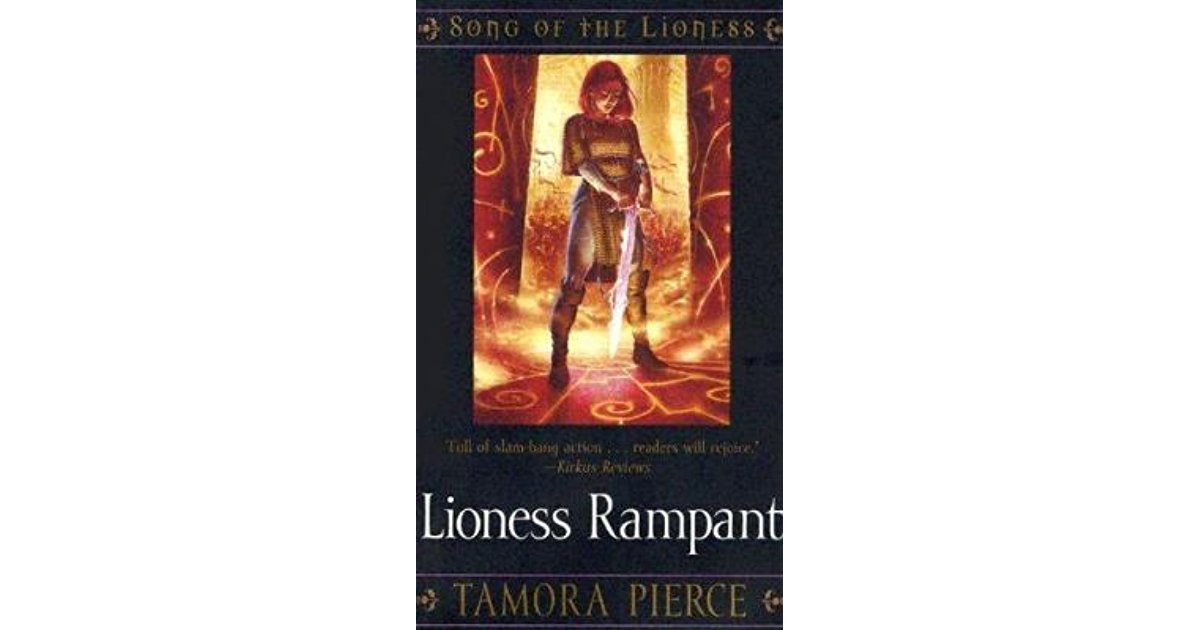
I tend to be inclined to binge things, so if I have all the books in a series or all the shows, I’ll go through them until I’ve finished everything. This was true with the Song of the Lioness by Tamora Pierce which I recently refinished with Lioness Rampant (Young Adult Fantasy 384 pages).
“‘I’m not sure I want to be a hero anymore.’ Having achieved her dream of becoming the first female knight errant, Alanna of Trebond is not sure what to do next. Perhaps being a knight errant is not all that Alanna needs … But Alanna must pusher her uncertainty aside when a new challenge arises. She must recover the Dominion Jewel, a legendary gem with enormous power for good – but only in the right hands. And she must work quickly. Tortall is in great danger, and Alanna’s archenemy, Duke Roger, is back – and more powerful than ever. In this final book of the Song of the Lioness quartet, Alanna discovers that she indeed has a future worthy of her mythic past – both as a warrior and as a woman.”
This is the finale book in the Song of the Lioness quartet. The story is really good because it shows that if you work hard enough, you can achieve anything. In the series, Alanna becomes a knight, then a shaman, and even gets to train with a Shang warrior. She defeats her nemesis, who attempts to kill the royal family and take the throne, and even wins an artifact of power to help her kingdom. She continues to work hard and she earns her place in history.
While I do enjoy this book, and it’s the final book in the series, I have one issue with how the book ended. The main heroine finishes her adventures, saves the day, then makes plans to get married and have a family. I appreciate very much that the ending was Alanna’s choice and that neither the marriage nor the family was actually shown in the book. I also appreciate that she realizes what a horrible thing it would be for Alanna to marry Jonathan and take the throne because of what that would do to the kingdom. They both put the needs of the kingdom over their own individual desires and eventually, they both realized that they loved other people and those other people made them individually happy. Overall, this book is a low three on my rating scale. I’m glad that I own it and I will continue to reread this book at the end of the quartet in the future.
Pierce, Tamora. Lioness Rampant. New York: Simon Pulse, 1988.
They have some interesting superiority complexes about teens. What, did they just turn 20? Dawww.
Way to keep clutching at those straws… Nevermind I’m 25 years old.
22 here, and living on my own in a big city. So y’know.
Self-sufficient aromantic asexual. Age 34. Whee, I’m so ancient that I’m almost to the point that people can stop telling me I’m a “stupid questioning teenager” and start blaming my asexuality on early menopause! (And considering I still get carded for Stuff Grown-Ups Do, I still get the “Whatever, you’ll change when you grow up” comment just as often as younger people do.)
‘Course, the thing I hate about “Well, not me, I’m old enough, I’m legit” is that I knew I was asexual when I was 15, too. All the mocking young asexuals deal with is really frigging ridiculous. If straight kids can know they’re straight as soon as they experience cross-sex attraction and nobody asks them to justify it, there’s no reason to slap a double standard on gay people or asexuals. We’re repeatedly asked if we’re sure or if we’re really old enough to know what we feel, and that teaches us over and over again that we’re not qualified to interpret our own feelings. Great lesson. I know asexuality looks like a blank space from the outside–a “not yet” rather than a “not at all”–but seriously, people should think about what they’re saying/doing when they mock young people who feel they’re asexual. Regardless of whether they turn out to not be asexual, attacking them for not being old enough to “know” that yet is completely non-constructive.
This seems like something everyone should know if they’re in the sciences and/or interested in reading scientific papers.
At one point I connected with a doctor who had a special interest in my daughter’s specific chromosome issue, and when he found out I’d started a parent group for it, he joined and uploaded every research paper he knew about to the files. I’d previous had to go to the local medical library and go through a complex procedure to get the info.
Connecting this way turned out to be an absolute bonus, as he connected other doctors with the group and they started doing some research with families who wanted to participate in genetic studies related to heart issues for the specific chromosome bit.
And don’t forget: a large number of those papers were published from studies which were performed with research grants from the government. In other words: we, the public, are being charged to access something we already paid for via taxes.
I literally can’t get myself to sit through movies that don’t have women. I’m like where the fuck are the women? Why are there so many men? This is boring as fuck goodbye
Even if it’s historically accurate?
as everyone knows, women were invented in 1990
All the notes of “women weren’t on old time battlefields” are wrong. There were more prostitutes and merchant women than there were soldiers in most every encampment. They followed the armies, marching alongside them, and notably ran the camps.
Many more women dressed as men to fight.
Long before female nurses were officially considered to be a part of the military, they were already on the battlefield. They merely didn’t get written into official reports because they were “invisible women”, “not supposed to be there”. Usually they would be local women running a makeshift care center out of their homes.
Movies involving ancient societies? Guess how many had female fighters?
Spies? Mostly female. Yeah, only the men were caught, usually (because nobody suspected the servant woman), but historians believe most cases had more women spies than men. Most cases meaning across time and continents.
Giving me a movie on samurai? Women were trained as well to avoid being captured and raped, and often fought just as hard as men. One woman notably survived multiple battles, and became a hero alongside her sisters after taking out 7 men before dying in her last fight (usually in sword fighting you’d be lucky to take out 2 enemy soldiers. 7 is fucking insane, but because she was a woman it was shoved under the records how the lord managed to survive).
Women have ALWAYS been on battlefields. Women have an intense history in driving victories and losses alike. They were supply runners, fighters, spies, assassins, prostitutes (look up how prostitutes essentially ran the western world, or even the social status of harem members. They literally fucking ruled), even underground activists.
The only time there weren’t many women were with cowboys. Actual western cowboys tended to be both POC and gay. In fact, any time women didn’t have a near equal or greater presence, there was a LOT of gay men.
History: either 80% female or 100% gay. And it’s 95% POC.
If a disability professional asks you to come and address their professional group, be very careful — especially if they ask you to “tell your story”. Sometimes disability professionals are prepared to learn from disabled people, but more often than not, it’s a setup for humiliating emotional exploitation.
Most disability professionals form their professional consensus on The Enlightened Approach to Disabled People without many or any disabled leaders in the room. Having already decided what they will do to us, disability professionals then bring in disabled people as validation fairies to help them feel the way they want to feel about it.
Even if the person approaching you seems nice, it’s worth being cautious — don’t trust a smile; look for evidence about whether or not they are prepared to take you seriously as an expert. Most disability professionals don’t want to learn from our expertise; they want us to help them feel good about themselves. What they usually want from us is an emotional performance that validates their self image and the approach they’ve decided to take to disabled people.
They want to feel inspired, without facing difficult truths. They want to feel moved, without changing. They want to say “I learn so much from you!” without reconsidering their worldview or professional practice, and they want to say “You have such a unique perspective!” to every disabled speaker, while treating us as largely interchangeable. (Disability professionals who are actually prepared to learn from us acknowledge gaps in their expertise, and seek out disabled experts to teach them what they need to know.)
When disability professionals *mean* “come make us feel good about ourselves”, what they usually *say* is some version of “we have so much to learn from your unique perspective” or “my colleagues need to hear your story”. When disability professionals ask a disabled person to “tell your story”, they generally expect us to follow these unwritten rules:
Tell the audience horror stories about your childhood that allow the listeners to feel righteous because We Would Never Do Such Things.
Make sure that the stories are graphic, but not too graphic. Horrify the audience enough so that their pulses raise a bit and they feel brave for listening to you, but be careful not to horrify them so much that they have nightmares.
Make sure that you tell the story in a way that doesn’t make them feel ashamed or responsible for any of it.
Give them someone to identify with so they can feel like excellent people. Usually it’s either “my mom never gave up on me!” or “there was this one awesome teacher who showed me how to believe in myself!”
Don’t talk about the lingering harm done to you, or how it’s affecting you in the present. Don’t make them think about harm done to disabled kids who are facing lifelong consequences of that harm. Don’t talk about present-day injustice, discrimination, or violence.
Tell your story as a tragic misunderstanding. Don’t talk about discrimination or systematic injustice.
Allow your audience to laugh at you. Tell self-deprecating jokes. Don’t insist on respect.
Don’t describe solidarity with other disabled people, and don’t attribute any of your success to other disabled people who you regard as equals.
Don’t describe fighting with a professional and winning, unless you can attribute your victory to someone they can identify with.
Don’t be angry, and don’t describe other disabled people’s anger as legitimate. (Under some circumstances, it may be permissible to describe it as understandable, but only if you’re appropriately condescending and give the impression that the therapy provided by the professionals in the room would fix it.)
Don’t talk about disability in political terms. Say that “times have changed”, without giving any credit to disabled people who fought for those changes.
Do not mention organized groups of disability activists, especially organized groups of disability activists who exist in the present and clash with disability professionals.
At the end of the presentation, open the floor for Q&A. When audience members presume that it’s ok to ask you intrusive personal questions, smile and give them an answer that makes them feel good about themselves.
When you’re in the audience of their presentations, do not expect this intimacy to be reciprocated, and do not expect them to show similar concern for your feelings.
Understand that you’re here to validate them, and they’re not there to validate you. Pretend that what they’re doing is listening and learning.
Don’t break character, and don’t drop the mask. Don’t acknowledge the unwritten rules or the unwarranted emotional validation they want from you. Accept compliments about your “honesty” and “authentic first hand perspective” with a straight face.
Above all, do not talk about being harmed by disability professionals who there’s any chance your audience would identify with.
When disability professionals expect you to be their validation fairy, this is a form of ableism and emotional exploitation. They should not be treating your life as a story about their benevolence as disability professionals. They should not be treating you as existing for the purpose of making them feel good about themselves. They should be treating you with respect as a real human being — and if you are an expert, they should be treating you with the professional respect due to a colleague.
I am not the validation fairy, and neither are you.
Tl;dr Disability professionals who say “tell us your story” often mean “make us feel good about how we’re treating disabled people”.
“Money can’t buy you happiness” is propaganda from rich people to convince the poor to be satisfied with less.
Delicious, finally some good fucking food.
they’ve actually studied this, and there is a measurable point up to which money basically does buy happiness, and then past that point it stops
a billionaire is not guaranteed to be any happier than a millionaire, but both those people are almost guaranteed to be happier than someone living in poverty
(the “point” turns out to be “the time at which you have enough money that all your needs can be met without anxiety and you have some amount of money left over to do things like pursue passions, give back to the community, and do other emotionally fulfilling things.” what a shocker!)
One thing I like about Pixar films is how the happy ending isn’t always what you think it’ll be. The toys don’t go with Andy to college, Gusteau’s restaurant gets closed down, Mike and Sully get kicked out of university, Carl never gets Ellie to Paradise Falls. But they find out that what they wanted isn’t necessarily what they needed, and I really like the fact that kids get to learn that life doesn’t always turn out the way they dreamed and that’s okay.
Except no that’s not what happened, that’s not why he sued, he sued because when he went to ask for more napkins, the staff started racially harassing him, all over fucking napkins. As for the amount, ut was probably exaggerated by the lawyer so when the court shrinks it, McDonalds would still have to pay at least something.
There are no such things as frivolous lawsuits made by individual people.
McDonald’s (and most businesses) have insanely good pr departments. The woman who sued McDonald’s for being burned by their coffee was turned into the face of “people will sue over anything” because suing over coffee being hot sounds ridiculous, right? Except for she was literally burned to the bone. The pictures are nauseating. What she went through was horrifying.
If you ever find yourself ridiculing an individual on a company’s behalf you’re probably just repeating pr propaganda


 C.A. Jacobs
 C.A. Jacobs