Probably one the most compelling issue to deal with when drawing characters. There’s clear pros and cons to both approach. The key, IMO, is to straddle the line between both. Give appeal and energy through the use of gesture, but always give hints of structure, weight and solidity to make the character feel like it lives in an environment. I do a quick, dynamic gesture first, then I go back in and add some structure on a second pass. In a rush, I’ll focus the structure pass on faces, hands and feet (feet: their position on the ground to give weight and/or balance to the pose.) -Norm @grizandnorm #tuesdaytips #100tuesdaytips #100tuesdaytipsbook #structuregesture #whynotboth
hey, thanks so much! this might get a lil long (as it always does!!) so bear with me.
firstly i want to say, there’s no right or wrong way to pick colors. every artist has their own palette they prefer and i think it’s super delightful to spend time developing your own special sense of color. so even though i’m explaining things in a “this is how you do it” sort of way, it’s not the only way! just my way. the best method to develop your own sense of color is to look at a LOT of art, look at a LOT of the world around you, and practice practice pratice.
at this point in my life i pick colors intuitively just because i think it’s something i’m naturally tuned into, and i’ve been doing it for a few years, so i don’t actively plan my palettes. but here are some things that i think about as i pick colors.
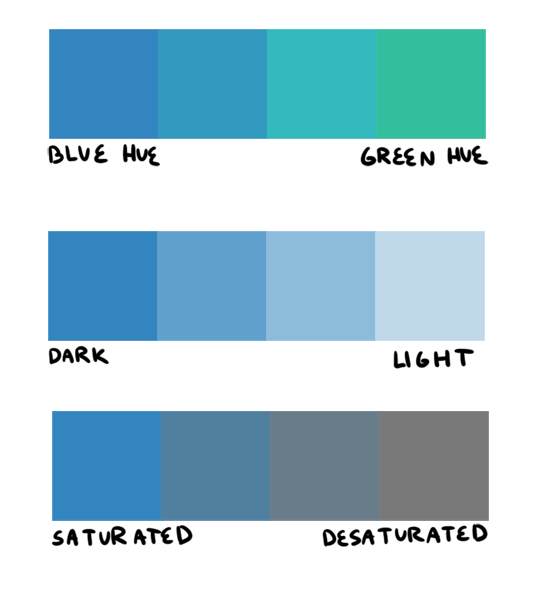
firstly, i want to go over hue, value, and saturation. i’m sure everyone knows these intuitively but i want to explain them in words. hue, value and saturation are what make up a color, and decide how colors differ from each other.
hue: what color the color actually is. red, purple, green, yellow, and everything in between.
value: how light or dark a color is. if you’re painting traditionally, adding more white or more black to a color lowers or raises its value.
saturation: how “pure” the color is vs how much neutral tone is in it.
here’s an example of all three:
this comes into play because a big mistake i see beginners make is that they pick a “just” color, and by that i mean they pick “just blue” or “just yellow”. imagine buying a set of oil paints and only using paints straight from the tube without ever mixing. it would be impossible! so i try to avoid picking “just” colors, except as for a complementary color (more on that in a bit). here are some variations of a red, for example.
so, the biggest thing for me when i pick colors is that i want them all to be friends. i want them all to have something in common so that they get along. i usually lose control of a painting when my colors feel to different from one another. so, i will usually start a painting with one color i know for sure i want, and “subordinate” other colors to it, meaning every other color i pick has to look good with that color. as to how you figure out what looks good and what doesn’t, that just takes time and lots of observation to build a personal opinion 🙂 here’s an example from one of my paintings. in this case, the main color is the trees.
and here’s another from rick & morty, the main color is the sky this time.
now that that’s out of the way, i’m going to give you the Actual Cheat Sheet for color palettes. in color theory, there are 8 basic color schemes that are generally pleasing to look at. here they are.
i usually use an analogous palette or monochrome palette out of preference. the two examples above more or less fall into those categories. however, i also like to use split complementary because the complimentary color adds a LOT of contrast and visual interest. it’s great to use if you have a specific thing in a painting you want to draw attention to. here’s an example:
it doesn’t always have to be a perfect split complementary, just one color that differs from the “family” of colors that take up a majority of the piece.
now! you might be wondering when’s the right time to subordinate a color, or where to put it, or how much of it to use, etc. and the answer is: CONTRAST. there is always visual interest in things that are different. i was rifling through my school notes and found these great types of contrast when working with color.
value: things that are light vs things that are dark.
hue: two colors that look different. I.E. yellow vs blue.
saturation: things that are saturated vs things that are desaturated.
proportion: note the example above. a majority of the painting is orange, so the green stands out because there is proportionally less of it.
temperature: things that are warm vs things that are cool.
complementary: red vs green, blue vs orange, yellow vs purple. when in doubt, these colors always contrast against each other because they have nothing in common (there is no red in green, etc).
simultaneous: this is a little advanced and i’m bad at explaining it, so please read up on it here.
a super helpful exercise is to look at your favorite illustrations, paintings, photographs, designs, etc and assess which one of the 8 color schemes (linked above) it has, and which types (can be more than one) of contrast it has. we did this in school and it REALLY helped me look at color better. here’s part of the assignment i did, the artist is annette marnat.
so! that’s pretty much how i think about color and how i pick my colors! i hope it was somewhat helpful! there’s so so so so much about color theory i can’t even begin to cover, i highly urge you to watch some videos and read some books and articles to further your study. a great starting place would be this series of videos. these are made by my teacher Richard Keyes, i think he had a dvd or something. everything i’ve talked about so far i learned from him and he is an absolute expert in color. these videos are invaluable. if you take anything away from this post, let it be to watch these videos hahaha.
to answer your question about my color leads, every painting was a collaborative effort between the three of us, and sometimes other painters too. it was a very hands-on crew, so i can’t say any of the r&m bgs i did are 100% “mine”. however, i think my personal color sense is waaaay different than jason or phil’s, which made the process very interesting because we usually had 3 very different opinions hahaa. you can check out their work here and here to see what things they brought to the table in relation to my own contributions.
thank you for the ask! again, i hope this was helpful 🙂
While it’s true that a lot of telemarketers are just folks trying to make ends meet, you still shouldn’t feel bad about hanging up on them in mid-sentence.
Many telemarketers aren’t actually allowed to end a call without making a sale; if they did so voluntarily, they’d be fired. By corporate edict, that call was only ever going to end in one of two ways: with you buying something, or with you hanging up on them. There’s no point trying to end the conversation politely because the script they’re working off of demands that they ignore and obstruct any attempt to do so – and they will be punished for failing to follow it.
You hanging up on them is literally the only way for them to get out of a call that’s not going anywhere, so you might as well get it over with. You’re actually doing them a favour.
Yes.
This is also an instance of a more general principle: notice when people are weaponizing social norms, and react by refusing to play the game.
Easy mode for this is the people on the street with pamphlets. They’ll weaponize social norms in an attempt to make you stop and talk to them. One script I see, for instance:
ACTIVIST: Hi! Excuse me, are you a student here?
PASSER-BY: –yes, I am.
ACTIVIST: Do you care about the ethical treatment of minorities on campus?
PASSER-BY: ….um, yes, but…
ACTIVIST: Were you aware that 90% of statistics about minorities are made up on the spot to serve as examples in tumblr posts?
PASSER-BY: …no, I wasn’t, but I really have to…
ACTIVIST: Here’s what our organization does to fight that!
…and so forth.
The trick here, of course, is that the first question is one which it’s socially unacceptable to avoid answering. If the activist opens with “would you like to help save a photogenic animal today?” you can say “no thank you.” If they open with “do you care about the whales?” you can grit your teeth and say “nope.”
But how do you respond to “are you a student here”? It’s a yes or no question, to which you definitely know the answer, so you can’t mumble something about not knowing. And it’s not explicitly related to their cause, so you can’t just automatically say “not today thanks.” (If you try either of those, they’ll call you on it – “what, you’re not a student today?”)
Ignoring them, or saying “that’s none of your business” or “leave me alone,” is a violation of social norms, and means you look like a jerk, because they asked a question that’s well within the realm of what’s socially permissible. So if you’re playing by social norms, you have to answer.
And then, once you’ve answered, you’re engaged in conversation with them. It’s an egregious violation of social norms to walk away from a conversation without going through the normal conversation-ending procedures. And they of course will not participate in those. So now you’re trapped, where you would have been free under social norms to walk past someone shouting at you about statistics if you hadn’t yet engaged with them.
The only way to escape these situations is to notice them and step outside the social game. This is hard; you will get intensethis-is-awkward, I-am-being-awful-and-mean feedback from your brain, which has noticed you are violating the rules and would like you to stop. But walking away without saying anything, or saying “I don’t want to talk right now,” is in fact the correct thing to do here.
And that’s easy mode. People selling something play this game blatantly. Hard mode is people who play it expertly, within society, so that you have to go along with what they want or be forced into violating social norms. (And people will go along with a lot rather than violate social norms.) Friends who ask you for things in a way that makes it awkward to refuse. Family members who treat you badly but do it in a way contrived so that any complaint will constitute you being rude. In the really extreme cases, the same dynamic shows up in abusive relationships. It’s the adult version of an abuser convincing a kid he’ll get in trouble if he tells his parents.
So this is, IMO, a really important skill to learn and to deploy properly. Social norms are great, I love doing the dance of social convention, it’s lovely and satisfying, but if your partner keeps trying to stab you with a poisoned dagger, maybe it’s time to stop dancing. Even if that looks weird in the middle of the dance floor.
This is something I never thought needed to be broken down before, but once you did it helped make a lot of things clear. Like, I already knew that sales people are pushy and try to rope you into conversations that are difficult to terminate, but describing the reasons why those conversations feel so awkward to leave abruptly was super enlightening.
Well said.
One other reason that people feel uncomfortable breaking social norms is the fear of retaliation. This is one that the face-to-face marketers tend to play on more than the telemarketers.
There’s a reason that chuggers (“charity muggers”) frequently pick on women – female-socialised people find it harder to say “no” and walk away from a social interaction. Some of this may be due to fear of retaliation. Lots of situations in which “a stranger forces you into weird public engagement” can escalate horribly, so it’s often easier to just mumble along with them and contrive an escape. Rejection (of the chugger/catcaller/marketer) is something that sometimes leads to retaliation, so depending on your experiences you might find yourself being afraid to “just walk away.”
I have had two experiences where chuggers caught me in public and reacted badly to my flat rejections. They were both men chugging for Greenpeace, and I actually complained to the organisation about them. Because they’re playing on social norms as well, using aspects of themselves in the marketing performance, they can get waaay too invested and in-character, and treat it as a social/sexual rejection, apparently. One of them actually lost his head and chased me down the street, shouting.
Anyway the best way I found to stop both of them was to stand at bay and scream “STOP HARASSING ME”, which created such public amazement among the other people on the sidewalk that the chuggers had to put their hands up and back away.
With the chasing-guy he sort of did a defeated primal scream and went back to his pitch, presumably having come back to his senses. but the other guy just raised his eyebrows like “hey WOW fair enough” so it worked out okay.
Basically even if there is retaliation, just remember that THEY STARTED IT and THEY MADE IT WEIRD.
I ran into two guys “talking” to people in a store and then in the food court who were recruiting for their church (which is shady af). The first guy they spoke to counld have been a discussion between people who knew each other but the second was a young black man you looked decidedly uncomfortable. I have never been one to ascribe to societal norms so I accosted them and asked them what they were soliciting. They panicked a bit and said all three of them went to the same church (which was not what the body language of the young black man said). To which I then replied, “Oh. So you’re soliciting religion. Creepy. Listen, this place as a very firm no solicitation policy and I’m going to report you as violating that policy for soliciting religion.” They panicked and left in a hurry. Once they left the building, I asked the young black man if he was okay and he said he was. I left him alone to finish his lunch (which was clearly what he wanted, since he put his headphones back in and started smiling at his video). I have never seen those two return to the store or food court where I found them. My point – many in-person telemarketers (or whatever) aren’t allowed in public spaces or businesses, including college campuses. They can hang out and have a booth or sit peacefully and talk to people who approach them but they are usually not supposd to force contact.
not to be dramatic, but Okoye telling her bitch ass husband she would end him without hesitation when he tried to manipulate her changed me as a person and cured my depression.
“would you kill me my love?”
“for wakanda? No question.”
a woman in my theater: “oH I HEARD THAT!!!!”
Listen. LISTEN. *cups your face in my hands* Listen to me. I have never so perfectly and purely seen a Paladin depicted in a movie as I saw in Okoye. Lawful good to her core. Pure, unvarnished loyalty to Wakanda and her people evident in every goddamned motion. Dignified, graceful, reverent respect for the rules of her country and its greater good.
There is something so beautiful about faith, something that just burns through with a beautiful glow that lights up someone’s eyes and every expression. There is a confidence and a peace that is both palpable and enviable when faith has been tested and come through intact. You could so hear it in her voice.
Personal shit is great, and I’m glad she was seen in a loving relationship. The Lone Woman Warrior trope is worn thin, and I’m sure even thinner for black women who are often not allowed to be lovable people on screen. But the core of the Paladin is ‘there is something greater than I, and I will sacrifice everything for it’, and it was beautiful to not only see that happen on screen but see her proved right, see her win, in one case by not even raising her weapon. She stood firm in her faith and the narrative said yes, it said this is just, it said your very faith will protect you from harm. And she’s not seen as hard or cold edged weapon for that. The imagery around her in that moment is more like a saint or an angel, glowing and reaching out a peaceful hand to a symbol of one of the tribes of her country. Her country loves her back.
Okoye doesn’t just love her country. She doesn’t just serve her country. She doesn’t just believe in her country. She has unshakable faith in an absolute truth: Wakanda Forever.
She is elevated for her faith as much as her skill.
armouredswampert: agelfeygelach: little-yogi: It’s a cute little thing though. Sometimes it is hard to remember that owls are incredibly dangerous predators seen by cultures throughout the world as ill omens. Especially when they look like toasted marshmallows. My boss once … Continue reading →
arkilliandragon: “Silvyr Rose- Expression meme 18/25″- Finished 18 out of 25 expressions for a meme I’m doing to get better practiced at drawing Silvyr for his upcoming comic. I’ve drawn him a few times, but not enough for a comic, … Continue reading →



 C.A. Jacobs
 C.A. Jacobs
