Book Review: How to Train Your Dragon by Cressida Cowell

This morning’s gym book was How to Train Your Dragon (Young Adult 214 page) by Cressida Cowell.

“Hiccup Horrendous Haddock III is a truly extraordinary Viking hero known throughout Vikingdom as ‘the Dragon Whisperer’ … but it wasn’t always so. Travel back to the days when the mighty warrior was just a boy, the quiet and thoughtful son of the Chief of the Hairy Hooligans. Can Hiccup capture a dragon and train it without being torn limb from limb? Join the adventure as the small boy finds a better way to train his dragon and becomes a hero!”

The book and the movie are not very similar. Just to get that out of the way.

I’m not quite sure what I should say about this book, and the main reason for that is because of how much I absolutely enjoy the movie. This is one of those weird times where I’m not positive if my having seen the movie first before I read this book hindered my view of the book or whether my having seen the movie first makes me more willing to forgive some of the concerns I have with the book.

The biggest difference between the book and the movie was the fact that in the book, there are zero female characters. In the movie, the female teenage Vikings participate in the dragon training on equal levels to the male teenagers, and in the case of Astrid, outperforms them in every way. The movie came out in 2010 and the original print of this book came out in 2003 in Great Britain and that may not seem like much time, but equality really has come a long way in that time. So I’m going to ignore that this book has only male characters and I’m going to focus on the things that were more positive in this book.

This book has some standard tropes in it, in the sense that the larger youths are bullies and they particularly enjoy picking on the two outcasts of the tribe, Hiccup and Fishlegs. As the story progresses, it’s clear that the normal Viking way of brute force and loud noises will not work to solve their concerns about giant dragons. And I guess I really just didn’t like how unlikable the dragons in this book are. The Green Death is fun because it’s obviously messing around and the tone for it was interesting. I was hoping Toothless really would be a special dragon instead of just a garden variety dragon, and I was also hoping that Toothless would be a bit more noble, but I think that there’s a lot of room for growth as the series continues.

Overall, this book was a good, fast read and it showed how you can use your heart and your wits to solve problems with a lot better judgment than yelling and screaming and being a bully. It was definitely a trope of the little guy who is born to do great things overcoming peer pressure and a series of trials and obstacles designed to test his ability to be the hero. It’s also along the lines of being true to yourself and that’s how you can become a hero. So overall, it has a lot of really great messages. I just couldn’t get over the fact that this book contained no female characters. With that in mind, I’m glad I own the book, but it’s probably only a middle grade two on my rating scale.

Works cited: Cowell, Cressida. How to Train Your Dragon. New York: Hachette Book Group, 2010. Original print 2003.

Posted in Book Reviews | Tagged , , | Leave a comment

Book Review: My Brother Michael by Mary Stewart

The next book I read for my Readings in the Genre: Mystery Classics class for Seton Hill University’s Master of Fine Arts in Writing Popular Fiction was My Brother Michael (Mystery 238 pages) by Mary Stewart.

My Brother Michael by Mary Stewart is by far my favorite of the novels for this class.

I found a lot of “firsts” in this book and all of them contributed to how much I enjoy and respect this novel. I was extremely excited to read a story written by a woman and the tone and setting immediately hooked me. Not only was this the first story so far this class to be written by a woman where the main character is a woman. This was also the first story we’ve read that took place in an area of the world vastly unfamiliar to the average Western reader, with multiple languages and multiple cultures. Even the setting, with the hot sun, the white canyon walls, the unsafe winding roads, and the normality of hiking through historical landmarks seems alien and distant to most readers.

This novel was also different in the sense that it didn’t start out with a body and it didn’t start out with a client. The mystery for this novel is extremely nebulous, but I would say that there are definitely multiple components and elements of mystery strewn throughout the story. This is the first story without someone who is in some way being paid to solve the mystery of someone else’s death.

The descriptions of Greece throughout this novel made me want to go there. The setting was harsh, with white canyons, rocks, and the arid, bright, burning sun. Most of the stories we’ve read so far take place in cities or in the lush green countryside. This is the first novel we’ve read for this class that used a setting unfamiliar in both country, personality, and culture. I was deeply engrossed in the setting throughout most of the book because of how descriptively Mary Stewart wrote about a culture and setting so unfamiliar to me.

There were some parts of the story were I wasn’t as engaged with the descriptions as I was with the descriptions of other parts of the story. She definitely introduced characters well, though, and all of the named characters in this story had a wonderful introduction description and also served the plot. This was one of the first stories we’ve read that wasn’t so overflowing with characters that it was easy to get them confused. Every character in this story was a person and nowhere near a cardboard cutout.

The first mystery is Camilla’s, involving the hired car and how to find the owner. The next mysteries get a little blurry after that because many things happen. Michael’s death isn’t a mystery because Stephanos tells Simon who killed Michael, where, when, and how. There isn’t even the mystery of why Michael was murdered because they are all aware of how hard World War II was on the entire area and how many things happened at that time. The mystery that continues to build throughout the story is more along the lines of what’s happening now and what or where is the treasure that Michael found so wonderful.

The middle of the book was a bit slow and uninspiring. I felt no sense of urgency for Camilla to actually find the owner of the car (and what actually happened with that anyway? Did they have to return the car and pay a huge fee for mileage and days used and such? And since they turned all of the gold and guns over to the government and didn’t get any reward, how are either of them going to pay for it?) The ticking clock wasn’t really present throughout the majority of the book, at least, not until Nigel goes missing and the attack in the art studio building. At that point, I felt as though the book really picked up and things started happening very quickly.

If the story had been told from Simon’s perspective, then we would have gotten another story similar to the ones we’d already read, with the male detective or protagonist who has little emotional capacity and is always capable of taking care of whatever comes his way. The difference between Camilla and these characters is that the reader honestly has no idea how she’s going to react to any given situation. Simon has very little outward reactions throughout the entire book and I think I would have been as emotionally disengaged and uncaring of him as I have been of all our other protagonists so far. But that’s also a really great look at the title, since it’s My Brother Michael, and it’s Simon who is actually Michael’s brother and not Camilla.

For Simon going through this novel, I could tell that he was curious about what Michael truly found that would have created such excitement in him. Surely not guns and gold would motivate Michael to speak so poetically about what he found if it were just the supplies brought in during the war. When the true mystery of what Michael, and eventually Nigel, found in that cave is revealed, it’s much more marvelous than some gold and supplies. Finding the hidden grotto with Apollo’s statue and the water was definitely an experience of awe for anyone with any sense of culture and respect, worth far more than finding gold and guns. The Apollo reveal was the highlight of the book. It was well described and pulled in the feel of the mythology combined with the setting. It made me feel as though both Simon and Michael were very shallow for being interested in some gold and guns from World War II and I was thankful that the Apollo portion was there because otherwise, I think I would have felt cheated with the book as a whole.

One of the most interesting parts about this novel to me is that it’s marked as a “Gothic Romance” by Wikipedia and as “Romantic Suspense” in other places. When I was attempting to find this book at any of the local bookstores, the clerks there told me that if they had it, it would be located in the “Historical” section. As I know this is the Mystery Classics Reading in the Genre course, I even checked under mystery. When I finally asked the owner of the used bookstore in the shady part of town if he had this book, he knew exactly what book I was looking for and told me that no one had asked about Mary Stewart or My Brother Michael in many years. He told me about how Mary Stewart also wrote fantasy and that she was writing fantasy before it became popular.

My Brother Michael had a surreal feel to it, and I suspect my feelings on that are related to the faint pan pipes Camilla hears at various points near the end of the story. The way Camilla talks about the mythology and the settings under the Greek sky gave the settings in this novel a very unique flavor and almost made me feel as though perhaps the old gods could be watching, or at least the ghosts of all those who believed so strongly that their gods were real and influenced every part of their lives. The setting was so well-written that I could almost feel the heat radiating from the white rocks throughout the entire novel.

I noticed repeated smoking of cigarettes. Smoking is used after a long hike over difficult terrain. Smoking is used after a brawl in the middle of the night with a man who is wandering around inside the place you’re staying. Smoking is used to have a discussion, or to just sit on a rock somewhere in the sun. There was a lot of smoking back in those days and it also appears to be a plot device to move the action forward. It gives the characters something to do and the readers something to read. In our modern times today, though, smoking is unhealthy and this kind of excessive smoking is not seen favorably.

I guess one of the key points for me about this novel is that I would have never seen it as a romantic anything without having been told repeatedly that I was supposed to see it as such. And even knowing that this was classified as a gothic romance and a romantic suspense novel, I still enjoyed it because I would have never seen any of that if no one had told me to look for it. And, quite frankly, I don’t read anything about the novels we read for class until after I’ve finished reading them so that my initial impressions aren’t marred by what other people tell me I’m supposed to think about things. The “romantic” elements in this novel, what few of those elements there were, were so artfully done that I didn’t even notice or care about them because they didn’t interfere with the plot or with character development and they weren’t woefully unrealistic. I think I would have been disappointed with the lack of romantic interaction if I’d been expecting romantic interaction and didn’t get it.

There was no real romantic element, which was okay for me because I wasn’t expecting one. I think it actually added some nice restraint on the parts of the characters because Camilla clearly finds Simon attractive and Simon clearly finds Camilla attractive, but they are both okay with the other person being a responsible adult and doing what’s best for their own lives. Yes, they have similar interests and they share many thought-processes and such, but they really have only known each other for a handful of days. Honestly, I think this is probably one of the most responsible relationships I’ve seen from many of the (usually completely false and unrealistic) expectations of relationships depicted in both books and movies/television. These two character don’t jump all over each other, but there is still clearly a solid connection.

I didn’t need the reminder of Philip’s missing ring tan line because at that point in the story, I didn’t really care about Philip or Camilla’s relationship to Philip. He was part of the past and he should have stayed that way. I think Camilla’s adventure would have been better served if that part hadn’t been mentioned at the end because even by mentioning him, it seems to me that she gives more value to his presence or absence in her life than she reasonably should. She’s obviously decided to start making her own decisions about her life and it seems weird and awkward to me that she had any thoughts about Philip’s ring after everything else she’d been through. I probably would have understood her thinking something about how Elizabeth would never believe the adventure she’d just been on, but we don’t really hear Camilla talking any more about her friend that was supposed to come with her.

Overall, a great novel and I’m extremely happy that I bought a hard cover book from the used bookstore with “Three novels of suspense” because I am definitely going to read more of Mary Stewart’s work.

Work Cited: Stewart, Mary. My Brother Michael. New York: M.S. Mill Company, 1960. Original Publication 1959.

Posted in Book Reviews | Tagged , , , , , , , | Leave a comment

Book Review: Lemony Snicket: the Unauthorized Autobiography by Lemony Snicket

Yesterday morning’s gym book was Lemony Snicket: the Unauthorized Autobiography (Young Adult 218 pages) by Lemony Snicket.

“The book you are holding in your hands is extremely dangerous. If the wrong people see you with this objectionable autobiography, the results could be disastrous. Please make use of this book’s reversible jacket immediately. Disguising this book, and yourself if necessary, may be your only hope.”

There were a lot of things that I found highly amusing about this book, but I think it wasn’t a very good gym book, as it was designed more to be used like a research and reference book and not really to be read from cover to cover. There are a lot of parts of this book that jump around and that I would have been happy to pull the referenced material to see what it said, but I was limited in the sense that I was on the stationary bike and didn’t have access to either my own library or the internet to look things up. There are times when specific passages in specific texts are mentioned, which made me curious to pull the referenced sources and actually see if the marks were correct and what kind of context was available or enhanced from the original books because of this book.

The opening page with the copyright information was absolutely hilarious. I wonder sometimes how many people read every part of a book and I don’t know that I would have read the copyright citation if I hadn’t been on the stationary bike and actually finished this book before achieving my twelve-mile goal. But because I finished the book before my mileage, I found myself reading everything that had words on it to help keep my mind off of exactly how much my cyborg parts hate me, especially when working out.

I’m sure that everyone at some point in their lives have been exposed to the standard copyright block about not reproducing or copying work without proper authorization, but the copyright paragraph in this book is just hilarious: “No part of this book may be used, reproduced, destroyed, tampered with, or eaten without written permission except in the case of brief, possibly coded quotations embodied in critical articles, reviews, and subpoenas. Allegedly printed in the United States of America. For information address HarperCollins Children’s Books, a division of HarperCollins Publishers, 1350 Avenue of the Americas, New York, NY 10019, although the people at this publishing house have no idea where the documents enclosed in this book came from. If you recognize yourself in any of the photographs or illustrations in this book you may find yourself in Very Frightening Danger and/or slightly embarrassed but there is nothing you can do about it. Please note that the author has been called a fraud, a criminal, a bestseller, a corpse, a fictional character, an unreliable narrator, an objective flaneur, an embattled gentleman, a magnetic field, an arsonist, and late for dinner by an odd number of dubious authorities. Send help at once. All right’s reserved. Wouldn’t you rather read about ponies?”

Overall, I’d say this isn’t really a book to read all the way through, but rather a book to use in conjunction with the other books from a Series of Unfortunate Events. I would also recommend not reading this until after the Carnivorous Carnival or the Slippery Slope and then using it as an additional source of information. I’d say it’s probably a middle to low grade two on my rating scale. I’m glad I borrowed it from the library, but it will be a good resource to have on hand when I reread the series again.

Works cited: Snicket, Lemony. Lemony Snicket: the Unauthorized Autobiography. New York: HarperCollinsPublishers, 2002.

Posted in Book Reviews | Tagged , , , | Leave a comment

Movie Review: Snow White and the Huntsman

Since I went out and watched the Huntsman: Winter’s War on Thursday night, I thought it would be only fitting to watch Snow White and the Huntsman last night.

This is a movie that hasn’t really come up in conversation much, and when it does, it’s usually prefaced by a discussion about Kristen Stewart as an actress. For years, I listened to other people’s opinions and I didn’t even give movies with Kristen Stewart a chance. Then, I found a movie called Camp X-Ray where Kristen Stewart plays a young Private First Class who is recently assigned to the detention facility at Guantanamo Bay, Cuba. This was the first movie I watched with Kristen Stewart and I thought she played the role of a young and stoic soldier working to figure out the “right” thing to do very well. I’ve also been through a lot in my personal life in the last several years and I have a greater respect for people and more of a willingness to not judge people based on other people’s perceptions or reactions. I’ve also become a lot more accepting and understanding of other people’s circumstances and there’s a lot about Kristen Stewart that I didn’t know or appreciate. She really hasn’t been in that many well-known movies and judging her based on the Twilight series, which I do not believe are valid judgment criteria, might be a disservice.

“Queen Ravenna, who seized control of her kingdom by marrying and killing its rightful ruler, needs the life force of young maidens to maintain her beauty. However, to become truly immortal, Ravenna must consume the heart of her stepdaughter Snow White. Snow White escapes, and Ravenna dispatches a huntsman to capture her.”

So when I watched Snow White and the Huntsman last night, I actually enjoyed the movie and I honestly think that people dislike this movie because of imposed bias. The world-building was imaginative and heart-felt. None of the fairytale creatures looked the way they are typically assigned, with the troll turning out to be something rather beautiful instead of some sort of monster and the dark forest being super trippy. The dark forest could have been real exactly as it was or it could have all been some sort of neurological poison in the air which caused hallucinations. A lot of the differences in the movie aren’t discussed, but rather accepted and I appreciated that part of the world-building. Early in the movie, I thought the birds were kind of weird and Disney cartoon-ish, but then you find out that the birds are transportation for some helpful people and it makes a lot more sense. There are so many fascinating creatures in this movie that simply exist and accepted, which really helped with the world-building for me and made the setting believable and realistic. The movie was a very different and new look at the typical Snow White story and I thought it was done very well.

Having just watched the Huntsman: Winter’s War the night prior, I was adamantly hoping that there wouldn’t be a love story between Eric the Huntsman and Snow White and I was not disappointed. Snow White and William definitely had feelings for each other and in the Huntsman: Winter’s War, William and Snow White are married and rulers of the kingdom, which is exactly how that story should go. The case could be argued that the Huntsman did have feelings for Snow White, but I think the opposite could be argued. The huntsman in this movie has a very substantial drinking problem and the introduction of this character in the movie is when he’s kicked out of a bar because he wasn’t paying for his booze. There’s then a brawl in the very muddy streets and he doesn’t do very well in this fight. He is then conscripted to help the Queen’s men to track Snow White in the dark forest. Yes, the Huntsman kissed Snow White exactly once and the argument could be made based on the fairy tale that it was true love’s kiss that awoke her from the enchanted slumber, but what if it was just a matter of timing and desperation? What if it just took Snow White’s body a little bit of time to get the poison out of her system and then she needed some or any sort of physical interaction in order to provide her body with a wake-up call?

I don’t think the Huntsman had any feelings for Snow White in this movie. I think that he believed that she had the ability to unite the people and overthrow the wicked queen. The Huntsman was tired of living in a world without hope where the land was dying and Snow White had the capability of destroying the wicked queen and bringing life back to the land. That’s a goal worth fighting for and a worthy goal to achieve, so of course it would matter to him as a person living in that area to want life made better.

I also liked how devoted William was to Snow White, which is made evident in his actions as soon as he knows she’s alive and that Ravenna is searching for her. He joins the Queen’s riders just so he can go with them to find her. He’s great with a bow and he stands by Snow White’s side, willing to protect her, but also willing to accept her as she is. Snow White forgives him for leaving when they were children, but that’s also the nature of that character – to be forgiving and try to help as much as possible.

Overall, I’d say this movie is probably a low three on my rating scale. I did enjoy it, but it’s not a movie I feel I could watch again right at this second. I think that I’ll buy it, assuming I can get Snow White and the Huntsman in a dual-pack with the Huntsman: Winter’s War.

Posted in Movie Reviews | Tagged , , , | Leave a comment

Movie Review: the Huntsman: Winter’s War

Last night, I went out and saw the Huntsman: Winter’s War with someone fantastic. I haven’t been to the movies in a long time and I honestly didn’t know anything about this movie. I’m glad that I went to the movie and I’m also glad I had no preconceptions about what the movie would be like. And I think this movie works a lot better if you haven’t seen Snow White and the Huntsman, or if you don’t remember that movie at all.

“Betrayed by her evil sister Ravenna, heartbroken Freya retreats to a northern kingdom to raise an army of huntsmen as her protectors. Gifted with the ability to freeze her enemies in ice, Freya teaches her young soldiers to never fall in love. When Eric and fellow warrior Sara defy this rule, the angry queen does whatever she can to stop them.”

This movie is a pseudo-sequel to Snow White and the Huntsman, but it’s a sequel only in a few very small ways. The movie tasks place in the same world with some of the same characters as Snow White and the Huntsman, but the story mostly focuses on Eric the Huntsman. Actually, this story focuses on the Huntsmen in general and shows how they are acquired as children and trained to be Freya’s army.

I enjoyed this movie greatly and thought it was hilarious and imaginative. The fantasy elements, creatures, and world-building were marvelous and the setting worked in favor of the story in every way.

There’s probably going to be spoilers in this review so if you want to be surprised then you should probably stop reading here.

Eric is a fantastic character. He’s talented, funny, and devoted, which makes him a character worth cheering for. Sara is also a fantastic character for the same reasons. The movie featured a lot of pairings, since Eric begins his journey with two dwarves and then collects another two dwarves, and is saved during a bar room brawl with other Huntsmen by Sara, whom he has believed for the last seven years to be dead.

The movie shows Eric and Sara being raised together as part of Freya’s army and how they became the best of the Huntsmen and then how they fell in love. Sara was remarkably skilled with a bow (I think this “series” has this thing about making primary love interests skilled with the bow) and she was also a very skilled fighter. It was remarkably refreshing to see a fighting partnership where both worked to augment each other and where they were equals. Eric and Sara’s interactions were honest and hilarious and I found myself genuinely hoping they would start communicating effectively again because the chemistry between them was so strong.

The dwarves were all hilarious. The male dwarves made constant jokes about the female dwarves, but the female dwarves were witty, clever, competent, and hilarious. The interactions between the two sets of dwarves was fun, for all that it was predictable. The movie had a general trend of pairing people together at the end, and while I understand it because this was a movie about how love is a good thing.

One of the things I enjoyed the most about this movie was Sara’s perspective of love. She spent a lot of the movie talking about how love is a lie and that those you love and give your heart to will always abandon you when you need them the most, and that really struck a lot of chords with me. I spent most of the movie agreeing whole-heartedly with Sara’s comments and her views on Eric. The truth, though, is that both Sara and Eric were deceived. When Freya formed her ice wall, Eric saw another Huntsman kill Sara and he watched her blood on the wall before he himself was knocked unconscious and his body thrown into the icy river. Sara saw Eric face overwhelming odds and flee away from the castle. Both were deceived by Freya so that they would each believe that their love was destroyed, Eric by believing the actual, physical death of Sara, and Sara by believing Eric was a coward who was unworthy of her love because he abandoned her after they married and swore to stand or fall together. As much as I believe that I am the villain of this story and that there are no happy endings for people like me, I wanted things to work out between Eric and Sara. I wanted them to communicate effectively and fight side-by-side to save the day (which they did). Their relationship isn’t perfect (nothing ever is) but it’s perfect for them and who they are, which makes it a viable match.

The reason we watch movies like this is for escapism and wish-fulfillment; we want to see the happily ever after ending because it’s usually so far from our real lives that it’s what our heart wants and is often denied. It’s the idea of finding someone who loves you who you love more than anything and having things actually work out. It’s thinking that somewhere, there’s someone who is a perfect partner for you – that you will fight and stand together and fall together. Someone who will believe in you, even when you don’t believe in yourself, but also someone who will knock you on your butt when you get out of line. Someone who will never miss.

Overall, I would rate this movie as a high three on my rating scale. The characters are worthwhile and hilarious and the setting is incredibly imaginative. I’m glad I went and saw this movie in the theater and I think I’ll buy it when it comes out.

Posted in Movie Reviews | Tagged , , | Leave a comment

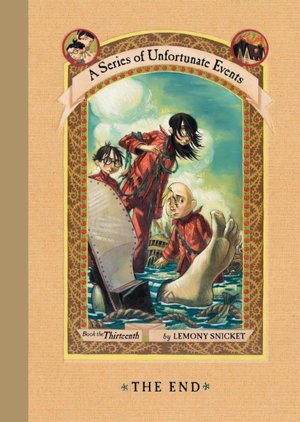
Book Review: a Series of Unfortunate Events: the End by Lemony Snicket

I finished a Series of Unfortunate Events 13: the End (Young Adult 339 pages) by Lemony Snicket a while ago, but hadn’t done up my review until now.

“Dear Reader, You are presumably looking at the back of this book, or the end of THE END. The end of THE END is the best place to begin THE END, because if you read THE END from the beginning of the beginning of THE END to the end of the end of THE END, you will arrive at the end of the end of your rope. This book is the last in A Series of Unfortunate Events, and even if you braved the previous twelve volumes, you probably can’t stand such unpleasantries as a fearsome storm, a suspicious beverage, a herd of wild sheep, an enormous bird cage, and a truly haunting secret about the Baudelaire parents. It has been my solemn occupation to complete the history of the Baudelaire orphans, and at last I am finished. You likely have some other occupation, so if I were you I would drop this book at once, so THE END does not finish you. With all due respect, Lemony Snicket.”

I think it’s safe to say that there will be spoilers and a whole bunch of plot details about the entire series here, so if you haven’t read this book or you haven’t read the rest of the series and you don’t want to know how everything turns out, I suggest you stop reading this particular review.

the endAround the fifth book in this series, I started to think that maybe the book titles would spell something out in code because this series definitely likes using codes and implying the use of codes. I did a bare amount of research about the series and found this great article which sums up a lot of my thoughts and feeling about the series pretty nicely. To the best of my knowledge, the letters used for each book don’t spell anything out. I am not good at anagrams, but the letters, in order, are: B, R, W, M, A, E, V, H, C, S, G, and P. I didn’t include The End or Chapter Fourteen in my list of initials and it looks like it should spell something like “Charms Web GPV” or “Ms Grave B Chep” or something else that makes absolutely no sense. There’s even an anagram thing on the Lemony Snicket wiki website that discusses the anagrams used throughout the series, but I couldn’t find any indication that the book titles were supposed to create some sort of anagram on their own. So if anyone reads this and can find a fun or meaningful anagram from the letters used in creating the titles for a Series of Unfortunate Events, please let me know. (And if you’re bored, Lemony Snicket’s actual website has anagram games and other distractions.

This book has a lot of really good final points about life in general, such as on page 95: “All day long, everyone in the world is succumbing to peer pressure, whether it is the pressure of their fourth grade peers to play dodge ball during recess or the pressure of their fellow circus performers to balance rubber balls on their noses, and if you try to avoid every instance of peer pressure you will end up without any peers whatsoever, and the trick is to succumb to enough pressure that you do not drive your peers away, but not so much that you end up in a situation in which you are dead or otherwise uncomfortable.” At this part of the novel, the Baudelaires have found themselves stranded on an island with some people who are friendly and helpful, but also not exactly free to do as they wish. The main leader, Ishmael, makes so many comments about how he’s not going to force anyone to do anything but that he really doesn’t think people should rock the boat that it made me frustrated. The way this portion of the story was written clearly showed that people can have the best of intentions, such as keeping all the colonists safe, but that the methods are often not ideal. I think that’s one of the other key themes from this book and this series – no one will ever be truly safe, so would you rather be in a world where you can be yourself and make a positive difference in the world or would you rather live in a world with so many rules and restrictions that you might be safe, but deeply unfulfilled?

The Baudelaire interactions with the rest of the islanders is a fairly accurate representation of our current modern world in that there are a lot of times when no one is forcing you to do anything but they actually kind of are forcing you to fit into certain molds so that their own lives are not inconvenienced by pesky things like the truth or trying to make the world a better place. How many times do we overlook homelessness, unemployment, sexism, racism, etc., so that we are not the ones who are rocking the boat? How many times do the people around us take the easy route of stuffing our heads in the sand so that we aren’t faced with hurt and disappointment from the people we care about or trust? There are so many quotes and motivational sayings throughout history about how all it takes for villains in the world to succeed is for good people to do nothing and sayings of those sorts. This book really shows how peer pressure works in situations where there really isn’t anything genuinely evil going on, but things just aren’t quite right, either. It’s very easy for Ishmael to lie to the islanders and keep them doped up so that they don’t care about what’s going on in their lives. If left to his care alone, the islanders would all die and he wouldn’t even think about it. In a lot of ways, Ishmael is like Count Olaf, in that he’s only really looking after himself and he uses other people to do his work for him.

I’m thinking that the Snicket family, the Baudelaire family, and Count Olaf’s family are all linked somehow and I finished this book with a powerful desire to actually try and map out the connections between all the people. I didn’t do that because I’m not sure I actually cared that much at this exact second and I certainly don’t have time for that kind of endeavor right now. I get the feeling that all three of these families are actually related families in a much broader sense. We know from the beginning the Count Olaf is actually one of their Uncles, as is Uncle Montgomery. And it’s late and I didn’t have the energy to actually look up any of the ties that bind between all the people in these books. But I do think that it’s all connected and it shows how people can bring others together or all fall apart, even if they are connected.

I think as some final notes about this series that I’ll mention that I’m not entirely certain I’m satisfied with the ending of this book and the series as a whole. There were a lot of mysteries that remained unresolved for the duration of this series. The one that I think about the most, oddly, is whatever became of the Baudelaire fortune that everyone was so keen on throughout so many of the books? Count Olaf spends a lot of his time attempting to corner the Baudelaire orphans so he can get his hands on their fortune and by the end of the book, Count Olaf is deceased and Violet might actually be old enough to be considered a legal adult, though the Baudelaires are now fugitives from the law. Would they have had access to their fortune and if so, would they be able to use it to pursue noble deeds? Would Mr. Poe have somehow managed to remain in charge of their fortune, especially since it’s being in charge of the Baudelaire fortune that earned him most of his promotions and extra money at the bank where he works? Did the Baudelaires ever link back up with the Quagmires and build their dreams of journalism, inventions, researching, cooking, libraries, and poetry?

The Quagmire story is incomplete by the end of this particular book and at the end of the official series, though it appears as though there are other books set in the same world that might shed some more light on some of the other people and mysteries found throughout a Series of Unfortunate Events. I’d be curious to see how everything worked out for the Quagmires, but I suspect that they did not have a pleasant ending, since this series was not about them and didn’t really seem to end well for anyone.

While I may not have been particularly satisfied with the ending of this book and the series in general because I’m not entirely certain that anything was resolved, I would say that this book and series had the most realistic outcome I’ve probably seen in a long, long time. When a very pregnant and broken Kit Snicket shows up on the island, she eventually dies during childbirth, which is completely realistic for a woman on a small island with three young adults having to deliver a baby in very primitive conditions. While in our modern world of idealistic happy endings, Kit would have been able to give birth without complications and everyone would have lived happily ever after, the reality is that reading a bunch of books or being able to invent something to make life a little bit easier is not going to do anything in a situation where you would have to help someone give birth in austere conditions if you had no practical skills in that task. Which is also the same for Count Olaf. He gets shot in the stomach with the same harpoon gun he attempts to use to convince others to do his bidding, and he’s shot through a glass diving helmet, which means he likely also got glass shards inside him from that shot. He also dies because there is no treatment for him on the island.

It was realistic that the story didn’t really have a happily ever after style ending because the truth is that life is really confusing and filled with a lot of people who may or may not impact our lives and we never really know how. We don’t know if those people will help us, betray our trust, or stick their heads in the sand so they don’t have to worry about rocking the boat. We are all of us human and each one of us is living our own stories. I might be the main character in my own story, but I could only be a non-player character, a villain, or a person who interacts with you to deliver side quests in your life. You never really know. All you can do is the best you can with the options you’re given. Sometimes your situation will have people who will tell you that you are “noble enough” and sometimes your situation will have someone who will kidnap and cajole others into getting their own way to try and steal everything from everyone and not do any actual work themselves. Real life doesn’t have a happily ever after because the story keeps going. Real life is a bunch of chapters compiled together that may or may not make sense but that you have to keep moving through anyway.

That’s what makes these books unique. These books don’t show the world the way we wish it was, they show the confusion and uncertainty of the world the way it is. But for all that there’s villains, there’s also people who want to be noble, and there’s redemption for anyone, if you just take the time to look. These books really showed a lot about how there’s more than just good and evil and sometimes good people can do things that have bad outcomes. These books have a lot of bigger picture things that I think would benefit readers of all ages in order to be more understanding of other people’s plights as well as to encourage support for allowing people to grow up with the things that interest them the most.

Overall, I’d say this book is probably a solid three on my rating scale. It didn’t have the ideal ending, but it is definitely something that I will probably think about and ponder for a very long time to come. The writing style is solid and a lot of fun and the characters are human and believable. The villain in the form of Count Olaf is over-the-top and ridiculous, he is only the most obvious villain. This whole series gave me a lot of really deep thoughts and for that I’m partially glad and partially annoyed because I don’t think my questions are answered now, nor do I feel as though most of the mysteries would ever be resolved.

Works cited: Snicket, Lemony. A Series of Unfortunate Events: the End. New York: HarperCollinsPublishers, 2006.

Posted in Book Reviews | Tagged , , , | Leave a comment

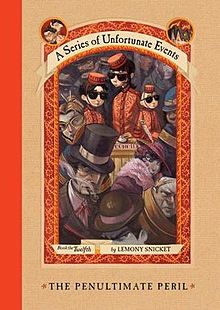
Book Review: a Series of Unfortunate Events 12: the Penultimate Peril by Lemony Snicket

This morning’s gym book was a Series of Unfortunate Events 12: the Penultimate Peril (Young Adult 353 pages) by Lemony Snicket.

ThePenultimatePeril“Dear Reader, If this is the first book you found while searching for a book to read next, then the first thing you should know is that this next-to-last book is what you should put down first. Sadly, this book presents the next-to-last chronicle of the lives of the Baudelaire orphans, and it is next-to-first in its supply of misery, despair, and unpleasantness. Probably the next-to-last things you would like to read about are a harpoon gun, a rooftop sunbathing salon, two mysterious initials, three unidentified triplets, a notorious villain, and an unsavory curry. Next-to-last things are the first thing to be avoided, and so allow me to recommend that you put this next-to-last book in another chronicle, or a chronicle containing other next-to-last things, so that this next-to-last book does not become the last book you will read. With all due respect, Lemony Snicket.”

I sometimes wonder about the history of the books I read. I picked up all of this series from used bookstores across multiple states and several of them have had notes in the front or marked pages. I wonder what the previous readers were marking, whether it was their place in the story as they had to put the book down and go to dinner or if something on that particular page spoke to them very strongly because of where they’d been or where they were currently at in their lives. This book has the name “elizabeth” written in careful print inside the front cover. I wonder what motivated Elizabeth to write her name in this book and then part ways with it at some point later. Did her family need the money for something else? Did she finish the whole story and decide she would never read them again? Does she sometimes think about this series at the strangest times and wonder whatever happened to her books from earlier in her life?

Oddly, I think it’s actually the tone and style of these particular books which has motivated my curiosity for the history of these particular books. The narrator often refers to reading and how important books are throughout these stories and the books and libraries go through a variety of experiences, sometimes damaging the books, sometimes destroying the books, and almost always having the books somehow save the day. That’s been one of the key underlying messages of this entire series so far is that research and knowledge can solve just about any concern. The concern or problem may not be solved with a happily ever after, but it will be resolved.

There were several sections of this book that I marked because of the similarity to how I view my own life. The first of these occurred on pages 14-15: “Deciding whether or not to trust a person is like deciding whether or not to climb a tree, because you might get a wonderful view from the highest branch, or you might simply get covered in sap, and for this reason many people choose to spend their time alone and indoors where it is harder to get a splinter.” This was a really important part of this book because I am of the opinion that there are a lot of really great people out there who are living their lives in fear because it’s easier to just live in a world where you’re cut off from everything than risk getting hurt. This is especially true with interpersonal relationships because it’s easier to be online in a situation where you can just ignore someone’s existence because they hurt you instead of working to have adventures and experience life. It’s easier to hide from the world than it is to live in it and that makes me often sad because I wouldn’t trade any of the time I’ve spent with the people I care about for anything. Sure, there were days when we got lost or when we said hurtful things to each other, but there were also the times where I laughed so much that I fell off the couch or where we spent hours rock climbing or talking about life. To me, life and love is worth the risk. But there are few who are courageous in that manner in today’s modern world and perhaps that’s one of the key motives behind this series.

My thoughts from the previous paragraph then move towards how people react to instances of interpersonal miscommunications in their lives. This is from page 195: “There are some who say that you should forgive everyone, even the people who have disappointed you immeasurably. There are others who say you should not forgive anyone, and should stomp off in a huff no matter how many times they apologize. Of these two philosophies, the second one is of course much more fun, but it can also grow exhausting to storm off in a huff every time someone has disappointed you, as everyone disappoints everyone eventually, and one can’t stomp off in a huff every minute of the day.” I think this struck me so powerfully because of how many times I have attempted to apologize for the mistakes I have made throughout my time, especially in the last several years when things fell apart. I sometimes have memories of other times in my life where I would wish to now apologize to someone for the way I acted or the words I used. I realize this is foolish and something that would not mend or repair the potential damage I may have done to those people, but perhaps it might mean forgiveness for me for things I regret. Perhaps it would prove that I am actually learning and growing and becoming a better person. But the point made here, in this book, is that at some point in our lives, anyone and everyone will disappoint you and you will be a disappointment to others. The best option is to forgive them as you can and do the best you can to learn how to make better choices in your own life so that you hurt people less.

In fact, this book also discusses what you can do in these types of situation on page 190: “We can ask for justice, and we can ask for a handkerchief, and we can ask for cupcakes, and we can ask for all the soldiers in the world to lay down their weapons and join us in a rousing chorus of ‘Cry Me a River,’ if that happens to be our favorite song. But we can also ask for something we are much more likely to get, and that is to find a person or two, somewhere in our travels, who will tell us that we are noble enough, whether it is true or not. We can ask for someone who will say, ‘You are noble enough,’ and remind us of our good qualities when we have forgotten them, or cast them into doubt.” All of this is exactly true. We are all human and we will all make mistakes or disappoint someone at some point in our lives. When you are disappointed and hurt, maybe try and look at the positive actions someone you care about was attempting. Look at the world through their eyes and see if there is some way you can be supportive. Forgive them, spend time with them, and tell them they are noble enough. Hopefully, they will be those same people who will then tell you that you are noble enough when you disappoint or hurt them. Because we are each of us human.

A good portion of the last several books in this series focused on what it really means to be a villain and this book continues with that trend. On page 29: “Since their first encounter with Count Olaf, the villain’s wickedness and deception had run rampant all over the Baudelaires’ lives, and it had been very difficult for the children to keep from becoming villains themselves. In fact, when they considered all of their recent actions, they weren’t entirely sure they hadn’t performed a few acts of villainy, even if they’d had very good reasons for doing so.” The Hotel Denouement was a fascinating setting for this portion of the series because Violet, Klaus, and Sunny spent the entire novel attempting to figure out how they could tell those with noble intentions from those with villainous intentions. With the exception of Kit Snicket at the very beginning of this novel, no one is ever honest or upfront with their intentions and things that could have positive intent could have negative consequences and things with negative intent could have positive consequences. The Baudelaires had no way of telling who was working towards villainous intent and who was working towards noble intent and therefore they just did the best they could with what little and limited knowledge and skills were available to them.

By the end of the book, they have participated sometimes unknowingly in acts which caused harm to others or to noble causes. They are doing the best they can in a world which seems more and more to have the odds stacked against them.

I think this book out of a Series of Unfortunate Events is my favorite. Things are an even balance between happy times and confusing times where things go wrong. The Baudelaires are in a really sticky place but they still work to save as many people as they can, even if those people won’t necessarily listen to them. There’s a lot of good passages in here that really resonated with my own world views and how I perceive life and interpersonal relationships. I’m glad that I own this book and will continue with the rest of the books in the series. And I think I would probably rate this as a very low four or a high three on my rating scale.

Works cited: Snicket, Lemony. A Series of Unfortunate Events: the Penultimate Peril. New York: HarperCollinsPublishers, 2005.

Posted in Book Reviews | Tagged , , , | Leave a comment

Book Review: a Series of Unfortunate Events 11: the Grim Grotto

Friday morning’s gym book was a Series of Unfortunate Events 11: the Grim Grotto (Young Adult 323 pages) by Lemony Snicket.

“Dear Reader, Unless you are a slug, a sea anemone, or mildew, you probably prefer not to be damp. You might also prefer not to read this book, in which the Baudelaire siblings encounter an unpleasant amount of dampness as they descend into the depths of despair, underwater. In fact, the horrors they encounter are too numerous to list, and you wouldn’t want me even to mention the worst of it, which includes mushrooms, a desperate search for something lost, a mechanical monster, a distressing message from a lost friend, and tap dancing. As a dedicated author who has pledged to keep recording the depressing story of the Baudelaires, I must continue to delve deep into the cavernous depths of the orphans’ lives. You, on the other hand, may delve into some happier book in order to keep your eyes and your spirits from being dampened. With all due respect, Lemony Snicket.”

I’ve found that this series is extremely addictive starting from the last book and now moving into this book. There’s a lot going on and things are moving faster and faster. It’s been really hard for me to wait for my gym days in order to finish a book and the series in general. The books are also getting noticeably longer and taking me about two gym sessions to finish each one. And yet, I just want to keep reading. As soon as I finish one, I want to move right on to the next.

Captain Widdershins is one of the most interesting adult characters who have appeared in this series so far. He recognizes the Baudelaire orphans in the periscope and offers to let them aboard, assuming they know the password and the V.F.D. challenges. When pressed about how he knows so much about the Baudelaires, their individual skills, and the things that have happened to them, he replies on page 32: “How does anyone know anything about anything? … I read it, of course! Aye! I’ve read every Volunteer Factual Dispatch I’ve received! Although lately I haven’t received any! Aye! That’s why I’m glad you happened along!” He is energetic, and as we learn throughout this book, also an avid reader and with an interest in poetry, which you wouldn’t think would be something he would enjoy. This just goes to show you that people are often not who you think they are when you first encounter them. Some people you think are indecisive or travelling quickly in the wrong direction have more information about a situation than you do. I guess the underlying moral of this part of the story is that you shouldn’t judge people based on first impressions.

Captain Widdershins is kind enough to fill the Baudelaires in with a little bit of information about the nature of some of the V.F.D. activities and he talks to them on page 98 about the different interests of the volunteers and the Voluntary Fish Domestication as one of the missions of Anwhistle Aquatics, where he spent four years training salmon to search for forest fires. Fiona’s brother is mentioned as working with Captain Widdershins and it seems like he was one to help and that he might have really enjoyed working with those fish. More about Fiona’s brother later in this review.

Meanwhile, in this same section of the book, Captain Widdershins lets us know that there are three Snicket siblings, Jacques who was killed by Count Olaf in the Vile Village, Kit who helped build the Queequeg submarine, and a third who is unnamed, but an astute reader would guess is Lemony Snicket, the author of these books, and the person who has been following the Baudelaire orphans. This is a very amusing way the author continues to be a part of the story and yet, not really a part of the story. I think it helps with the tone of the series and adds to the mystery surrounding both the author and the bigger picture events hinted at throughout the books.

This book was just filled with passages that I relate to on levels I can’t adequately describe.

Page 120 had a section that really stuck out with me: “A citation for bravery is nothing more than a piece of paper stating that you have been courageous at some time, and such citations have not been known to be very useful when confronted by danger.” I found this to be probably the single most accurate statement in the entire series. If you are ever faced with a situation where you have to do something requiring all of your courage, it’s not usually helpful to think that if you make it through that situation alive that someone might give you a piece of paper for your bravery.

Here’s one that hit me pretty strongly on page 148: “It is often difficult to admit that someone you love is not perfect, or to consider aspects of a person that are less than admirable.” I think that one of the key components of real love is that you see that the other person is not perfect and that they are flawed, just as you are flawed, and there is love regardless. Real love is accepting someone for who they were, for who they are, and for who they will someday become. Real love is acknowledging that no one is perfect, but they are perfect for you. You have to remember the good things and the bad things about the people in your life. You can’t just put them on a pedestal and pretend like mistakes weren’t made on both sides. But it’s being willing to move through those mistakes and become better people who make things fit together again. I have even come to the point of my life where the memories that used to hurt now make me smile and I continue to hope that someday, that friendship will be given another chance.

But now, back to the Grim Grotto 🙂

A lot of my discussions about these books lately have involved conversations about villains. What makes someone a villain versus a hero? I’ve discussed it multiple times since about book eight, the Hostile Hospital. I was very amused when this came up on page 187: “If you are considering a life of villainy – and I certainly hope that you are not – there are a few things that appear to be necessary to every villain’s success. One thing is a villainous disregard for other people, so that a villain may talk to his or her victims impolitely, ignore their pleas for mercy, and even behave violently toward them if the villain is in the mood for that sort of thing. Another thing villains require is a villainous imagination, so that they might spend their free time dreaming up treacherous schemes in order to further their villainous careers. Villains require a small group of villainous cohorts, who can be persuaded to serve the villain in a henchpersonal capacity. And villains need to develop a villainous laugh, so that they may simultaneously celebrate their villainous deeds and frighten whatever nonvillainous people happen to be nearby.” This goes fairly well with some of the discussions I’ve had about what it means to be a villain and I was amused that Lemony Snicket was so kind in the offering up of a description of what a villain should be like and what a villain should have.

This book also goes a little deeper into some of the motivations people might have for working with people who they know are not positive individuals. You might think you don’t have a choice, or you might think that you should stay somewhere you might be uncomfortable due to family pressure.

And just as a random note, I suspected from the very beginning the Mr. Poe was not a very useful person, and to find that he is likely one of those who have been making things even more difficult for the Baudelaire orphans is not a surprise at all.

There’s a lot going on in this book and the books get more complicated the deeper into the series I get. I’m enjoying it greatly and overall, I’d probably rate this book as a high three on my rating scale because I really like the writing style, the characters are unique, and the message is mostly a positive one (for all that the book is not a happy story). I’m glad that I own this book and will continue with the rest of the books in the series. This is the first book in the series so far that not only ends with the Baudelaires mostly safe, but also making a turn for the better. It was very difficult to not immediately pick up the next book and start it, especially with the new character introduced at the very end.

Works cited: Snicket, Lemony. A Series of Unfortunate Events: the Grim Grotto. New York: HarperCollinsPublishers, 2004.

Posted in Book Reviews | Tagged , , , | Leave a comment

Book Review: a Series of Unfortunate Events 10: the Slippery Slope by Lemony Snicket

Monday morning’s gym book was a Series of Unfortunate Events 10: the Slippery Slope (Young Adult 337 pages) by Lemony Snicket.

slippery slope“Dear Reader, Like handshakes, house pets, or raw carrots, many things are preferable when not slippery. Unfortunately, in this miserable volume, I am afraid that Violet, Klaus, and Sunny Baudelaire run into more than their fair share of slipperiness during their harrowing journey up – and down – a range of strange and distressing mountains. In order to spare you any further repulsion, it would be best not to mention any of the unpleasant details of this story, particularly a secret message, a toboggan, a deceitful trap, a swarm of snow gnats, a scheming villain, a troupe of organized youngsters, a covered casserole dish, and a surprising survivor of a terrible fire. Unfortunately, I have dedicated my life to researching and recording the sad tale of the Baudelaire Orphans. There is no reason for you to dedicate yourself to such things, and you might instead dedicate yourself to letting this slippery book slip from your hands into a nearby trash receptacle, or deep pit. With all due respect, Lemony Snicket.”

I have to admit that with the tone shift of the last two books, I was a little hesitant to read this book. The last two books set Violet, Klaus, and Sunny up as just beginning a villain arch, where they were doing more and more things that may have had a good intent, but weren’t exactly morally, ethically, or legally sound. In the last several books, the Baudelaire orphans participated in more and more deceitful activities towards people who were generally good people. They lied to Hal and stole his keys to the library of records at the end of the Hostile Hospital and helped set fire to Madame Lulu’s tent at the end of the Carnivorous Carnival.

On a note fairly unrelated to my review of this book, there was a section on page 35 that reminded me of one of my favorite old computer games, King’s Quest V: Absence Makes the Heart Go Yonder. king's quest v mountain trailI remember that section of the game where you start hiking in the mountains and it’s the part of the trail that is just starting to have snow all over everything. It’s at this point in the game where you have to put on the cloak you found earlier, and it’s around this part of the Slippery Slope where Violet and Klaus layer up on strange things they managed to save from the caravan that almost killed them between the end of the Carnivorous Carnival and this part of the book. They’re wearing an inside-out sweatshirt over a coat and a poncho outside the other coat. The way the scene was described in the book definitely made me think of that part of King’s Quest V, especially when combined with the front cover of this book.

One of the fun things this series is doing a lot more is to find creative ways of making phrases that all use V.F.D. On page 80, Violet and Klaus meet with a mixed group of strangers and familiar folks. In order to communicate their intent and identity, they use some pretty fun verbage, such as Very Fascinating Drama, Very Fun Day, Vinegar-Flavored Doughnuts, and Violent Frozen Dragonflies. This whole exchange was very amusing to me.

Even though this book was written more than a decade ago, there are some very crucial truths to be found in this young adult book. For instance, on page 95 when Violet and Klaus continue their exchange with the helpful stranger, the stranger says: “I know that having a good vocabulary doesn’t guarantee that I’m a good person … But it does mean I’ve read a great deal. And in my experience, well-read people are less likely to be evil.” And this is so, so very true. There are multiple articles I’ve read lately that indicate those who read a great deal tend to be more empathic and more willing to listen to other people. Throughout this entire series so far, all of the villains are greedy and not extremely well educated. Now, Madame Lulu/Olivia was very clever in using a great deal of knowledge and books in order to tell people’s fortunes or answer their questions, but she only used that information for selfish gain. It doesn’t strike me as though she read for entertainment or the sake of acquiring more knowledge. I even marked another passage on page 135 where the author mentions a novel called Corridors of Power, which is a real novel by C.P. Snow, “which told the story of various people discussing how the world has become a corrupt and dangerous place and whether or not there are enough people with the integrity and decency necessary to keep the entire planet from descending into despair.” Again, this is yet another example of these books providing insight into our modern world today, even though they are young adult books written more than a decade ago.

Klaus and Violet finally get the information from a trusted friend that V.F.D. stands for Volunteer Fire Department, which didn’t make much sense to them until it was explained the firefighters such as this don’t necessarily have to deal with actual fire in order to help make the world a better place.

The three youths are faced with a very difficult decision starting around page 247, where they decide to set a trap for Esme in order to trade her to Count Olaf for Sunny.  “Taking someone prisoner, of course, is a villainous thing – even if you have a very good reason for thinking of doing it – it can make you feel like a villain, too.” And this is exactly the point of the entire series so far, I think. Everyone can at some point in their lives remember doing something or saying something that they were later ashamed of or that wound up causing harm to others. Most of those decisions, you knew they weren’t the best idea and they made you feel very uncomfortable before accomplishing them and once everything was done, but you still did it anyway. So the three youths still dig the pit and set the trap, but the key part of this particular novel comes when Esme is about to actually fall into the trap and they realize what a horrible thing they’re about to do to another person. They choose the path of honesty and, even though things don’t go exactly well for them, Violet and Klaus are reunited with Sunny and the four children manage to escape from Count Olaf and the other villains. It was a much harder path for them, but they did the right thing and they still met their intent of reuniting with Sunny and escaping Count Olaf.

Near the end of the novel, the two powder-faced women realize that maybe this life isn’t what they thought it should be or what they wanted. So they actually leave Count Olaf and walk by themselves, unhindered, down the mountain.

Of course, the rest of the evil villains have now captured a group of children and intend on using them for slave labor and the Baudelaire orphans are together and free of Count Olaf’s grasp, but they are separated from their trusted friend and in a potentially unhealthy situation.

This book was a very good and quick read and I’m really enjoying how the books are picking up the pace and how the Baudelaire orphans are starting to get to the point where they are making the hard, but morally right, decisions again. I’m continuously impressed with their resourcefulness and the skills which they use to get themselves out of the terrible predicaments they are faced with because of the greed of others.

There’s a lot going on in this book and the books get more complicated the deeper into the series I get. I’m enjoying it greatly and overall, I’d probably rate this book as a high three on my rating scale because I really like the writing style, the characters are unique, and the message is mostly a positive one (for all that the book is not a happy story). I’m glad that I own this book and will continue with the rest of the books in the series.

Works cited: Snicket, Lemony. A Series of Unfortunate Events: the Slippery Slope. New York: HarperCollinsPublishers, 2003.

Posted in Book Reviews | Tagged , , , | Leave a comment

Book Review: The Big Sleep by Raymond Chandler

The next book I read for my Readings in the Genre: Mystery Classics class for Seton Hill University’s Master of Fine Arts in Writing Popular Fiction was The Big Sleep by Raymond Chandler.

The Big Sleep has been the most enjoyable out of all the mystery novels we’ve read so far. I liked the character of Philip Marlowe and I think that he was a professional detective like we haven’t seen before. He clearly cared about himself and was the first one completely capable of taking care of himself responsibly. He starts out with a description of himself in chapter 1, page 1: “I was wearing my powder-blue suit, with dark blue shirt, tie and display handkerchief, black brogues, black wool socks with dark blue clocks on them. I was neat, clean shaved and sober, and I didn’t care who knew it.” He described men and women with near equal detail, and he described them as a detective would, or as someone who is used to searching for clues and having to read people and their behavior in order to get those clues. When he meets the butler in chapter 1 on page 5, Philip says: “He was a tall, thin, silver man, sixty or close to it or a little past it. He had blue eyes as remote as eyes could be. His skin was smooth and bright and he moved like a man with very sound muscles.” He had various other descriptions of men and women all throughout the story and it was always a very visual imagine. Part of the descriptions that works is how it’s not just about the way they dress, but also about the way they carry themselves. And Philip goes into a lot of depth not just to notice and describe the women, but the men as well. This shows that he really is a very good detective, since he sees more to people than their appearance.

The Big Sleep was definitely well written with good prose and there’s a lot to be said about learning writing style from reading books like this. The dialogue moved smoothly and I never questioned whether the dialogue was realistic because it flowed that smoothly. I guess my concern with the dialogue was that I sometimes couldn’t tell who was talking and who was in each scene. There might have been some issues with showing and not telling bit, which I think is conveyed fairly solidly throughout the book, though there is also a lot of visual descriptions included in the story. For some reason, I noticed a lot of the color blue throughout the book. I mean, it starts with him in a bright blue suit, which he describes very nicely. I tried to do a search to count the total number of times the word “blue” was used, but I got to about 52 in the first several chapters and had to stop. But since I like the color blue, it wasn’t really a bad thing. Perhaps it was used to add color to a very dark world.

I did pay attention to the way characters and the setting were described. I could very much empathize with Philip when he meets with the General in the first chapter in the greenhouse. I’ve been places like that and the writing style made me feel it all over again – the uncomfortable stickiness of your clothes and the smell and the overall atmosphere.

I was impressed to see our first detective who cared about his appearance and was fully capable of taking care of himself. Not only did he take care of himself, but he was a true professional the entire time. He didn’t mix business with pleasure. All of the named women in the novel attempted to seduce or sexually entice Philip at some point throughout the story and he denied all of their advances, sometimes in rather amusing ways. Philip might very well be someone who is a very solid professional who does his job well and who is an upstanding citizen. I definitely agreed with his morality in attempting to refund the money to the General and I really liked his interactions with the General.

I’m not really sure I could tell you exactly what I read in this novel. I know a bunch of people were killed and the main character seemed to magically be there for the vast majority of the murders, but I’m not really sure I remember exactly who was responsible for which deaths. And in the long run, I don’t think it really matters. I found it incredibly odd that Philip continued to find himself at the scene of so many murders. He’s there when Mr. Arthur Gwynn Geiger is shot and then he helps Carmen Sternwood get back to the house and cleaned up. Joe Brody gets shot through the door while Philip is there, getting the pictures of Carmen. He just happens to go to the right building at the perfect time to witness Harry Jones get poisoned by Canino. He eventually kills Canino. This story is a very good example of the ticking clock in mysteries because things keep happening and it’s all very fast-paced. The whole story takes place in about five days and someone dies pretty much every day.

The reason that I’m referring to Philip Marlowe as Philip throughout my discussions of this book is because all the women are given first names (Vivian, Carmen, Agnes) and the men are referred to as last names. This is fairly common throughout most stories and is designed to make the men look more professional and the women look more personal. I prefer to put them on equal footing. In fact, in the entire Chapter 28, around page 288-301, Philip never once mentions the name of the woman he is talking to. We know that she’s Eddie’s Mars’ wife, but her name isn’t mentioned. Is it because she is not going to attempt to seduce Philip that she has no name during this portion? That was actually one of the things that made this book a little challenging for me is that character names were so rarely mentioned that there were a few times when I wasn’t quite positive who the characters in the scene were.

I was starting to really think about sexism in these novels and about how these stories always have the “dame” and she’s always a very specific style of character, which really makes me frustrated. This seems to be a trope, and a rather annoying one at that. Are their queer or non-heteronorm mysteries out there where the lead detective is a guy and has to go into Chip-N-Dales or something like that and get hit on by all these hot and easy guys?

I understand the time it was written and how that was a very different time than what we live in now. Oddly, there are a lot of books today that still use the same format of referring to women by their first names and men as their last names, and with the same intent of making the men look more professional and the women look more personal. We read a lot of articles and had quite a few discussions on it during one of my gender studies courses many, many years ago.

I recently read an article called Harry Potter’s female readers now driving the boom in ‘grip lit’. It was a really interesting article (found here: http://www.theguardian.com/books/2016/mar/17/harry-potters-female-readers-now-driving-the-boom-in-grip-lit (Links to an external site.) and it discussed some very interesting trends about book buying.

“Statistics from Nielsen Book show that fiction sales were up 5.2% last year, with crime and thriller novels accounting for 29% of the market, the second-largest genre behind general and literary fiction, which was worth 41%. The crime sector is estimated to have increased last year to a record volume of over 25m copies sold – including ebooks – with psychological thrillers such as The Girl on the Train, called “grip lit” by the book sales monitor (Links to an external site.), helping drive the growth.

Nielsen said that 67% of grip lit is bought by women, with 25 to 34-year-olds accounting for the largest age category within that. Women accounted for 60% of the sales for Paula Hawkins’ smash hit The Girl on the Train, with the same age range dominating sales. Just 17% of sales of the novel were to males aged 25 to 34.”

This novel had a lot of death and a lot of murders and sometimes, I’m not sure I knew what Philip was truly attempting to investigate. He tells everyone repeatedly that he’s not looking for Rusty Reagan, but no one seems to believe him, and I, as a reader, didn’t see Philip actually doing anything to pursue Rusty until near the end. In this way, the mystery was complex and interesting, as were the characters, because no one was similar. The murders were mostly conducted by different people, though they were more or less facilitated by the same people. For me, there was a good balance of action and “what’s going on” to make the book interesting.

Since the story is about Philip working through a mystery of who is attempting to black mail the General’s family and why and not really about solving a bunch of murders, I was willing to give the story a bit of credit for how he managed to get to all of the crime scenes just in time to witness the crime. I don’t think it was particularly realistic to have him witness so many crimes, but the idea with this kind of story back then was to focus the action and attention on only one main character, the hero detective of the story. It did seem to be a bit like a Disney chase with characters appearing and disappearing and how everything was formulaic.

I guess one of the differences from my perspective between The Glass Key and The Big Sleep is that official personnel such as police personnel in The Big Sleep tended to actually care that more people were killed, instead of like in The Glass Key where random people just died and the officials didn’t really care how or why or do anything about it. I do acknowledge that that was probably more common and a sign of those times, but from my perspective today, it just seems weird. The dark environment in which people lived back then has a lot to do with why this novel and the others set in this timeframe are so different from the way we read things today. Maybe this kind of stuff was commonplace back then and it truly was believable? Or maybe it was escapism for the populace of that time, believing that there was a “good guy” out there who could find the truth for truth’s sake, not just for the draw of money. And maybe that “good guy” would participate in activities that might make the streets safer for “normal” people. I don’t know.

The Bremen reading had some really great points about mystery writing in general. “If the situation is false, you cannot even accept it as a light novel, for there is no story for the light novel to be about. If the problem does not contain the elements of truth and plausibility, it is no problem; if the logic is an illusion, there is nothing to deduce. If the impersonation is impossible once the reader is told the conditions it must fulfill, then the whole thing is a fraud.” These thoughts are actually pretty solid for any genre, and most genres should have an element of some sort of mystery, be it attempting to figure out how something happened or why, or actually investigating a death of some sort.

I think that the crime and thriller categories started with books exactly like The Big Sleep. There’s a mystery, combined with a lot of action, and characters who are very different than the “typical” people we all might know in our own social circles. The Big Sleep was a great title, and I felt it matched with the overall tone of the entire novel very, very well.

Overall, I would say this is probably a mid-grade two on my rating scale. I’m glad I didn’t buy it and I’m not entirely certain I would ever read it again, but I did get some valuable stuff out of it.

Work Cited: Chandler, Raymond. The Big Sleep. New York: Knopf, 2002. Electronic Book. Original Publication 1939.

Posted in Book Reviews | Tagged , , , , , , , | 1 Comment