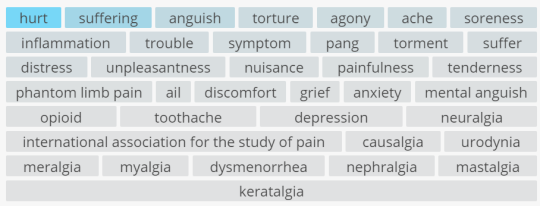
For example, if you go into Related Words and type in ‘PAIN’, you’ll get:
If you go into Describing Words and type in ‘PAIN’, you’ll get:
One is a thesaurus and one will actually give you words you can use to describe the thing you’re writing about. If you put ‘FOREST’ in Describing Words, you’ll get a massive page of ways and means to describe aspects of a forest.
I hope this help! Feel free to reblog! Enjoy writing time!
PSA to all you fantasy writers because I have just had a truly frustrating twenty minutes talking to someone about this: it’s okay to put mobility aids in your novel and have them just be ordinary.
Like. Super okay.
I don’t give a shit if it’s high fantasy, low fantasy or somewhere between the lovechild of Tolkein meets My Immortal. It’s okay to use mobility devices in your narrative. It’s okay to use the word “wheelchair”. You don’t have to remake the fucking wheel. It’s already been done for you.
And no, it doesn’t detract from the “realism” of your fictional universe in which you get to set the standard for realism. Please don’t try to use that as a reason for not using these things.
There is no reason to lock the disabled people in your narrative into towers because “that’s the way it was”, least of all in your novel about dragons and mermaids and other made up creatures. There is no historical realism here. You are in charge. You get to decide what that means.
Also:
“Depiction of Chinese philosopher Confucius in a wheelchair, dating to ca. 1680. The artist may have been thinking of methods of transport common in his own day.”
“The earliest records of wheeled furniture are an inscription found on a stone slate in China and a child’s bed depicted in a frieze on a Greek vase, both dating between the 6th and 5th century BCE.[2][3][4][5]The first records of wheeled seats being used for transporting disabled people date to three centuries later in China; the Chinese used early wheelbarrows to move people as well as heavy objects. A distinction between the two functions was not made for another several hundred years, around 525 CE, when images of wheeled chairs made specifically to carry people begin to occur in Chinese art.[5]”
“In 1655,Stephan Farffler, a 22 year old paraplegic watchmaker, built the world’s first self-propelling chair on a three-wheel chassis using a system of cranks and cogwheels.[6][3] However, the device had an appearance of a hand bike more than a wheelchair since the design included hand cranks mounted at the front wheel.[2]
The invalid carriage or Bath chair brought the technology into more common use from around 1760.[7]
In 1887, wheelchairs (“rolling chairs”) were introduced to Atlantic City so invalid tourists could rent them to enjoy the Boardwalk. Soon, many healthy tourists also rented the decorated “rolling chairs” and servants to push them as a show of decadence and treatment they could never experience at home.[8]
In 1933 Harry C. Jennings, Sr. and his disabled friend Herbert Everest, both mechanical engineers, invented the first lightweight, steel, folding, portable wheelchair.[9] Everest had previously broken his back in a mining accident. Everest and Jennings saw the business potential of the invention and went on to become the first mass-market manufacturers of wheelchairs. Their “X-brace” design is still in common use, albeit with updated materials and other improvements. The X-brace idea came to Harry from the men’s folding “camp chairs / stools”, rotated 90 degrees, that Harry and Herbert used in the outdoors and at the mines.[citation needed]
“But Joy, how do I describe this contraption in a fantasy setting that wont make it seem out of place?”
“It was a chair on wheels, which Prince FancyPants McElferson propelled forwards using his arms to direct the motion of the chair.”
“It was a chair on wheels, which Prince EvenFancierPants McElferson used to get about, pushed along by one of his companions or one of his many attending servants.”
“But it’s a high realm magical fantas—”
“It was a floating chair, the hum of magical energy keeping it off the ground casting a faint glow against the cobblestones as {CHARACTER} guided it round with expert ease, gliding back and forth.”
“But it’s a stempunk nov—”
“Unlike other wheelchairs he’d seen before, this one appeared to be self propelling, powered by the gasket of steam at the back, and directed by the use of a rudder like toggle in the front.”
Give. Disabled. Characters. In. Fantasy. Novels. Mobility. Aids.
If you can spend 60 pages telling me the history of your world in innate detail down to the formation of how magical rocks were formed, you can god damn write three lines in passing about a wheelchair.
Signed, your editor who doesn’t have time for this ableist fantasy realm shit.
If your fantasy setting is having trouble with things like “What other cultures exist in this universe and how do they get on?” or “How do diabled people live?” or “How’s gender work here?” without sounding like Your Conservative Aunt Edna That You Really Wish You Didn’t Have To Be Nice To At Thanksgiving, it’s a good sign that you need to go back, not to the drawing board, but to yourself and your real world, and think real hard about how you’re handling those things in real life.
It’ll do you and your writing a literal world of good.
My biggest pet peeve is being talked to AS SOON as i wake up. I hate that shit. Stop tryin to communicate with me. Stop askin me questions. Im tryna understand the universe all over again dont talk to me yet ur gonna confuse me and piss me off.
⚠️ MORNING PEOPLE DO NOT INTERACT! ⚠️
I tell people that I am not a morning person and what they hear is ‘I purposely chose to stay up til the wee hours and then it’s my own fault for not getting enough sleep when I am awakened at a normal time when normal people should be up, and I just need to correct this failing to live a happier life’.
What I am ACTUALLY telling them is ‘I have delayed sleep phase disorder, where in my circadian rhythm is different from theirs and my brain does not produce melatonin the way theirs does. When I am forced to get up before I have had a full 9 hours sleep–especially if I am awakened during sleep cycle–I am working at an extremely reduced ability level and will be unable to work at my peak efficiency and effectiveness until the afternoon.
‘As a result, I may rely on caffeine and other stimulants for the first 5 hours of the day, which also contributes to insomnia, and burnout in the late afternoon means I may snack on carbs for the energy boost. It is the equivalent of having permanent jet lag such as when you are 5 hours off from everyone around you.
‘It is not something that can be cured, only a condition to manage, and requires the people around me to make reasonable accommodations such as not trying to force me to interact with them and be decisional when I first wake up.
‘I also have ADHD, which means I have difficulty working when there is noise and chatter preventing me from being able to concentrate. I need calm quiet to be able to do my best work, and the only time I actually have calm quiet is when the rest of the world is asleep.
‘During the day, I artificially create this quiet during the day, using noise-cancelling headphones when I am forced to work in a noisy environment, or by working alone in a quiet space. And when you deny me that quiet, I expend a tremendous amount of energy just trying to focus. And I am much more likely to miss steps, or make errors, affecting the quality of my work as well as how long it takes me to complete.’
And what people hear is ‘I am lazy and unwilling to change,’ when in reality THEY are the ones unwilling to change because it is inconvenient, or requires them to be considerate of others.
plot twist: the introverted character who doesn’t like big social gatherings or speaking in front of people is still an introvert by the end of the story because introversion is not a character flaw and it doesn’t need to be overcome
Look, I’ll go on your stupid adventure, but you better leave me the fuck alone when we get back.
Bilbo Baggins.
NOT A GOOD EXAMPLE HE WAS SO INTROVERTED HE USED A CURSED OBJECT TO GET AWAY FROM PEOPLE
are u kidding excellent example 100% relatable big mood
Based on my own reading/experience, here are some books with asexual leads by asexual authors that you might want if you want a focus on both those things.
We Awaken An F/F interracial romance discusses asexual against the backdrop of lucid dreams and the loss of family. It was great to see two aces dating and what it means to each of them.
Tash Hearts Tolstoy I personally haven’t read this one but would have likely adored it when I was younger. Ace vlogger adapts Anna Kerenina goes viral and with her literary love, Tolstoy, in the back of her mind navigates her new IRL crush.
Let’s Talk About Love This book’s cover is made to look like an ace pride flag and to see a black girl as the protagonist and written by a debut black author is definitely a joy to see. Set in at college, this biromantic lead might appeal more to aces who things slightly more figured out.
Finished Let’s Talk About Love! Alice’s problems will very much relate to aces who aren’t fully out. Since it’s set in college, other problems/dynamics lean to that demographic. Also the book is very fluffy. Like beyond adorably cute at times.
it’s hilarious to me when people call historical fashions that men hated oppressive
like in BuzzFeed’s Women Wear Hoop Skirts For A Day While Being Exaggeratedly Bad At Doing Everything In Them video, one woman comments that she’s being “oppressed by the patriarchy.” if you’ve read anything Victorian man ever said about hoop skirts, you know that’s pretty much the exact opposite of the truth
thing is, hoop skirts evolved as liberating garment for women. before them, to achieve roughly conical skirt fullness, they had to wear many layers of petticoats (some stiffened with horsehair braid or other kinds of cord). the cage crinoline made their outfits instantly lighter and easier to move in
it also enabled skirts to get waaaaay bigger. and, as you see in the late 1860s, 1870s, and mid-late 1880s, to take on even less natural shapes. we jokingly call bustles fake butts, but trust me- nobody saw them that way. it was just skirts doing weird, exciting Skirt Things that women had tons of fun with
men, obviously, loathed the whole affair
(1864)
(1850s. gods, if only crinolines were huge enough to keep men from getting too close)
(no date given, but also, this is 100% impossible)
(also undated, but the ruffles make me think 1850s)
it was also something that women of all social classes- maids and society ladies, enslaved women and free women of color -all wore at one point or another. interesting bit of unexpected equalization there
and when bustles came in, guess what? men hated those, too
(1880s)
(probably also 1880s? the ladies are being compared to beetles and snails. in case that was unclear)
(1870s, I think? the bustle itself looks early 1870s but the tight fit of the actual gown looks later)
hoops and bustles weren’t tools of the patriarchy. they were items 1 and 2 on the 19th century’s “Fashion Trends Women Love That Men Hate” lists, with bonus built-in personal space enforcement
Gonna add something as someone who’s worn a lot of period stuff for theatre:
The reason you suck at doing things in a hoop skirt is because you’re not used to doing things in a hoop skirt.
The first time I got in a Colonial-aristocracy dress I felt like I couldn’t breathe. The construction didn’t actually allow me to raise my arms all the way over my head (yes, that’s period-accurate). We had one dresser to every two women, because the only things we could put on ourselves were our tights, shifts, and first crinoline. Someone else had to lace our corsets, slip on our extra crinolines, hold our arms to balance us while a second person actually put the dresses on us like we were dolls, and do up our shoes–which we could not put on ourselves because we needed to be able to balance when the dress went on. My entire costume was almost 40 pounds (I should mention here that many of the dresses were made entirely of upholstery fabric), and I actually did not have the biggest dress in the show.
We wore our costumes for two weeks of rehearsal, which is quite a lot in university theatre. The first night we were all in dress, most of the ladies went propless because we were holding up our skirts to try and get a feel for both balance and where our feet were in comparison to where it looked like they should be. I actually fell off the stage.
By opening night? We were square-dancing in the damn things. We had one scene where our leading man needed to whistle, but he didn’t know how and I was the only one in the cast loud enough to be heard whistling from under the stage, so I was also commando-crawling underneath him at full speed trying to match his stage position–while still in the dress. And petticoats. And corset. Someone took my shoes off for that scene so I could use my toes to propel myself and I laid on a sheet so I wouldn’t get the dress dirty, but that was it–I was going full Solid Snake in a space about 18″ high, wearing a dress that covered me from collarbones to floor and weighed as much as a five-year-old child. And it worked beautifully.
These women knew how to wear these clothes. It’s a lot less “restrictive” when it’s old hat.







 C.A. Jacobs
