Movie Review: the Legend of Korra Book Two: Spirits

I recently picked up the entire Legend of Korra series because I’d read so many good reviews about the series as a whole. So while I might have purchased them a long time ago, I only recently started taking the time to watch these. Obviously, I started with the Legend of Korra: Book One: Air, and then I moved on to the Legend of Korra: Book Two: Spirits.

“Korra and Team Avatar embark on a new journey deep into the mythology of the mystical Spirit World, encountering creatures like nothing they’ve seen before and discovering the truth about the very first Avatar! With a battle for the fate of the world between the light and dark spirits Raava and Vaatu fast approaching, Korra delves deeper into the Avatar’s past and realizes what she must do in order to restore balance between the physical and spirit worlds.”

The second season of this series has fourteen episodes, Rebel Spirit, the Southern Lights, Civil Wars: Part 1, Civil Wars: Part 2, Peacekeepers, the Sting, Beginnings: Part 1, Beginnings: Part 2, the Guide, a New Spiritual Age, Night of a Thousand Stars, Harmonic Convergence, Darkness Falls, and Light in the Darkness.

This season appeared to have a lot more humor than the first season, or at least humor done in a completely different way. Desna and Eska were both hilarious, especially the relationship between Bolin and Eska. It was kind of refreshing to see honest portrayals of relationships throughout this season. Bolin was in an abusive relationship with Eska, but Eska’s comments concerning their relationship really are amusing. Eska makes these deadpan comments that are exactly what you would think people in a relationship could or would say, but she says it without any visible emotion. Which I probably shouldn’t have laughed at, but I did. Mako and Korra realize they have some communication issues and decide to take a break. This is, again, some extremely motivational examples of honesty when dealing with strong interpersonal relationships, and also realistic in that they demonstrate how confusing emotions can be. With honest and open communication, things work out the way they’re supposed to, and so few people in our real world take the time and effort to be honest with each other that this is a really great example how to build healthy relationships.

One of the really interesting parts of this story to me involve how fantastic of a pilot and driver Asami is. She is a character in the series that has no bending powers, but she continues to find ways to not only help the team, but also doesn’t allow the emotional confusion to affect her interactions with the other characters.

This entire series felt very Zelda-ish to me. The light and dark spirits reminded me almost exclusively of the Legend of Zelda: the Twilight Princess. I’m not sure if that was intended or not, but it amused me greatly.

The story of the first Avatar was interesting and I liked how it felt a little bit like the animation style was different for that entire section.

Overall, this season is probably only a three on my rating scale. I like the first season a lot better, but I’m still happy that I own this and will watch it repeatedly.

Posted in Movie Reviews | Tagged , , , | Leave a comment

Book Review: Dune

The next book for my Readings in the Genre: Science Fiction Classics for my Master of Fine Arts in Writing Popular Fiction from Seton Hill University was Dune (Science Fiction 511 pages) by Frank Herbert.

This book is so massive that it’s really hard to find just one thing to talk about at any length. I think one of the things that struck me the very first time I read through any of the Dune books was the combined use of philosophy, religion, and technology.

The majority of the deeply philosophical points, for me, usually started with the sayings at the beginning of each chapter. Just for the sake of clarity, here is the dictionary.com definition of philosophy: “the rational investigation of the truths and principles of being, knowledge, or conduct.” Many of the concepts discussed throughout this book involve looking at humanity as something greater than each individual’s experiences and a lot of those passages really made me stop and think about the world in which we currently live. For example, on page 337 the opening of this chapter is listed as coming from the “Collected Sayings of Muad’Dib” by the Princess Irulan. The passage reads like something taken straight out of a philosophy text: “The concept of progress acts as a protective mechanism to shield us from the terrors of the future.” Another example of this can be found on page 428, which is listed as coming from “Muad’Dib: The Ninety-Nine Wonders of the Universe” by Princess Irulan. That passage says: “When law and duty are one, united by religion, you never become fully conscious, fully aware of yourself. You are always a little less than an individual.” These two passages clearly demonstrates deep philosophical thought processes evident throughout this book; passages designed to make you sit down and look at your perception of the world around you.

Religion is another aspect of this book, and the entire Dune series, that really can’t be ignored. From the Atreides family arrival on Arrakis, they are given glimpses of a religious structure so encompassing and so powerful that it takes up the entire planet. The customs of that religion are so bound up in the culture of the Fremen that it’s impossible to separate the two into different aspects. Even though the readers are lead to believe that the Fremen way of life was initiated by the Bene Gesserit, as referenced when Jessica and Paul first encounter the Fremen in the desert on page 290, the seeds that were planted perhaps centuries ago were changed and morphed into something the Bene Gesserit may not have intended. Jessica reflects on this throughout the story and even though she becomes the Reverend Mother of the Fremen, she still seemed to me as though she didn’t really fit with the Fremen and that she didn’t really have natural Fremen tendencies like Paul. She felt more like an outsider and not like a true member of the community, even as their Reverend Mother, whereas Paul, the genetic culmination of a variety of different Bene Gesserit plans, blended with the Fremen as though he was born and raised as one of them.

Another of the things that really stuck out with me was the use of technology throughout this book. The book starts out with space travel and personal shields and then moves to a world where technology doesn’t function or will create situations that will potentially cause you personal harm. The world is a desert planet, wherein the power lies in who controls the water, while the controller of the spice are those who control space travel. So it just happens that whoever controls the water also controls the spice, which makes one “backward” desert planet very, very powerful, for all that it has very little in the realms of usable technology. It’s really hard for the characters in the book to depend on their technology when they’re given so many reasons why they can’t use it, it’s completely ineffective, or the environment destroys it. The Harkonnens are reduced to using artillery instead of the lasguns because the lasguns wouldn’t work. Everyone had to stop using their shields because the shields would attract the worms. Their ‘thopters have a variety of technical issues with flying in the desert conditions of Arrakis and their machines either draw the attention of the worms or malfunction because of the sand.

The Atreides family arrives on Arrakis completely dependent on their technology and unprepared to face a lot of the really deep issues that life with the Fremen forces them to face. There’s a lot going on in this book and a lot of philosophical ideas that are seeded throughout the story, as well as a strong religious undertones, and the beginning dependencies on technology. It was a really deep book and one that I actually enjoyed.

I think the big issue I had with the italicized thoughts stemmed more from the fact that those thoughts were all head-hopping. For example, on page 331, the first series of italicized thoughts is from Jessica’s point of view and then five paragraphs later, it’s from Paul’s point of view. I think that maybe the reason that bothered is because it threw me out of the story because I would read as though I was an outside observer and then I would get internal thoughts from a character that I may or may not have thought of as being the main point of view for that particular scene or chapter.

One of the things I kept thinking about as I read this book was how annoyed I am with our own culture and society right now for spending so many of our resources developing inconsequential things when we could be developing technology to help ourselves survive in arid deserts, which our own planet has plenty of. We could use this part of technological science fiction to create science fact and provide ourselves with ways to live in less-than-friendly environments. I read some biologist reports about climate change and the most recent estimates say that the world’s supply of fresh water will reduce by 40% in the next 15 years. If that doesn’t motivate us to start developing more water-saving technology now while we can, I’m not sure what will. Anyway.

I really like the connections between high fantasy and Dune. It’s really easy to forget about the technology because, in a lot of ways, the story takes place in humanity’s distant past. The story focuses on the one critical element that no human life, or really life as we understand it at all, can survive without, and it’s something we can’t artificially create. The technology takes a back seat to water. And when water becomes so desperately important that it’s the survival of the entire planet at stake and not just the survival of an individual or family, of course religion would factor heavily into things. Religion, especially as used throughout this book on Arrakis, is used to bring the Fremen together and to unite them under a series of guiding principles and to give them hope.

This book brings up a really good point about status and how having the luxury to waste something that is a precious resource is a symbol of wealth and status. On Arrakis, that status is water and how those who have the wealth to waste water in such ridiculous ways. Like dropped bowls on the floor and letting beggars fight over who gets the towels. It’s interesting to me that water is portrayed in this way because I see a lot of similarities with some of the wealth distribution in our own world today.

Religious indoctrination definitely seems to be the main base for the population of Arrakis’ pyramid on Maslow’s hierarchy of needs. While the basic “need for water, safety, love, and self-actualization are all met through the bond of the Fremen”, none of those things can be found independent of each other. People left on their own most often die in the desert, as everyone needs to help and support everyone else in order to survive in such an austere environment. Water really is the life of everything

Arrakis isn’t just a setting or a familiar place – it’s a completely foreign, alien world with cultures, sub-cultures, economic class and standing, and a complex ecological system. Paul’s ride on the giant sandworm is such a vivid portrayal of life on Arrakis. That was one of the memorable parts of the book for me. It was a scene of adventure, triumph, learning, camaraderie, and freedom, all wrapped up in one place. He’d been their leader for so long already and yet he still hadn’t mastered a talent that twelve year-old Fremen could accomplish with ease. It was the final test of his purpose as the Muad’Dib and it was triumphant, but he didn’t accomplish the task flawlessly. He also learned valuable lessons from his success and the sense of camaraderie and freedom made me almost feel the wind and sand in my face. I could almost picture myself right there with them on the back of that sandworm.

The “Collected Sayings of Muad’Dib” conveyed a sense of something bigger than just this book. I felt as though they sometimes related to the content of the chapter and sometimes not. But I definitely felt as though there were a lot of those sections that could have parallels drawn between our world now and the world of Arrakis in Dune. I’ve read some of the books later in the series and I definitely remember feeling a fairly strong philosophical strand throughout the rest of the books.

The societies, politics, and landscapes created in Dune were so absolutely immense and immersive that I can’t even fathom writing this kind of novel in a world without technology. My copy of just the novel, not including any appendixes, was over 500 pages long. So it’s not just a matter of keeping all that information stored in your head, but also a matter of typing up the entire thing on a type-writer and going over every correction *by hand*. Can you even imagine the mailing fees associated with sending that much *paper* through the snail mail system to get to the publisher?

Everything about the world-building and greater human conceptualities is definitely high on my own list of reasons this book was a solid read. Overall, I would rate this book as a three on my rating scale. While a very good and very deep book, it wasn’t something I could or would read again for fun.

Posted in Book Reviews | Tagged , , , , , , , | Leave a comment

Movie Review: the Legend of Korra Book One: Air

I recently picked up the entire Legend of Korra series because I’d read so many good reviews about the series as a whole. So while I might have purchased them a long time ago, I only recently started taking the time to watch these. Obviously, I started with the Legend of Korra: Book One: Air.

“The time of Aang the last Airbender has passed, but the spirit of the Avatar lives on in Korra, a teenage girl from the Southern Water Tribe. Against the wishes of her guardians, Korra leaves the safety of her home in the Southern Water Tribe to travel to Republic City. There she begins her quest to capture the man who ultimately seeks to rid the world of bending forever.”

The first season of this series has twelve episodes, Welcome to Republic City, a Leaf in the Wind, the Revelation, the Voice in the Night, the Spirit of Competition, And the Winner Is, the Aftermath, When Extremes Meet, Out of the Past, Turning the Tides, Skeletons in the Closet, and Endgame.

I have to say that I enjoyed this first season immensely. Korra is a fantastic Avatar, someone I relate to in a lot of ways. I think it’s amusing that this series starts with Korra as a very small human, but with a huge attitude. When they go into Korra’s house and she is like, “Rawr! I am the Avatar!” I laughed. As she progresses through the series, she matures from a hot-headed action-heroine to a much more level-headed person who understands better what she’s fighting for and why. She learns about friendship and loyalty, and what it means to do the right thing.

Korra’s first interaction with Bolin is rather amusing, as he is a pretty entertaining individual. I really like the Fire Ferrets and noticed the interesting correlation between the pro-bending tournaments and using special skills for monetary gain. You’ve got an entire population with special powers, and when Korra first enters the city, gangs who have bending powers are using those powers to intimidate a local shop keeper. Then, you meet with Bolin and Mako who are pro-bending in the arena, using their powers in a game, for financial game for others. So even while there are a lot of benders who are using their powers as members of the police force, many of the benders are flaunting their skills and their powers. In a lot of ways, this makes sense for a world that has moved beyond the war during Aang’s time as the Avatar. And it still gets to me that those with power would abuse it so extensively.

One of the things that really struck me with this series is the music used for the fight scenes. I really liked the use of the percussion instruments. At some point, I’m going to look up the soundtrack and see if I can get some of the music.

All of the characters in this series were very well done. As much as romantic plots and subplots annoy me, I found the interaction between Mako, Asami, and Korra to be realistic, especially in regards to interpersonal relationships. Bolin is the first person Korra meets and he likes her and seems like a fun guy. So in a normal show, you would think that Korra and Bolin would link up, but they just don’t have any chemistry. So I’m glad that they are friends and that they accept that they can go out and hang out and still have a good time without any romantic influences. Mako, Asami, and Korra all admit that it’s a confusing time for all of them and they don’t let their own personal feelings get in the way of helping each other out, though they do admit their feelings. That was one of the parts that struck me as very courageous. Admitting to people you care about that you care about them is one of the most difficult things we can do, and most of us lack the courage to do so, or when we finally admit that we care, those we care about walk away.

I’m not going to go into any more depth about the series so that I don’t give away any plot points to anyone who hasn’t seen the series yet. Needless to say, it’s absolutely worth watching. It’s easily a four on my rating scale, as I’m glad I purchased this season, and I’m positive that I will watch this repeatedly.

Posted in Movie Reviews | Tagged , , , | Leave a comment

Book Review: the Stars My Destination by Alfred Bester

The next book for my Readings in the Genre: Science Fiction Classics for my Master of Fine Arts in Writing Popular Fiction from Seton Hill University was The Stars My Destination (Science Fiction 212 pages) by Alfred Bester.

I was pleasantly surprised by The Stars My Destination. The beginning of the book started out a little awkwardly for me because of the potential for the book to focus on the technical and scientific aspects of this story. This was another story that I went into blind, which means I didn’t read the back of the book, or any summary online, or anything that told me anything about the novel. I know from my own personal tastes that I tend to enjoy “soft” science fiction quite a bit more than “hard” science fiction, so when The Stars My Destination immediately began with scientific experiments and terminology, I became a little worried.

Why do I prefer “soft” science fiction stories over “hard” science fiction? I think for me, I’m more interested in the interpersonal relationships often explored throughout “soft” science fiction. The Stars My Destination had more elements of “soft” science fiction than it did for “hard” science fiction because while the technology was there and it existed, none of it was ever explained. I think that’s one of the huge draws of “hard” science fiction for those who enjoy it is the look at potentially new and creative ideas. Interstellar travel was just a given in The Stars My Destination and none of the devices used to actually transport people across the galaxy are ever mentioned. The book never talks about faster than light drives, hyperspace, warp drives, or any other of the aspects as to why the technology should function the way it did. The book also doesn’t really address how long interstellar transportation required or what kind of technological differences existed between the inner planets and the satellite planets. The interior of the ships are never described, just left plain and bare, unless used to described or mirror what was going on with Gully at any given time. When Gully worked to repair the Nomad, the repairs were never specified. Gully never spelled out exactly what he was doing; he just knew what he was working on would work and if it didn’t, he would find a way to make it work, but at no time did he ever talk about how the space ship works or how jaunting really works. Kathryn Cramer in Hard Science Fiction states: “Hard sf is receptive to a variety of sciences, but its literary tactics and attitude seem most suited to physics and astronomy, disciplines operating on a grand scale” (Cramer 192).

For me, “hard” science fiction deals most with science, technology, and the scientific ability to prove or disprove actual facts, while “soft” science fiction such as the sub-genre of space opera deal more “… with wars in space balanced by a nuanced understanding of politics and persuasive attentiveness to personal relationships” (Westfahl 206). The Stars My Destination demonstrated more characteristics of being “soft” science fiction in the sense that it was character and emotion-driven. Not just emotion driven, but the overwhelming emotional trends throughout this entire book are all the negative emotions such as anger, jealousy, revenge, and greed. The majority of the definitions or descriptions I’ve read of “hard” science fiction specifically exclude emotions as part of the scientific process. Or when there are emotions, the emotions are ones such as curiosity or passion for the scientific process and rarely human emotions such as love, joy, or revenge.

Politics and political science are also fields in which the less emotional content, the more successful a person or narrative will be in their interactions with others within the same field. In this way, politics and “hard” science fiction are natural partners because both can look at concepts with a much greater impact than a story that only impacts one governing system or one galaxy.

I’m not sure that David Hartwell’s list of characteristics of “hard” science fiction were actually helpful to me, even though it did provide a little bit more clarity into some of the reasons behind why “hard” science fiction is the way it is.

The first females introduced in the novel are designed for mating purposes, but on a fringe colony like where the “Scientific People practice Natural Selection”, I figured that any new blood at all would be immediately desired in order to increase the gene pool of what would otherwise be a stagnant population. People who were even remotely based on science at any point throughout their evolution would know the benefits of increasing the genetic diversity of an isolated population.

I guess the main reason that I didn’t see any issues with the way women were treated in this novel is because *everyone* was treated poorly. From my perspective, the sex on any or all of the characters could have been changed and it wouldn’t have affected Gully’s transformation at all. So the story struck me as something more genderless than anything because gender really didn’t matter. I think there were only a couple implied sex scenes throughout the entire novel but they were never a driving force within the novel itself. Jisbella transitions from a helpless *prisoner* to a an intelligent *person* to a conflicted *partner* to a vindictive *former friend*.

I think that the telling style for this story worked for me because by telling and not showing, we were given a world free of racial stereotypes. I’m fairly certain that the only person whose racial identity is even remotely discussed is Robin, and I am certain of that because I remember some of his comments as Gully searched for her along the lines of him calling her a tall and beautiful black woman. Or something along those lines. While one can (and probably does because of when this story was written) assume that all the rest of the characters who are not specifically designated as other ethnicities are white, you could also just as easily assume that they aren’t. I can’t really say with certainty that this book is fairly close to being neutral in both sexual and gender representation, but that is the impression and feeling I got from my reading of the book.

I was a little less enthusiastic about cheering for Gully to get his revenge. Up until about the 75% mark in the book, I was thinking that Gully would find out that the Vorga was carrying refugees and they couldn’t pick him up because to do so would have endangered or cost the lives of those refugees. I was expecting him to realize that and then feel remorse for killing the members of the crew, but I was not prepared for the section where we learn that the Vorga really was swindling the refugees; taking all their money, stripping and humiliating them from all their worldly possessions, then dumping them naked out the airlock. One of the key things I’ve learned throughout my travels is that the absolute worst and most frightening monster anyone could ever imagine is the human one, and this story definitely proves that.

Towards the end of The Stars My Destination, Gully is more and more often referred to as a monster and there are some massively monstrous things done in the last quarter of the book when the truth about what the Vorga did was unearthed. While Gully did learn that revenge really wouldn’t solve anything for him and that justice was likely unfair, he then took things one step further and put the fate for the common populace back with the common man.

Gully learned to be a better human and really, there isn’t anything anyone can say or do at the end of the day that isn’t more remarkable than acknowledging your own faults, accepting them, and working to be better than the person you were before. While revenge was the key motivational factor, once Gully is more educated about the world around him, he learned that there is a difference between revenge and justice. So once the section with the truth about what happened to the refugees came to light, then I absolutely understood Gully’s obsession and genuinely wanted to see him complete his journey. And it was the fact that the crew of the Vorga were morally ambiguous that really sold me on Gully’s development to truly be a better human.

I thought it was really interesting that the final view of humanity is offered by a robot bar-tender who then short-circuits after offering the keys to humanity’s unpredictability. I think that also kind of says that there really isn’t a right way of doing things and that humanity will always be in flux. Kind of also along the lines of how the bottom can rise up and displace those at the top. I think, though, that history has clearly demonstrated that once those at the bottom rise up and are now at the top that they will then create conditions wherein there will be a new bottom that will rise up. It’s a never-ending cycle.

I don’t think that any explosions would have been triggered by Gully giving the PyrE to the common people with no pattern or purpose at first, but once those in charge had to explain to the populace as a whole what PryE is that then there would be problems. Human curiosity tends to get us into some very interesting situations 🙂

Overall, this book was probably a three on my rating scale. It had a lot of good things going for it and I’m pretty sure I’ll read it again at some point in the future.

Works Cited:

Bester, Alfred. The Stars, My Destination. New York: Bricktower Press, 1996. Print.

Cramer, Kathryn. “Hard Science Fiction.” The Cambridge Companion to Science Fiction. Ed. Edward James and Farah Mendlesohn. Cambridge: Cambridge IP, 2013. 186-196. Print.

Westfahl, Gary. “Space Opera.” The Cambridge Companion to Science Fiction. Ed. Edward James and Farah Mendlesohn. Cambridge: Cambridge IP, 2013. 197-208. Print.

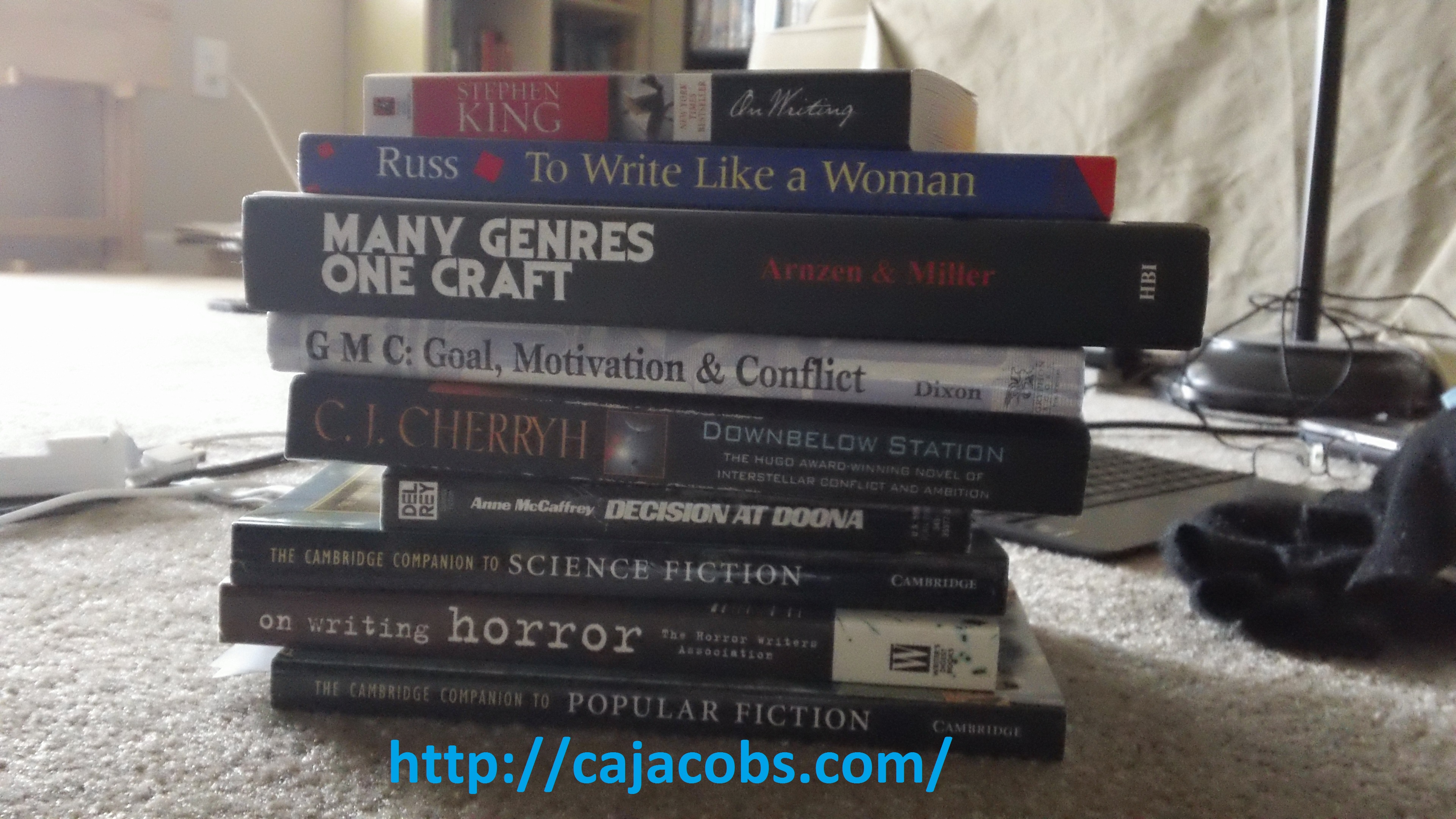
 

Posted in Book Reviews | Tagged , , , , , , , | Leave a comment

Book Review: More Than Human by Theodore Sturgeon

The next book for my Readings in the Genre: Science Fiction Classics for my Master of Fine Arts in Writing Popular Fiction from Seton Hill University was More Than Human (Science Fiction 186 pages) by Theodore Sturgeon.

Science Fiction is one of those genres where a plot about aliens or humans with extra abilities can be used like a window into the social and cultural norms of the current society. More Than Human by Theodore Sturgeon accomplished this on a variety of levels, with one of the key themes used throughout the book being one of repression.

All of the main characters throughout this book are repressed in some way and don’t fit into the social norms established for that time. The first main character in this book, the Idiot who eventually becomes Lone, starts out as nothing more than an extra character in a world he doesn’t understand. It took me a really long time to figure out that he was a real human because this book is classified as Science Fiction, which means he could have been a robot or an alien or a zombie. One never really knows. But as it turns out, he was human. He was just a human that was probably classified as having some sort of mental disability, which meant that society as a whole didn’t treat him very well. Idiot/Lone was desperate for some sort of social interaction but he had no idea what that meant or that it was even something that he was missing. In this way, society discarded him and left him to his own devices. When Lone meets the Prodds and they take care of him and he starts to learn about communication and farming, he starts to realize that he really is someone who is different than the rest of the people, but different in an okay way. Some of the most powerful parts of this book are when Idiot is talking about friendship and he has Janie ask Baby about what friendship means and Janie tells him that “He says it’s somebody who goes on loving you whether he likes you or not.”

Lone didn’t learn to take care of himself or to love himself until he went and spent time with the Prodds and they taught him about what love and unity is like. They showed him patience and let him learn things on his own time. They cared for him, though it seemed to them at times that there was no hope for him. They stuck with him and just kept trying anyway, and eventually, he learned how to talk, then how to communicate, then how to help. He learned about love and friendship from them and had Baby define it for him. But Lone learned how to take care of and love himself because of the Prodds. And he was a better head for the gestalt than Gerry was because of his compassion, his ethos, which Gerry would never have and so the gestalt needed another person. And the greater whole grew and they became again a part of a greater whole.

I think Lone’s death was designed to prove that the characters are just as frail and human as everyone else, as much as it seems like it was a death out of the Stone Age and should have been something preventable, even at the time this book was written. Because before Lone’s death, I got the sense that the characters in the novel were more than human even in the sense of basic mortality. Look at how long Baby must have survived in the cradle at Prodd’s farm before being rescued by Lone and taken back to the cave with the rest of the gestalt. Or how many wounds Lone survived when he dealt with Evelyn’s father. I think Lone’s death was intended perhaps to humanize the parts of the gestalt and show them mortality, but it didn’t teach them fear. I don’t think that any of them actually feared physical injury or death, but just accepted it at face value, like Janie did when she was discussing how Lone got himself killed in such a stupid way.

The other main characters are all repressed as well, starting with Beanie and Bonnie, who are twins, but are African American. This is an issue of racial repression, as Gerry, Alicia, and Janie are all white. In the 1950s when this book was written, racial discrimination was a huge factor in the daily lives of just about everyone. When everyone moved into Alicia’s house, Miriam originally took Beanie and Bonnie away for the meals and it was as though they were all separated, even though they all lived in the same house. Back in the 1950s, it was a huge deal for white people and colored people to be seen being social together and this created a huge issue with repression.

All of the main characters dealt with repression based on their inability to get along with normal society because they had unique ways of looking at the world and unique ways of dealing with their environments. Individually, they were all broken, but together they became much greater than the sum of their parts.

Gerry asked Doctor Stern what the point of all the discrimination was and he was told that everyone likes to make themselves seem better than other people. I think that’s true in today’s society as well, but it’s not nearly to the extent as it was back in the 1950s, though it doesn’t feel like we’ve made that much progress sometimes.

Even the technology is repressed in this book. Lone cares about the Prodds, even though he understands that something went terribly wrong when we returns to return the axe that he borrowed from them. Whereas before, the house was clean, the animals cared for, and the farm work done, when Lone returns, the house is decrepit and Mrs. Prodd is nowhere to be seen. Lone knows what happened to Mrs. Prodd and he knows that Mr. Prodd can’t deal with the Baby. So he starts cleaning things and Mr. Prodd joins in with the cleaning and then Lone notices that the truck is stuck so when he returns to their living area, he encourages Janie to have Baby tell him what he needs to do in order to help Mr. Prodd to be able to farm more efficiently. In the end, he winds up creating some sort of anti-gravity engine that is very simple to attach to the truck. He wants it to be a surprise for Mr. Prodd so he installs it before the sun comes up only to find that Mr. Prodd is gone and won’t likely come back. The technology is something the world isn’t ready for and its very existence could cause great harm, so it is repressed.

All the different children were left to their own devices, and each of them grew up in individual parts of their world without love, companionship, or friendship until they started meeting each other. Even once they did meet each other, they were still alone and isolated from the world in which the rest of the people live. Even after meeting each other, they were still individually repressed until Barrow finally joins them. I got the impression that Janie’s mother was hosting gentlemen in a fashion that included much more than just drinking, which did not help Janie and her development.

I am glad that Sturgeon didn’t go into detail about what Gerry thought was fun was he decided to be a bully. Janie discusses it a little bit, about how he went to school because it amused him and how he continuously strove to be the best at everything he attempted, but how when he realized that there was no competition, things became boring. It’s almost the classic story of a kid who has been bullied for his whole life who suddenly gains great power and then abuses that power. Thankfully, all Gerry does is disguise himself in order to get rid of the anti-gravity tractor so the world isn’t destroyed. The book definitely encourages everyone to treat everyone else better and with more compassion and to be more than human.

None of the characters would have been able to function as a greater whole together if they had been accepted and supported earlier in their lives. I think their individual repression of themselves was a key component to them actually needing each other. If they hadn’t have needed each other and called out to each other, then they wouldn’t have come together to blesh and work towards being better together.

I think one of the reasons this novel actually works is because it shows that all of the parts of the gestalt started out as what most would consider to be less than human. Each one had to travel their own path in poor living conditions in order to come together as a whole, and even when they were all placed into what society deemed a positive living condition with Alicia Kew, that it nearly destroyed the gestalt due to complacency and playing by society’s rules, which weren’t effective rules for them.

Overall, I think I would rate this book as a two on my rating scale. It brought up a lot of really good points, but the style kind of threw me.

Posted in Book Reviews | Tagged , , , , , , , | Leave a comment

The Asexual Friend

So what’s it like to be friends with someone who is Asexual? (And, just to be fair, I am speaking about me as a person, not making comments about Aces as a whole).

Anyone who has ever actually met me will tell you right off the bat that I’m different. Different how? “I don’t know. Just different.” I am many contradictions. For all that I live in a hierarchical world of rules, I tend to not do what I’m told, but I also have one of the stronger senses of ethical reasoning. For all that I keep mostly to myself, I’m actually one of the most generous, big-hearted people I know. I’d like to think that being friends with me is pretty neat.

A lot of my friends and the people I interact with are married. I’m pretty sure I’m friends with them for who they are, but I think that most of them being married is actually really balancing for me in a lot of ways. There’s no confusion about wanting to hook up or be anything other than friends or people who join each other for a meal every now and then. This concept seems a lot less clear to the spouses of my friends. It’s more frustrating for me because whoever I’m hanging out with knows beyond any doubt that I seek out their company because I enjoy hanging out with them, but if their spouse happens to be the same sex as me, their spouse tends to go into all sorts of weird, jealous behavior. While I do understand where the spouse is coming from, usually the miscommunication happens because the spouse has never met me. Once they do, things usually clarify that I really am disinterested in sexual relations. So while I don’t exactly go around telling people who I’m Ace, it’s apparently very obvious in the way I conduct myself that sexual relations have no value to me.

It used to be that people would meet me and assume that I was/am gay. And my coworkers still might think that because I never talk about it. I discourage them very vocally from discussing anything relating to sex, physical attractiveness, or other things that I feel have no place in a professional work environment, but I really don’t think they realize that’s my view on all sexual innuendos. They probably think I’m gay because I always stop them from talking about how hot they find certain chicks by talking about males in the same shallow and derogatory fashion in which they constantly discuss females, but my comments never come out sounding as though I’m doing anything other than working to make them uncomfortable (which works). Asexuality is something that appears to be such a foreign concept to so many people that I often either don’t purposefully tell people that I’m Asexual or I even wind up giving up on attempting to explain what it means to those people I do tell.

I witnessed an online genre fiction discussion today wherein the suggestion was made that perhaps all genre stories should have some sort of romantic element because a lot of fanfiction has a lot of romantic stories, which means the readers aren’t getting the romance they want, even out of their action-adventure or space-horror novels. I tried to articulate that there are people out there who don’t want or need sexual or romantic interests in their stories. Sometimes, you really do just want to see giant robots fighting giant monsters. But Asexuality is still a cloak of invisibility.

What’s it like to be Asexual?

It means that when I have a super rough day, I want to play Super MarioKart or watch hilarious movies. It means that I value people for who they are and not what they look like or their perceived attractiveness. It means that I’ll kidnap extremely handsome athletic jock-types and force them to get burgers, chat over frozen yogurt, browse used bookstores, and watch animated movies with me. And once all that is done, I will expect a friendly hug and I will continue on my way.

It means that I am more comfortable around people who will never hit on me.

It means that I get to be grateful to everyone in my life. I get to say, “Thank you” and never have to justify it.

It means that I get to be honest with all the people in my life and to express how much each and every one of them means to me and how much I love them. It means that I get to actually tell people, “I love you” and completely mean it without any need for anything other than their continued presence in my life.

But it also means that I have different levels of love in my life, just like anyone else. I love all my friends and family, but I am also capable of stronger, deeper, break-your-soul love. Just because I have no interest in sexual relationships does not mean that I lack the capability to fall in love. So I guess the hard part about being Ace and loving everyone is that someone I love as a part of me might not see themselves as special because I love everyone.

But overall? I’d say being friends with an Asexual like me is actually a really fantastic thing 🙂

Posted in Randomness | Tagged , , | Leave a comment

Homework for Today

20150228_homework_cajacobs This is my homework for today. Any guesses what I’m working on? 🙂

Posted in MA in Writing Popular Fiction, Writing | Tagged , , , | Leave a comment

Movie Review: Lilo and Stitch

I haven’t seen Lilo and Stitch since it first came out in theaters when I was a lot younger. I’m not quite sure why I never took the time to find this movie and watch it again.

“Lilo is a lonely little girl, and Stitch is a mischievous little creature from outer space. When Stitch crash-lands in Hawaii, Lilo adopts him as her pet, but he soon turns her world upside down.”

This movie did a great job of messing with my feels. I instantly related to Lilo. She didn’t see the world in the same as those around her. She made a doll and because the head was too big, she made up a story about how creatures had laid eggs in the doll’s brain and that’s what increased the swelling in the doll’s brain and why the doll’s head was so much larger than the body. She tried to make friends with the other girls in the hula group and they saw her as weird and wouldn’t let her play with them. Her sister tries really hard to make ends meet but it seems like the only parts of Nina’s life that anyone sees are the worst days and not the best ones. Nina tries to keep her Ohana together and maintain custody of Lilo, but Lilo isn’t willing to stop being who she is. Lilo’s entire situation made me relate to her on just about every level. And then when things are extremely low, Lilo prays for a friend. She doesn’t pray for a big house or a ton of money or anything other than a friend. Someone who won’t leave her and someone who is strong enough to be friends with her.

That’s probably the most relatable wish/prayer from this entire movie. I feel Lilo’s loneliness. That’s a lesson that’s been hammered into me especially hard in the past year.

Meanwhile, Stitch is a lab creation, designed by an alien scientist to be the ultimate destructive weapon. Stitch is sentenced to banishment on an uninhabited planet and escapes to Earth instead. When the alien council’s representatives show up to recapture Stitch, he uses Lilo and Nina as a cover to hide behind to keep himself safe. Lilo adopts Stitch from a local pet shelter and he pretends to be her dog. Lilo realizes immediately that Stitch is not really a dog, nor is he a normal pet at all. But she loves him and has faith in him anyway. She accepts that he’s not really the best model citizen there is and so she works to teach him how a model citizen should behave. At first, he only does the right thing because he doesn’t want to be captured by the representatives from the alien council, but eventually, Lilo’s unwavering love and faith show him what life with a Ohana is like.

The main theme of this movie is love, family, and friendship. It teaches you to accept people for who they are and to work to understand others better. Lilo and Stitch shows you that you might not be quite right by other people’s standards, but there is someone out there to whom you are a perfect match. Someone who will just understand you and be there for you no matter what. This movie shows you to be who you are, no matter what other people think of you, and also to spend time with those who matter to you because you never know what the future might entail.

You can see why this movie had such an impact on me, yes? 🙂

Overall, I would rate this movie as a four on my rating scale. I enjoyed the story and the characters were all very well done.

Posted in Movie Reviews | Tagged , , , | Leave a comment

Movie Review: Captain America: the First Avenger

It surprises me that I haven’t actually done a review on Captain America: the First Avenger yet. This is one of those movies I can watch if I’m feeling like I need to believe in good people and heroes.

“Captain America leads the fight for freedom in the action-packed blockbuster starring Chris Evans as the ultimate weapon against evil! When a terrifying force threatens everyone across the globe, the world’s greatest soldier wages war on the evil HYDRA organization, led by the villainous Red Skull.”

You know, sometimes I wonder if the backs of the movie boxes and the previews would be different if the markets didn’t put so much bank into everyone just automatically knowing about these movies. Anyone who doesn’t know anything about Captain America, either the comic books or the current movies and his role in the Avengers, wouldn’t really have any idea what this movie is about based on the back of the movie box.

So what is this movie about?

This movie is about heroes. And heart. Friendship and sacrifice.

This movie is basically about all the good in the world.

The movie starts with a little guy from Brooklyn. He spends most of his time standing up to, and getting beaten down by, bullies in every form. He attempts to enlist in the Army in order fight in World War II, but is denied due to excessive medical considerations. He attempts to enlist multiple times from multiple different cities, all with the same results. His repeated attempts to enlist and his repeated failures bring him to the attention of a special program which allows him to enlist in the Army, just as he wanted.

He’s sent to training, where he gives everything he has to every task he is assigned, even though he is the slowest runner and the physically weakest. He uses his brains to solve one of the training problems. But the absolute key part of this entire sequence is when a dud grenade is thrown into the training area and the smallest, weakest trainee covers it the best he can with his frail body while the rest of the trainees take cover and hide. It was this moment that defined both Steve Roger’s character and the character of the entire movie.

Even when you have nothing to lose, risk everything to save those you love, and those you love include those who have also volunteered their lives to serve their country. It’s a powerful message, that even the smallest person can make a huge difference.

So it’s no surprise that Steve is chosen as the supersoldier candidate. When the doctor is discussing the procedure with him, he talks about the reason Steve was chosen was because the serum enhances whatever traits a person already possesses. Good becomes great and bad becomes worse. A strong man has nothing to work for – nothing to gain. A weak man-made strong knows the true power of strength and compassion.

Steve goes through a lot throughout the course of this movie. He starts out as an experiment with too high of a cost and he gets benched. He has to participate in shows and he does his best to believe that what he’s doing is making a difference, but when he finally does arrive in Europe and encounters the true volunteer military, he is rejected as a false symbol and this affects him in a deeply personal way. With the help of Agent Carter and Howard Stark, Steve gets dropped behind enemy lines into a secret HYDRA base where he frees hundreds of allied fighters and finds that his best childhood friend, Bucky Barnes, is still alive. Steve rescues him and together, they start overthrowing HYDRA’s grip on the war.

When Steve puts together his special team, he bases that team on friendship. He chose the people who fought for each other, those who had been captured, survived, and continued to fight anyway. Those who earned their freedom and had the will and capacity to continue to fight for other people’s freedom. To put their lives in danger to protect those without the resources or capability to fight themselves.

This movie is filled with true heroes, not just Steve.

Overall, this movie is probably a four on my rating scale. I’m glad I own it and I watch it repeatedly, especially when I need my faith in the world restored.

Posted in Movie Reviews | Tagged , , , | Leave a comment

Book Review: Fahrenheit 451 by Ray Bradbury

My first homework assignment for my Readings in the Genre: Science Fiction Classics for my Master of Fine Arts degree from Seton Hill University in Greensburg Pennsylvania was Fahrenheit 451 (Science Fiction 165 pages) by Ray Bradbury.

Upon first glance, readers might not be entirely clear as to the classification of Ray Bradbury’s novel Fahrenheit 451. The novel appears to have no technology gone amiss, no aliens, no adventures in outer space, and yet, it’s considered one of the science fiction classics. One of the really good ways to understand the classification of Fahrenheit 451 can be found on page 163 of the Cambridge Companion to Science Fiction: “The feature that unites every kind of sf is the construction – in some sense – of a world other than our own. This may be another planet (or even another universe); or it may be a ‘future world’ in which conditions have changed in some dramatic way. But whatever new conditions or circumstances apply – alien invasion, Martian colonies, a permanent cure for the ageing process – the writer has to signal the changes, and the reader has to be able to understand the significance of these signals” (Jones 163).

A shorter version of Fahrenheit 451 appeared in “Galaxy Science Fiction” under the title “the Fireman” in 1950. Thinking back on the world in 1950 and how Ray Bradbury and his contemporaries viewed the world and the directions technology might take has a variety of parallels with the modern world and modern society today. Early in the story, on page 18, the readers are introduced to some of the technology that is actually familiar to the world in which we live today, especially the “electronic bees” Mildred had plugged into both ears. The first dynamic headphones didn’t hit the market until the DT-48’s from Beyerdynamic, and smaller earbuds weren’t available on the market until the 1980s. This is one of the key factors of science fiction – the sense of wonder as described by Farah Mendlesohn in the “Introduction: Reading Science Fiction” chapter in The Cambridge Companion to Science Fiction. So even though small earbuds weren’t invented yet, Ray Bradbury had the idea in his head that maybe, someday, technology would move to a portable format for audio entertainment, and he was right! And then, on page 19 of Fahrenheit 451, Mildred is in the TV parlor, which is an entire parlor devoted to television screens. Since Montag is not exactly rich, he’s only been able to afford three screens for three walls so that Mildred can somehow participate in her show. She has boring scripts that she can read to the other characters on the screen, as she discusses on page 20. Modern technology has moved to being fully interactive to the level of video games being able to sense what actions a gamer is taking and for the video game to react accordingly. This is a further extension of the wall screen idea that Ray Bradbury is demonstrating in this story, which was published before televisions even progressed passed the black and white formatting for the mass market audiences. According to Nielsen.com, in 2009 there were 2.86 televisions per American household, which is more televisions per household than people. This is also in keeping with the implied statistics from Fahrenheit 451 because there were three screens in the television parlor of Montag’s house while there were only two people who lived there.

What’s really interesting is the idea that the people of the future had extensive use of technology and their lives were still lacking in basic happiness. On page 59 of Fahrenheit 451, Beatty is talking to Montag about the world in which they live: “People want to be happy, isn’t that right? Haven’t you heard it all your life? I want to be happy, people say. Well, aren’t they? Don’t we keep them moving, don’t we give them fun? That’s all we live for, isn’t it? For pleasure, for titillation?” If anything, modern society has more technology and we are far more dependent upon that technology than even Ray Bradbury and the other science fiction authors of his time could ever imagine. We have computers the size of our hands and millions of computers run all of our day-to-day lives. We have planes that transport us to the other side of the planet within a single day and devices that give us full access to the combined knowledge of humanity. And yet, so many of the people in our world are struggling with disease, hunger, homelessness, depression, and poverty. We are, in many ways, living in part of the future that Ray Bradbury envisioned in Fahrenheit 451.

With all that said, and the connections between science fiction of the past and the present world in which we live, where does that mean science fiction is likely to head? What direction could science fiction travel in that hasn’t already been touched on by someone’s imagination? Stories abound in the modern world of space travel, aliens, robots, technology run amok, and humanity on the brink of extinction. If you speculate that the science fiction of the present can shape the face of the next fifty to one hundred years of human and technological evolution, what kind of changes could science fiction make for the benefit of all humanity? Perhaps science fiction should look towards solving global problems in small ways, or find ways to unite people with vastly different religious or cultural beliefs to encourage a world or society to live in peace. Perhaps science fiction has a responsibility to encourage people to become better stewards of the world in which they live, or to become inventors again of those things which we have only imagined or seen in movies. Perhaps an entire genre encouraging and providing information for people to learn how to communicate effectively with those they love in their lives, because for all the technology we have, we’re forgetting how to interact with other real people.

No matter what path science fiction takes, it will eventually turn from science fiction into science fact. The only responsible thing to do is to image a better world or universe and make the world better without having to wait for a war to destroy all the major cities and start all over again, like at the end of Fahrenheit 451.

Overall, I’m going to say that this book is a solid three on my rating scale. Once you get used to the flow and the style of the story, it reads very, very quickly. There’s a lot of really good correlations between the modern world in which we live and the future times envisioned and I think there’s a lot we can learn from this novel.

Works Cited:

Bradbury, Ray. Fahrenheit 451. New York: Random House Publishing, 1996. Print.

Jones, Gwyneth. “The Icons of Science Fiction.” The Cambridge Companion to Science Fiction. Ed. Edward James and Farah Mendlesohn. Cambridge: Cambridge University Press, 2013. 163-173. Print.

Mendlesohn, Farah. “Introduction: Reading Science Fiction.” The Cambridge Companion to Science Fiction. Ed. Edward James and Farah Mendlesohn. Cambridge: Cambridge University Press, 2013. 1-12. Print.

http://coolmaterial.com/roundup/history-of-headphones/

http://en.wikipedia.org/wiki/History_of_television

http://www.nielsen.com/us/en/insights/news/2009/more-than-half-the-homes-in-us-have-three-or-more-tvs.html

Posted in Book Reviews | Tagged , , , , , , , | Leave a comment