Movie Review: All Dogs Go To Heaven

Continuing with my trend of watching older animated movies from my childhood, today I watched All Dogs Go To Heaven.

I haven’t seen this movie in decades and I remember it being really depressing but also really sweet at the same time.

Charlie is definitely a swindler, a dog who uses everyone and everything around him to meet his own needs. He’s greedy and selfish and doesn’t think about anyone except himself. While he does take care of his friend, Itchy, he does it because he would be alone and would have to do everything by himself if he didn’t. The only time he shows loyalty to Itchy is when Itchy comes back from being beaten up by Carface and his gang. He tells Itchy that he’s his best friend and that taking care of Ann Marie was only because he was using her. Ann Marie overhears this conversation. She’s hurt and she runs away and things go badly from there.

I think the reason I like this movie is because it’s a movie about redemption and love. You can spend such a huge portion of your life being greedy and selfish and still learn how to love and give up everything for someone you love. The movie is about learning what’s truly important in life and learning that not everything is about taking care of yourself and doing whatever you want. The movie shows that if you’re given a second chance, use it to make amends and to find love, not to get revenge. Use your time to make the world a better place for those around you.

Overall, I enjoyed the movie and probably rate it as a high two or a low three on my rating scale. It’s a good movie to watch every now and again, but not something I could watch over and over again.

Posted in Movie Reviews | Tagged , , | Leave a comment

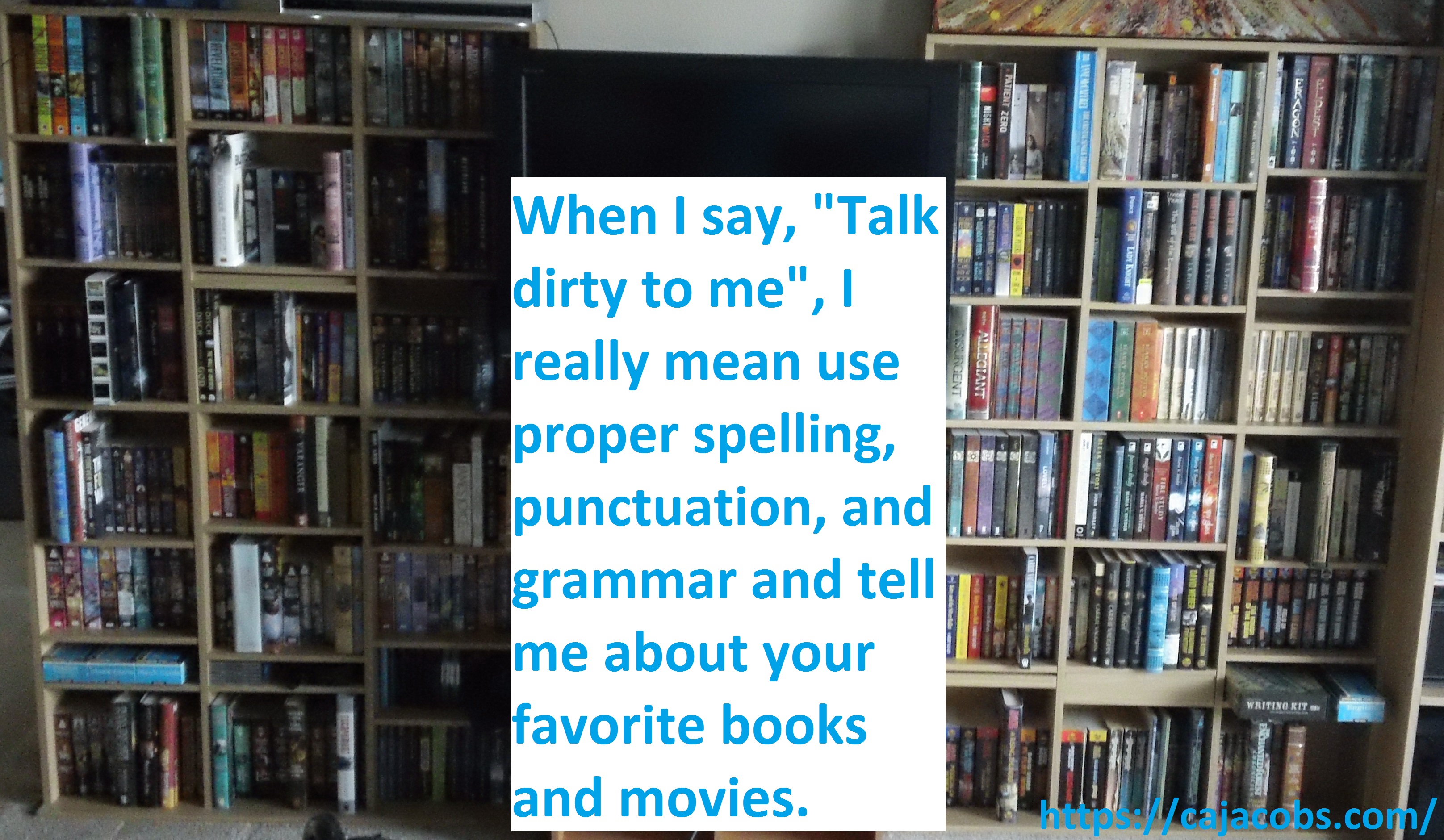
Talk Dirty To Me

20141004_talk_dirty_to_me

Posted in Randomness | Tagged , , , , | Leave a comment

Movie Review: The Aristocats

I think I saw the Aristocats once when I was little but I don’t remember much about it at all. I found it on sale a month or more ago and picked it up and decided to watch it today. I’m glad I did because this is exactly what I needed.

The movie started out with a selection of hand-drawn outlines of the cats participating in a variety of cute cat tasks. It made me really realize how much I enjoy the hand-drawn animation style from when I was a kid. Sure, the animation doesn’t look as sharp as movies do today, but the stories were fun and the music amusing and I find myself smiling and laughing more during these movies than during a lot of the modern stuff. It seems like most of the modern animation messes with my emotions more and I think I’ve wound up tearing up at some point during every one of them. Maybe that’s one of the bigger draws of the animated movies from my childhood – they are fun and amusing and not so emotionally charged.

There was a lot of positive examples of friendship and family in this movie and that really came through with the characters. The characters in the Aristocats were a lot of fun. The two dogs who conspired to keep the hat and umbrella were amusing and a pair of old friends. They each had their faults but they stuck together anyway even though they didn’t always get along or agree. The two geese were so polite and optimistic that it made me smile. The horse and the mouse were both loyal friends to the Duchess and the kittens, even though they were all different species. The Duchess was always calm, poised, and collected, but still capable of getting out of bad situations. O’Malley was charming and musical but also good at heart.

I really liked the music in the Aristocats as well. Maybe I’ve just got a thing for classic jazz right now, but it made me smile and think about trying to find a swing club or someplace where you could just go to dance and have a good time. I think modern clubs are much less classy than my mental images of what swing clubs were like.

This movie really motivated me to want to get to the part of my life where I just read, write, hike, teach, and live a quiet life. A life with kittens and without the stress of my current occupation. But that life feels like just a dream right now. An unachievable goal.

But back to the Aristocats.

I guess this movie does have a subtle sad point at the end of the movie. The Madame takes such good care of Duchess and the kittens and she loves them so much but she really doesn’t have anyone to take care of the cats if something happens to her. So she can leave all her wealth and her estate to them, but they’d still need a human to use that wealth.

Overall, I enjoyed the Aristocats. I thought it was a cute and fun movie and I would probably rate it a three on my rating scale. I’m glad I own it and will likely watch it again.

Posted in Movie Reviews | Tagged , , , , | 1 Comment

Theater Review: Peter Pan

Last night, I had the absolute privilege of watching the live musical Peter Pan at the historic Thalian Hall Center for Performing Arts in Wilmington. I had a wonderful evening and this production is absolutely worth going to see.

I’ve been to the Thalian Hall Center several times now and I’m fairly familiar with the layout. I’m always excited now every time I get to see a show because I enjoy looking out onto the stage and seeing how everything is set up before the show starts. The stage design really sets up what kind of mood the performance will have and I could tell based on the colors of the set, with the pink walls and the brightly colored quilts on the beds, that this was going to be a lot of fun. I’m very familiar with Peter Pan by this time, having recently read the book and watched several of the movies, so I was hopeful that the musical would be as fun and light-hearted as the stage setting indicated.

I think that this is the most enjoyment I’ve gotten out of any of the live shows I’ve attended  so far, including shows I saw before I started heading down to the Thalian Hall Center. I’ve seen plays in Seattle, Minneapolis, and some smaller venues across different states and this was definitely the most fun that I had with any of the shows I’ve been to.

Holy buckets, the characters got to fly around the stage! Peter Pan did a great job with the acrobatic tricks and the flying around the stage and I really enjoyed watching Wendy, John, and Michael learning how to fly. I also liked how Peter Pan was able to fly around in the final battle with Captain Hook. It was a lot of fun to watch.

The costumes were well-done and fit each character exactly. Peter Pan’s outfit was fantastic and blended so well with the scenery and some of the other characters that I sometimes had difficulty keeping track of where Peter Pan was at certain times throughout the show, which is exactly how it should be, especially when Peter Pan is messing around with the pirates. The costumes for the pirates, the lost boys, and the Indians were all distinct and wonderfully done. I was a huge fan of the costumes for the Indians because of how bright and different they were while still being true to the source content meant from the book or the movies. I think everyone in the theater had an “awh” moment when the small humans in animal costumes went on the stage. Even though their roles were very small, they were very cute and played their parts well. The animal costumes for Nana and the crocodile were also very artfully done. The crocodile itself looked amazing and as though it required a vast amount of work both to make it and to use it.

I really enjoyed the sets for the show as well. The distinct difference between the bedroom where the story starts and ends and Neverland during the adventures were fantastic. The bedroom was bright and filled with colors and Neverland was a more nature forest environment. When the pirate ship rose up from the stage, I was impressed. That was a pretty neat trick and I liked how they did it. I liked how the show used all of the parts on the stage effectively.

Overall, the characters were a lot of fun, the story was good, the stage settings and costumes were bright and colorful, and I had a great time. The performer who won the role of Peter Pan did a fantastic and amazing job with all aspects of the role and performed superbly.

I have to admit that my reading of Peter Pan by J.M. Barrie a few months ago combined with where I was at in my life gave me some negative residual emotions in regards to Peter Pan. I felt sorry for Peter Pan because the ending of the book makes it absolutely clear that he would never truly have love in his life and that he was selfish and cold. I can’t think of anything worse in life than living without love. I think that the ending of the musical did a great job of having a more positive residual effect and I left the theater feeling cheered and in a much better place with Peter Pan as a whole.

Posted in Theater Reviews | Tagged , , , , , | 1 Comment

Character Flaw of the Day: I Have NO Ability to Daydream

This may seem like an odd thing to say, that I have NO ability to daydream. If you know me, you know that I’m a very creative person. I’m also hard-working, conscientious, thoughtful, caring, and smart. But what does ANY of that have to do with my inability to daydream?

Let me explain.

Daydreams, according to Webster’s Dictionary, are “a pleasant, dreamy series of thoughts.” This implies that those things you daydream about are fantasizes, or having no real substance.

I’m pretty sure that my secret goal all throughout my life has been to be a Hobbit. Eat, drink, read, write, work in your garden, and really just live a quiet life. For me, though, I’m thinking about being a Hobbit more like Bilbo. He goes out, has great adventures, then comes back super rich and uses all of his new wealth to spoil his friends and family members and live a mostly quiet life. He still travels out to see the Elves every now and again and other of his companions come to visit him, but overall, his life is rather plain.

When I first realized that this was my true secret goal in life, I immediately started thinking about ways where I could do as little as possible for as long as possible. I have no desire to live in a cardboard box, you see. At the time, I was absolutely buried in student debt and didn’t have very many real career opportunities. I did a bunch of research and found a good, but very demanding, job that would take care of me, let me travel the world a bit, and allow me full financial security. There are a lot of draw-backs to this plan, but it is a long-term plan to get me to my goal in life.

My daydream.

As I progressed in my career, I realized that I desperately wanted to take up writing again. So I applied, and was quickly accepted, to Seton Hill University’s Master of Fine Arts in Writing Popular Fiction program. There really wasn’t a long delay between my recognizing something I wanted in my life and then me working towards a way to make that goal achievable.

I have also decided that I want to teach when I am done with my current occupation. I think doing a year teaching English as a second language in a foreign country sounds awesome. So I am upgrading my MA to an MFA so that I am qualified to teach at the university or college level and once I get a break there, I will get my Teaching English as a Second Language certification. After I do that for a bit, then I’ll come back and start teaching at a small community college, hopefully in Montana.

So when I say that I do not daydream, I’m really saying that I am not very good at just sitting around, waiting for someone else to make my life what I want it to be. I am a hard-worker, which means I am willing to put forth any effort necessary to get me to my goals.

There are so many people out there who don’t admit to themselves, let alone anyone else, what they really want in life. And because they don’t know what they want, they don’t know how to work towards getting it. Life is full of uncontrollable stressors – school, work, family, rent, medical stuff – that impact our abilities to actually accomplish our goals, but I sometimes wish there was a way for me to convince people that it’s okay to want to be what you really want to be. And if that’s what you really want, or who you really are, you should find a way to work towards what you want.

I’m at a cross-roads. Very, very soon, I will have to decide whether to continue on my current path and continue working in a job that I feel is starting to weigh heavily on my soul, but one that will take care of me for the rest of my life if I can manage to do this for another nine years, or if I want to change my path and risk everything I’ve worked so hard for in order to achieve sooner gratification of what I want now. Both options have so many parts that are equally appealing or frustrating and I might have found a loophole that will let me do both at the same time, but that loop hole is going to require so many things outside my control to line up that I’m not sure if I should even attempt  it.

Included in my inability to daydream is also the ability to have very random, very focused, creative ideas that impact those around me. I’m something like a super generous prankster.

Posted in Randomness | Tagged , | Leave a comment

Book Review: The Hobbit by J.R.R. Tolkien

While I’m certain that I read The Hobbit (Fantasy 317 pages) by J.R.R. Tolkien at some point when I was very, very young, I remember the cartoon movie that came out in the 80s and the more recent live-action movies that came out rather recently a bit better than my memory of the book. After just finishing the book now, I have to honestly say that Bilbo is an excellent hero, even though he is definitely the reluctant one.

The story starts out with the initial meeting of Gandalf and Bilbo, as Gandalf searches for “someone to share in an adventure” (page 12) and Bilbo promptly replies: “We are plain quiet folk and have no use for adventures. Nasty disturbing uncomfortable things! Make you late for dinner! I can’t think what anybody sees in them.” The very next day, thirteen dwarves show up at his home and make themselves uninvited guests. Bilbo spends the entire time frustrated and upset and then when they start talking about him going on the adventure, he “burst out like the whistle of an engine coming out of a tunnel” (page 25). Clearly, this is not someone who is typical adventuring material, especially since “the poor little hobbit could be seen kneeling on the hearth-rug, shaking like a jelly that was melting.”

But then on page 27, Bilbo says: “that you think I am no good. I will show you … Tell me what you want done, and I will try it, if I have to walk from here to the East of the East and fight the wild Were-worms in the Last Desert.” He would have never had the courage to even stand up and say that much if Gandalf hadn’t believed in him. But because Gandalf believed in him, he saw something in himself that said he was made of better stuff than a bunch of uninvited dwarves thought. And he would prove it to them. Gandalf shows up, tells Bilbo he’s late and he has to get going, and Bilbo just goes. He doesn’t pack, he doesn’t finish or bring his cakes, he just goes. Gandalf doesn’t give him time to think about it and Bilbo just does what he asked.

With the company’s first experience being cold, wet, hungry, and miserable, they send Bilbo off to investigate a fire to see if they can get some food. On page 43: “Off Bilbo had to go, before he could explain that he could not hoot even once like any kind of owl any more than fly like a bat.” The majority of the time in the beginning of the story, Bilbo is rushed into doing things that most people wouldn’t do, especially if they were given any time at all to think about what they were doing. When Bilbo gets picked up by the trolls, he responds to their questions quickly, but then realizes that he might be putting the dwarves in danger, so he tries to confuse the Trolls and give them less information. He is a reluctant hero, but he is a loyal friend. He manages to get out of the trolls grasp, but then he hides in the bushes because there’s nothing he can do to prevent the trolls from grabbing the dwarves one-by-one. Having no combat experience and no weapons, he helps Thorin as best as he could. But when he can do no more, he hides in a bush and Gandalf saves them all.

The company then gets captured by goblins and taken to the goblin king. Once Gandalf again comes and saves them, Bilbo has to be pretty much carried through the entire mountain on the backs of the dwarves because he couldn’t keep up. When he gets knocked unconscious, he wakes up and doesn’t know what to do. So he keeps moving forward. He is mostly a passive observer, but he continues to make the choice to go back and help his friends. Right out of the goblin caves on page 101: “He had just made up his mind that it was his duty, that he must turn back – and very miserable he felt about it – when he heard voices.” He had no business going back, it scared him and made him miserable, but he felt that his friends needed him.

Bilbo goes from becoming someone the dwarves have to take care of to someone who is truly a hero. He has a magic sword and a magic ring and a lot of luck, but he doesn’t kill Gollum when he’s given the chance on page 97 because he pities him for “endless unmarked days without light or hope of betterment, hard stone, cold fish, sneaking and whispering.” He is not a violent hero. He doesn’t start actually killing things until he must save the dwarves from the Mirkwood spiders on page 167: “Somehow the killing of the giant spider, all alone by himself in the dark without the help of the wizard or the dwarves or of anyone else, made a great difference to Mr. Baggins. He felt a different person, and much fiercer and bolder in spite of an empty stomach, as he wiped his sword on the grass and put it back into its sheath.” From that point on, Bilbo becomes the action-hero of the story instead of the accidental hero. He goes on to liberate the dwarves from the elfish prison and get them all the way to Lake-town.

Bilbo sees the ridiculousness of the entire treasure situation and tries to solve it peacefully by giving the Arkenstone to the Elvenking, the Bard, and Gandalf in hopes that they can use it to buy the peace with Thorin. In a way, it works, because it delays them fighting amongst themselves just long enough for the goblin and warg army to show up and everyone to band together against a common enemy. He freely admits to Thorin that he gave the Arkenstone to them in order to bring peace and Thorin throws him out. He stood up for what he believed was right, even though he was the smallest amongst them.

What really makes Bilbo a hero to me is that he will do anything to help his friends and he actually doesn’t like violence at all. He isn’t very good at it and there are so many things that are much better pursuits than killing things. The vast majority of page 301 with Thorin’s death sums up the entire hero experience for me: “’No! said Thorin. ‘There is more in you of good than you know, child of the kindly West. Some courage and some wisdom, blended in measure. If more of us valued food and cheer and song above hoarded gold, it would be a merrier world. But sad or merry I must leave it now. Farewell!’ Then Bilbo turned away, and he wept by himself, and sat alone wrapped in a blanket, and, whether you believe it or not, he wept until his eyes were red and his voice was hoarse. He was a kindly little soul.”

Overall, this book is easily a four on my rating scale. I am glad that I own it, and glad that I own a fancy copy of it, so that I have all the full-page maps and illustrations. If I’d known how much fun this book is to read and how great a hero Bilbo is, I probably would have read this book and reviewed it much, much sooner.

Posted in Book Reviews | Tagged , , , , , , | Leave a comment

Book Review: Hell House by Richard Matheson

Another of my assignments for my Readings in the Genre: The Haunted class to get my Masters of Fine Arts in Writing Popular Fiction from Seton Hill University was Hell House (Horror 301 pages) by Richard Matheson.

As with most of the books for this class, I am likely to have a number of spoilers so if you haven’t read the novel and you want things to be something of a surprise, you’re probably better off not reading this review.

The tone of Hell House was completely different than that of The Haunting of Hill House by Shirley Jackson. I found The Haunting of Hill House to be rather nostalgic and lonely whereas Hell House was aptly named and extremely violent on a variety of levels. And yet, both books did have some rather obvious similarities. I think the most common theme between both these novels was the mostly innocent female character. In The Haunting of Hill House, that character was Eleanor. In Hell House, that character was Edith. I was interested that both names also started with an “E” and I’m not sure that has any relevance or not, but it was something that I noticed. Both women seemed to be characters who did not fit into the societal norms of sexuality and both viewed their lack of those norms as something that made them less worthy of love and attention in their own minds. In a lot of ways, I think both women were actually Asexual and that was part of the way that both houses were able to form attacks against both women. This was seen in Eleanor as her mixed feelings towards Theo and in Edith as her actual repulsion of Florence, Lionel, and Ben. But the house was still able to use their confusion about their own sexual identities and the way they thought they should behave based on what their societies said they, as women, should want.

Meanwhile, one of the things that actually annoyed me throughout the entire novel was how the men were known by their last names and the women were known by their first names. This made things super confusing for me on a variety of levels because Edith and Lionel were both Barretts, but referring to Barrett as a character tended to mean Lionel and not Edith. And then Florence referred to Ben as Ben, but the author indicated Ben as Fischer. This seriously annoyed me to nearly the point of violence.

I thought that Hell House was definitely an engaging read because it built tension so well. I tend to have a very vivid and graphic imagination so I’m not usually so keen on horror novels that allow my over-active imagination to run wild with me, but this book did a great job of balancing just enough disgusting and graphic violence for me to get a good idea of what was going on, but not pushing so hard that I felt sick and put the novel down. I actually greatly appreciated that balance and thought that it really helped to build the tension throughout the story.

There were a lot of places that really helped to develop the setting as one filled with malice and violence, like early in the story on page 27 where the car drives through the greenish mist and then on page 29 where they find the concrete bridge and the tarn. All the windows in the house were boarded up and the very atmosphere says a combination of “toxic”, “go away”, and “gross death”. For horror world-building, it’s fantastic. If I ran into this place in real life? I’d probably add it to my “nope” list.

I really like how much faith Lionel had in his science, but there were a lot of times when I was frustrated by his sheer arrogance. Florence has a great case that both Lionel’s view of supernormal experiences and Florence’s view of mediums can both be correct, but Lionel rejects them out of hand. And then Lionel puts them all in serious danger by monologuing about exactly what his machine will accomplish and how on page 224. I wanted to jump inside the book and hit him with a frying pan or something to wake him up to the extremely bad idea of telling the house what he intended to do in order to purge it of the crappy things it did to people.

This is where I’m going to ruin the ending of the book, so if you haven’t read the book and you want to be surprised by what happens, you really, really should stop reading here.

The end of the book actually made me laugh because I kept thinking about that episode of Buffy the Vampire Slayer where the gang went to the frat party and it was taken over by a fear demon. When everyone finally faces their fears and they join together again to face the final demon, it turns out to be a tiny, miniature demon and Buffy just steps on it after Xander mocks it by saying, “Who’s a little fear demon?” So when I got to the end of the novel and it turns out that Belasco is a short ego-maniac, I burst out laughing. Ben got rid of the evil in Hell House by mocking it to death.

Overall, I think I’d probably rate this book as a solid two on my scale. It had great tension and a lot of wonderful development and I was highly amused by the way the book ended. But I’m not sure how likely I am to read it again for any other purpose than to learn how to write better horror.

Posted in Book Reviews, MA in Writing Popular Fiction, Readings in the Genre | Tagged , , , , , , , , | 2 Comments

Book Review: Lud-in-the-Mist by Hope Mirrlees

Another of my reading assignments for my Readings in the Genre: Fantasy Classics for my Master of Fine Arts from Seton Hill University in Writing Popular Fiction is Lud-in-the-Mist by Hope Mirrlees (Fantasy 160 pages).

For whatever reason from the beginning of Lud-in-the-Mist through to the end, this story reminded me of Prohibition in the United States. I did some research to see if Hope Mirrlees was an American author or if she lived in the States from 1920-1933 when there was a nationwide constitutional ban on alcohol. Some quick research showed that she was British and spent time in Scotland and South Africa, but I really couldn’t shake the similarities between Lud-in-the-Mist and the time in American history when alcohol was forbidden. One of my classmates indicated that fairy fruit becomes symbolic and that the symbol is related to purpose and contentment. This brought up a stronger attachment between fairy fruit and Prohibition for me. I first linked it in Chapter II around page 13: “In spite of the law’s maintaining that Fairyland and everything to do with it was non-existent, it was an open secret that, though fairy fruit was no longer brought into the country with all the pomp of established ritual, anyone who wanted it could always procure it in Lud-in-the-Mist.” And the same could be said with the alcohol during Prohibition. In both instances, people in public will discourage the use of fairy fruit/alcohol, but everyone has the public secret that if they truly wanted to partake of those forbidden substances that they would be able to do so. In this sense, the youth seek more fairy fruit because they tasted it and it had an addictive quality to it, just like alcohol. Once they have experienced the fairy fruit and then been denied any more, Ranulph and the Primrose ladies leave the town for the melodies of things beyond the Debatable Hills. And then there was the passage in Chapter XII around page 78 where Luke writes to Nathaniel: “For though it seemed gibberish, it gave me the shivers, and that’s a fact. And mad folks are often as dangerous as bad ones, so I hope your Worship will excuse me writing like this, and that you’ll favour me with an answer by return, and take Master Ranulph away, for I don’t like the look in the widow’s eye when she looks at him, that I don’t.” I saw so many correlations between fairy fruit and Prohibition throughout this story. I think that part of the draw of fairy fruit is that it’s forbidden and known to cause such unsavory actions. It truly is easier to turn a blind eye to the smugglers bringing in fairy fruit and to those accused of partaking of the fairy fruit rather than face the purposelessness of their own existences.

The entire book is all about the denial of non-real elements from the “real” world in which the characters live. This starts in Chapter II around page 12 with: “Well, a few years before the opening of this story, a Winckelmann, though an anonymous one, actually did appear in Lud-in-the-Mist; although the field of his enquiries was not limited to the plastic arts. He published a book, entitled Traces of Fairy in the Inhabitants, Customs, Art, Vegetation and Language of Dorimare. His thesis was this: that there was an unmistakable fairy strain running through the race of Dorimarites, which could only be explained by the hypothesis that, in the olden days, there had been frequent intermarriage between them and the Fairies. For instance, the red hair, so frequent in Dorimare, pointed, he maintained, to such a strain.” The passage goes on to describe a variety of different aspects and physical characteristics you could use to determine whether or not something or someone could have a fairy background. The book has so many instances of men with red-hair causing potential issues throughout the story that the reader is given all the information they need in order to pick up the clues about how fairyland continues to infiltrate the area of Lud-in-the-Mist. There are so many clues, in fact, that it was sometimes difficult for me to understand how the people of Lud-in-the-Mist *didn’t* see the connections. Especially as the opening parts of the story have repeated instances of Willy Wisp or some other version of that name throughout the story. I’m fairly certain that it is only my very recent exposure to The King of Elfland’s Daughter by Lord Dunsany that keyed me into the Willy Wisp as a Willow Wisps.

One of the differences between the people from the Vale of Erl and the people from Lud-in-the-Mist is that they both believed in fairylands and where the boundary existed, but for the people from the Vale of Erl, the boundary was a physical manifestation that marked the borders, even though they willfully put it out of their minds, whereas the people from Lud-in-the-Mist only had a vague notion that the boundary for the Elfin lands existed somewhere to the west. The people from the Vale of Erl and the people from Lud-in-the-Mist both acknowledged that anything that came out of the Elfin lands would be something completely different and would be obvious in their encounters with the normal world. The people of Lud-in-the-Mist believed that things from the Elfin lands would change characteristics upon interaction with things from their normal world and the people from the Vale of Erl seemed to think that things or creatures from the Elfin lands would retain their original fairy characteristics. One example of this from Lud-in-the-Mist is when Nathaniel is speaking with Hempie in Chapter X around page 70: “’And as for the shells and pots … when we were children, we used always to whisper that they came from beyond the hills.” Master Nathaniel gave a start, and stared at her in amazement. “From beyond the hills?” he repeated in a low, horrified voice. “Aye, and why not?” cried Hempie, undaunted. “I was country-bred, Master Nat, and I learned not to mind the smell of a fox or of a civet cat … or of a Fairy. They’re mischievous creatures, I daresay, and best left alone. But thought we can’t always pick and choose our neighbours, neighbourliness is a virtue all the same. For my part, I’d never have chosen the Fairies for my neighbours – but they were chosen for me.”’

The people from Lud-in-the-Mist are in a constant state of denial about the interaction between the fairy people and the people they are most familiar with, and attempt to ban anything that is thought to come from the Elfin lands, but most especially the fairy fruit. The fairy fruit is both the proof of the interaction between the Elfin lands and their normal lands and is blamed for anything and everything that goes wrong throughout the novel. If you son or daughter suddenly acts in a completely bizarre and unseemly manner, it must be the ingestion of the nefarious fairy fruit. The conspiracy goes so deep as to acknowledge that the fairy fruit is being somehow smuggled into the land, but everyone denies seeing any trace of it. The proof of the smuggling is hidden so well behind hidden passages and people who the populace know or trust that it’s impossible for the true source of the interactions between the two lands to be brought to sufficient light to satisfy the Senate as to how to stop the smuggling. Ambrose and Nathaniel witness the smuggling in action and when they take appropriate action to show to the rest of the Senate how the fairy fruit is entering their town, but the operation is moved and then looks more to implicate Nathaniel and he is removed from his office as Mayor immediately following his revelations to the Senate. The Senate refuses the potential proof in front of them because they don’t want to see it. Their lives are so much simpler if it’s Nathaniel and his incompetence that are the source of their problems instead of the fairy fruit. So, in a way, they acknowledge the existence of the fairy fruit and its impact on their lives, but they also deny its existence and focus instead on the problems of the person in charge.

Even at the very end in Chapter XXX around page 156, the people still don’t accept how close the Fairy world and their own are intertwined until Ambrose talks to them about the coming of the Fairy people: “I have sometimes wondered, recently, whether we have ever really understood the true meaning of that proverb. Our ancestors built the town of Lud-in-the-Mist between these two rivers, and both have brought us their tribute. The tribute of the Dawl has been gold, and we have gladly accepted it. But the tribute of the Dapple we have ever spurned. The Dapple – our placid old friend, in whose waters we learned as lads the gentle art of angling – has silently, through the centuries, been brining fairy fruit into Dorimare … a fact that, to my mind, at least, proves that fairy fruit is as wholesome and necessary for man as the various other gifts brought for our welfare by our silent friends.” The members of the Senate are at first horrified, even though they heard some of the reasoning behind these actions from Leer during Leer’s trial in Chapter XXVI around pages 138-140.

This whole book is a balance between denial and what could be considered the real or normal world. I think that’s one of the reasons this story is one of the better examples of Liminal Fantasy – there’s always that unclear element between what is fairy and what is “real” and this bleeds into the perceptions of the characters throughout the story. There was always an undercurrent throughout the novel for me about whether or not the entire town was drugged right from the beginning and having some sort of mass-delusions or hallucinations. There was definitely a huge sense of dreams and not reality that I felt as a reader throughout the entire story.

Overall, I’d probably rate this book as a high two or a low three on my rating scale. I’m happy that I read it and I might actually read it again at some point.

Posted in Book Reviews | Tagged , , , , , , , , , | Leave a comment

Book Review: The Shining by Stephen King

Another of my reading assignments for my Readings in the Genre: The Haunted for my Master of Fine Arts from Seton Hill University in Writing Popular Fiction is The Shining by Stephen King (Horror 683 pages).

I have to say, I’m actually seriously enjoying the reading material for this class. A lot of the books so far have been “classic” horror novels or movies that I’ve never read or seen. I’m really glad that this class is motivating me to expand my repertoire of horror novels.

I had never read, nor had I ever seen, The Shining before I read it for this class, but I saw the previews for the Jack Nicolson movie with him attacking a door with an axe. I think I also remember seeing previews for one of the movies with a little boy in a hallway with two creepy looking girls. The reason I mention my viewings of previews for the different movies was because it provided my brain with pre-conceived notions as to potential scenes from the book. As it turns out, those pre-conceived notions in my head were completely incorrect. So if you have not read the book, know that I will include a number of spoilers and that if you don’t want the story and ending to be ruined for you, you might want to stop reading here.

I think the best part of this book for me was the constant foreshadowing. I marked a variety of passages throughout the book that all deal with the scene with Jack chasing Danny in the hotel while Danny attempts to hide. I think this foreshadowing worked because it was never the exact same scene copied and pasted throughout the novel, but rather sections that have many similarities and are not exactly the same. In each section, Danny is hiding and afraid and something (or someone) is hunting him.

The first time that Danny sees something bad happening at the Overlook Hotel is in Chapter 4: Shadowland (around page 47 in the version I read): “Now he was in a room filled with strange furniture, a room that was dark. Snow spattered against the windows like thrown sand. His mouth was dry, his eyes like hot marbles, his heart triphammering in his chest. Outside there was a hollow booming noise, like a dreadful door being thrown wide. Footfalls. … The room faded. Another room. He knew (would know) this one. An overturned chair. A broken window with snow swirling in; already it had frosted the edge of the rug. The drapes had been pulled free and hung on their broken rod at an angle. A low cabinet lying in his face.” Danny dreams or sees several instances of this scene throughout the novel, each time providing him with a greater sense of dread and also a greater sense of certainty that this was a true and upcoming future.

Some of the other instances of foreshadowing that I marked were sort of related to the final showdown and sort of not related to the final showdown. These were the scenes where characters other than Danny, usually Jack, where you start to get a feeling for what kind of manipulation the Overlook will use in order to convince Jack to take the action the Overlook desires, which is to kill Wendy and Danny. I saw examples of this in Chapter 22: In the Truck (around page 301) where Danny is talking to Wendy about how Jack views their current situation. “But grownups were always in turmoil, every possible action muddied over by thoughts of the consequences, by self-doubt, by selfimage, by feelings of love and responsibility. Every possible choice seemed to have drawbacks, and sometimes he didn’t understand why the drawbacks were drawbacks.” Not only does that passage give a sense of foreshadowing for Jack’s thoughts, but it’s also a solid paragraph about what it means to be an adult. Passages like this throughout the novel provided me with the logic and reasoning behind future actions that wouldn’t make sense to a rational person and really provided the sense that sometime during their stay at the Overlook, rational logic would be suspect and characters would continue to look for ways to justify illogical actions.

The Overlook’s manipulation of Jack continues in Chapter 26: Dreamland (around page 337) where Jack discusses the beating of his mother with the cane, how little Jacky counts every blow of the cane against his mother. This part of Jack’s past is violent and frightening and provides the Overlook with more fodder to continue to warp Jack’s perspectives. The foreshadowing continues for Jack when he finds the roque mallets in the equipment shed in Chapter 33: The Snowmobile (around page 415): “He frowned a little, then smiled. Yes, it was a schizo sort of game at that. The mallet expressed that perfectly. A soft end and a hard end. A game of finesse and aim, and a game of raw bludgeoning power.” Having seen Danny’s repeated nightmares of the roque mallet and the destruction and fear it causes, this is a perfect setting for the reader to get that sense of foreboding where the stage is now fully set for really bad things to happen.

Chapter 33: The Snowmobile had one other really amusing part for me (around page 424): “The Overlook was having one hell of a good time. There was a little boy to terrorize, a man and his woman to set one against the other, and if it played its cards right they could end up flitting through the Overlook’s halls like insubstantial shades in a Shirley Jackson novel, whatever walked in Hill House walked alone, but you wouldn’t be alone in the Overlook, oh no, there would be plenty of company here.” This was amusing to me because I just finished reading The Haunting of Hill House by Shirley Jackson a few weeks ago and some of the recent discussions on the Readings in the Genre: The Haunted discussion board involved using the setting as a character.

Overall, I would probably rate this book as a high two or low three on my rating scale. I’m absolutely glad that I read it and I think I can learn a lot about how to do good foreshadowing and how to build tension, but I’m not entirely certain that it’s a book I would need to read repeatedly.

Posted in Book Reviews, MA in Writing Popular Fiction, Readings in the Genre | Tagged , , , , , , , , | Leave a comment

Book Review: Treecat Wars by David Weber and Jane Lindskold

I’ve needed a serious break lately so I read Treecat Wars (Young Adult Science Fiction 366 pages) by David Weber and Jane Lindskold last night.

This is the third novel in the Star Kingdom Series and I’ve absolutely enjoyed every book so far. I didn’t even know there was a third book until I was doing research a few days ago. As soon as I found out there was a third book, I immediately went to the bookstore, picked up the book, and read it cover to cover in a matter of hours.

I think there are probably a lot of reasons why this series is so appealing to me and why I can get through the entire book in one sitting. I think the first of those is that the whole series is a mix of technology and outdoor adventuring. It’s kind of the way I see the colonizing of space to go in the future and if I could live in any fantasy world, I would probably happily live in this universe. You have space travel, other planets, other cultures, sentient alien species, and also entire planets of unchartered wilderness.

I’m interested in the political ramifications of the Adair Foundation and how everything that happens with them might be able to be related to the current Honor Harrington series. It’s not something I put too much of my extra thoughts and interests into, but it is something that I’ll be keeping in the back of my mind as more of the books in this series are published. Something along the lines of a broad-spectrum conspiracy that will have lasting, inter-stellar ramifications.

There are a couple of things that I continue to really enjoy about this series. The first, and most important for me, is the character development. I am positively thrilled to be reading a young adult series that has very little in regards to teen romance. The story here is focused mainly on the treecats, Stephanie Harrington, Anders Whitaker, and Jessica Pheriss. While there are romantic undercurrents, those undercurrents have very little to zero impact on the actual story. I thought when I first started this story that the romantic undercurrents were going to become annoying and obvious because of how torn Stephanie was when her and Anders had to be on different planets for any length of time, but that part of the story was handled at the exact level it should be – it affected the characters and their emotions, but the story easily could have moved forward without those elements. It’s actually those small romantic undercurrents throughout the story that bring this story even closer to reality. People are going to have feelings and emotional responses to other people and this story has those elements, but they don’t take over the story.

I continue to like and appreciate the way the treecats continue to evolve in this series. I remember when I first read On Basilisk Station several years ago and how fascinating Nimitz was to me then. I think that this series is really doing a great job of building the treecat society and creating a believable world that is a happy mix between where the Honor Harrington series is right now and creating more subtle nuances in the current development of the treecat history. It’s a fascinating bridge. But, really, this series just keeps making me want to meet a treecat and make friends with them in real life, which is the mark of a good series when the readers wish that the reality expressed in the novels they read were their actual reality.

Right near the end of the book, there were a lot of really well-done relationships bits. Stephanie is talking to Karl about Anders and Jessica and Karl says, “They don’t really belong just to you, you know. And you don’t belong to just them. No matter what words you use, Jess and Anders have lives beyond how they relate to you … And you wouldn’t have gotten involved with them if you hadn’t thought both of them were pretty great people, right?” (page 352). I guess in some ways, this was pretty close to some of the things that have happened in my own life and some of it was so similar to my own relationships. You can never control how you feel or your emotional reactions to things. You can control how you allow those feelings to affect your interactions with your world, but you can’t control the feelings themselves. Nor can you control how other people feel or what they choose to do about their feelings in their lives. This story was about as real as situations get and it was refreshing to have things turn out in way that was not the standard relationship solution.

Overall, I would say this book rates an easy four on my rating scale. I am glad that I own this book and I’m positive that I will wind up rereading this book in the future, potentially multiple times.

Posted in Book Reviews | Tagged , , | Leave a comment