Book Review: A Series of Unfortunate Events 04: the Miserable Mill by Lemony Snicket

I have decided that a Series of Unfortunate Events are the perfect books for my morning cardio routine at the gym. Yesterday’s book was a Series of Unfortunate Events 04: the Miserable Mill (Young Adult 194 pages) by Lemony Snicket.

“Dear Reader, I hope, for your sake, that you have not chosen to read this book because you are in the mood for a pleasant experience. If this is the case, I advise you to put this book down instantaneously, because of all the books describing the unhappy lives of the Baudelaire orphans, The Miserable Mill might be the unhappiest yet. Violet, Klaus, and Sunny Baudelaire are sent to Paltryville to work in a lumbermill, and they find disaster and misfortune lurking behind every log. The pages of this book, I’m sorry to inform you, contain such unpleasantness as a giant pincher machine, a bad casserole, a man with a cloud of smoke where his head should be, a hypnotist, a terrible accident resulting in injury, and coupons. I have promised to write down the entire history of these three poor children, but you haven’t, so if you prefer stories that are more heartwarming, please feel free to make another selection. With all due respect, Lemony Snicket.”

One of the points I have commented on for my previous reviews of this series is how much I enjoy the writing style. I like how the structure works and how the sentences flow. I think this is a great book for anyone, not just younger people because of how words are defined not just by the context but by a similar definition. The story, and the series, continues to subtly and not-so-subtly introduce new vocabulary to people who may want new words and to those who may not have a very extensive vocabulary to start with. There are many examples of words being used and also described in context and defined, which I think is a great way to improve a reader’s vocabulary. And it’s written in such a way as to not be condescending, but to also demonstrate the full meaning of the intent of the word when used in very specific context.

In every one of these books so far, the unfortunate events are resolved by the special skills of the three Baudelaire children. The Baudelaires have to switch specialties for the duration of this book, which was an interesting twist. Due to the nefarious intent of the Lucky Smells Lumbermill foreman, Klaus has multiple issues with his glasses and it winds up being Violet who has to conduct book research without Klaus’ assistance in order to prevent disaster for the Baudelaire orphans. Klaus then has to invent something to prevent a horrible “accident” and Sunny participates in the strangest sword duel I’ve ever read about or seen. The Baudelaire children continue to demonstrate extreme resourcefulness in the face of crappy situations and I believe their ability to resolve issues with mostly knowledge is admirable.

I think my favorite part of this book was on page 108 when Klaus said, “I’m never skipping the boring parts of a book again.” This was at a point where the siblings realize that sometimes knowledge that isn’t particularly entertaining can be very, very useful at the strangest times, which was something I very much relate to.

Another very interesting correlation with the book happened for me on page 144 where the changes in Klaus are very obvious: “Klaus usually looked interested in the world around him, and now he had a blank expression on his face. His eyes were usually all squinty from reading, and now they were wide as if he had been watching TV instead. He was usually alert, full of interesting things to say, and now he was forgetful, and almost completely silent.” The correlation made here is that those who read might be more likely to be interested in the world around them, while those who watch TV are likely to become disinterested and mindless. Those who I associate with who read voraciously seem more imaginative and interactive than those I know who watch a lot of television. But maybe that’s just me and my thoughts.

Overall, I’d probably rate this book as a solid three on my rating scale because I really like the writing style, the characters are unique, and the message is mostly a positive one (for all that the book is not a happy story). I’m glad that I own this book and will continue with the rest of the books in the series.

Works cited: Snicket, Lemony. A Series of Unfortunate Events: the Miserable Mill. New York: HarperCollinsPublishers, 2000.
Posted in Book Reviews | Tagged , , , | Leave a comment

Book Review: A Series of Unfortunate Events 03: the Wide Window by Lemony Snicket

I needed another book to read while I was at the gym this morning and a Series of Unfortunate Events is becoming high on my list of motivational gym books. This morning’s book was a Series of Unfortunate Events: the Wide Window (Young Adult 214 pages) by Lemony Snicket.

“Dear Reader, If you have not read anything about the Baudelaire orphans, then before you read even one more sentence, you should know this: Violet, Klaus, and Sunny are kindhearted and quick-witted, but their lives, I am sorry to say, are filled with bad luck and misery. All of the stories about these three children are unhappy and wretched, and the one you are holding may be the worst of them all. If you haven’t got the stomach for a story that includes a hurricane, a signaling device, hungry leeches, cold cucumber soup, a horrible villain, and a doll named Pretty Penny, then this book will probably fill you with despair. I will continue to record these tragic tales, for that is what I do. You, whoever, should decide whether you can possibly endure this miserable story. With all due respect, Lemony Snicket.”

At this point, it looks as though I’m definitely going to read the whole series, and hopefully finish them all soon. While I repeated a good portion of my comments between the first book review of a Series of Unfortunate Events: the Bad Beginning and a Series of Unfortunate Events: the Reptile Room, I don’t feel the need to include those comments here. So if you are reading this review, I would recommend that you read the other reviews first.

The writing style in these books is really fantastic. I like how the structure works and how the sentences flow. I’m not one who usually comments on things like that, except for this series, it appears, because I really am drawn to these books. I think this is a great book for anyone, not just younger people because of how words are defined not just by the context but by a similar definition. The story, and the series, continues to subtly and not-so-subtly introduce new vocabulary to people who may want new words and to those who may not have a very extensive vocabulary to start with. There are many examples of words being used and also described in context and defined, which I think is a great way to improve a reader’s vocabulary. And it’s written in such a way as to not be condescending, but to also demonstrate the full meaning of the intent of the word when used in very specific context.

Part of my amusement with the writing style in this book is that there are several times where the author addresses the readers in order to inform them that the experiences of the Baudelaire orphans are not ones which anyone should attempt to duplicate. These interludes amused me greatly, even though they were sometimes at points in the story which were moving so quickly that I almost didn’t notice the humor.

In every one of these books so far, the unfortunate events are resolved by the special skills of the three Baudelaire children. Violet invents a signaling device, Klaus solves a very complicated riddle using grammar books in Aunt Josephine’s library, and Sunny is far more perceptive at solving concerns in a very simple way. It was Sunny who steals the keys and Sunny who, again, proved the identity of the nefarious culprit. Each of the three Baudelaires bring their own strengths to the table and none of those strengths are stereotypical norms. When Violet, Klaus, and Sunny arrive at Lake Lachrymose, Aunt Josephine has prepared “normal” presents for the children – a doll for Violet, a train for Klaus, and a rattle for Sunny – all of which are the exact opposite of the presents most suited to each of the children’s skills and interests.

This book does have several morals throughout the story, especially towards the end. Aunt Josephine spends so much time being afraid of everything that she never truly gets a chance to live her life. And then she uses that same fear to put the Baudelaires into jeopardy in order to attempt to save herself from Captain Sham. The book makes a point of showing that a true guardian is someone who protects their charges, provides properly for their charges, helps them, and believes in them; none of which Aunt Josephine does for the Baudelaire children.

One of the best parts of this book for me was when the three children, instead of bemoaning their circumstances and living in terror like Aunt Josephine, they are thankful to each other and they vocalize this thanks. That tells me everything about the character of Violet, Klaus, and Sunny and is a trait which I aspire to emulate more often in my own interactions with others.

Overall, I’d probably rate this book as a solid three on my rating scale because I really like the writing style, the characters are unique, and the message is mostly a positive one (for all that the book is not a happy story). I’m glad that I own this book and will continue with the rest of the books in the series.

Works cited: Snicket, Lemony. A Series of Unfortunate Events: the Wide Window. New York: HarperCollinsPublishers, 2000.

Posted in Book Reviews | Tagged , , , | Leave a comment

Book Review: A Series of Unfortunate Events: the Reptile Room by Lemony Snicket

I needed a book to read while I was at the gym yesterday morning and I didn’t want anything long or complicated because of how much energy I’m putting into the mystery books I’m going through right now, so I chose a Series of Unfortunate Events: the Reptile Room (Young Adult 190 pages) by Lemony Snicket.

“Dear Reader, If you have picked up this book with the hope of finding a simple and cheery tale, I’m afraid you have picked up the wrong book altogether. They story may seem cheery at first, when the Baudelaire children spend time in the company of some interesting reptiles and a giddy uncle, but don’t be fooled. If you know anything at all about the unlucky Baudelaire children, you already know that even pleasant events lead down the same road to misery. In fact, within the pages you now hold in your hands, the three siblings endure a car accident, a terrible odor, a deadly serpent, a long knife, a large brass reading lamp, and the reappearance of a person they’d hoped never to see again. I am bound to record these tragic events, but you are free to put this book back on the shelf and seek something lighter. With all due respect, Lemony Snicket.”

I’ve found that a lot of comments from my previous book review of A Series of Unfortunate Events: the Bad Beginning apply to this book as well. I’m going to leave those comments here, just in case someone randomly decides to read this book review without reading the previous one for this series.

This series is very aptly named, as it truly is a Series of Unfortunate Events. I think in a lot of ways, this book is actually a lot more realistic about demonstrating how life often is filled with chains of unpleasant things and how things rarely work out perfectly. There are multiple times throughout this story where a typical story of this nature would have a happily ever after, such as if Uncle Monty had been able to remain the guardian for the Baudelaire children. They could have been happy travelling the world and studying reptiles with Uncle Monty.

But that’s not how the real world works.

In the real world, sometimes things just go wrong. It’s no one’s fault and there’s no one to blame for it or nothing you can do to fix it. Just like in the book, when the real world throws something less-than-stellar at you, you just have to do the best you can to find a solution and keep moving forward with the hope or knowledge that someday, things might actually get better.

I enjoyed the writing style of this book very, very much. I think this is a great book for anyone, not just younger people because of how words are defined not just by the context but by a similar definition. The story, and the series, continues to subtly and not-so-subtly introduce new vocabulary to people who may want new words and to those who may not have a very extensive vocabulary to start with. There are many examples of words being used and also described in context and defined, which I think is a great way to improve a reader’s vocabulary. And it’s written in such a way as to not be condescending, but to also demonstrate the full meaning of the intent of the word when used in very specific context.

One of the things I liked the most about this book is that the three siblings were all very different and had non-stereotypical interests. Violet is an inventor, Klaus is an academic, and Sunny is a powerful biter. Because of their various interests, they believe that anything can be solved, with the mindset that all you have to do is research what you’re trying to accomplish and there will be a book somewhere that will help you or point you in the right direction. This turns out to be true throughout the story, but the story also shows that just because you learn the information you needed doesn’t mean that things will turn out perfectly. One example of this is when the children use Uncle Monty’s books on reptiles to identify the method of Uncle Monty’s death and find clues to prove something nefarious happened to him. Even though things didn’t work out perfectly, the Baudelaire children use books and knowledge to solve the concerns in their world, and that is a huge win for me.

We are all, regards of our age, influenced by the world around us and the method we receive information. People who read this book will perhaps think that any concern can be addressed with enough research and information, which I think is probably the most important thing to teach.

Overall, I’d probably rate this book as a solid three on my rating scale because I really like the writing style, the characters are unique, and the message is mostly a positive one (for all that the book is not a happy story). I’m glad that I own this book and will continue with the rest of the books in the series.

Works cited: Snicket, Lemony. A Series of Unfortunate Events: the Reptile Room. New York: HarperCollinsPublishers, 1999.

Posted in Book Reviews | Tagged , , , | Leave a comment

Book Review: a Series of Unfortunate Events: the Bad Beginning by Lemony Snicket

I needed a book to read while I was at the gym yesterday morning and I didn’t want anything long or complicated because of how much energy I’m putting into the mystery books I’m going through right now, so I chose a Series of Unfortunate Events: the Bad Beginning (Young Adult 162 pages) by Lemony Snicket.

“Dear Reader, I’m sorry to say that the book you are holding in your hands is extremely unpleasant. It tells an unhappy tale about three very unlucky children. Even though they are charming and clever, the Baudelaire siblings lead lives filled with misery and woe. From the very first page of this book when the children are at the beach and receive terrible news, continuing on through the entire story, disaster lurks at their heels. One might say they are magnets for misfortune. In this short book alone, the three youngsters encounter a greedy and repulsive villain, itchy clothing, a disastrous fire, a plot to steal their fortune, and cold porridge for breakfast. It is my sad duty to write down these unpleasant tales, but there is nothing stopping you from putting this book down at once and reading something happy, if you prefer that sort of thing. With all due respect, Lemony Snicket.”

This book is very aptly named, as it truly is a Series of Unfortunate Events. I think in a lot of ways, this book is actually a lot more realistic about demonstrating how life often is filled with chains of unpleasant things and how things rarely work out perfectly. There are multiple times throughout this story where a typical story of this nature would have a happy after, such as if Judge Strauss took the Baudelaire siblings in and was able to adopt them on her own. They could have lived lives filled with libraries and gardens.

But that’s not how the real world works.

In the real world, sometimes things just go wrong. It’s no one’s fault and there’s no one to blame for it or nothing you can do to fix it. Just like in the book, when the real world throws something less-than-stellar at you, you just have to do the best you can to find a solution and keep moving forward with the hope or knowledge that someday, things might actually get better.

I enjoyed the writing style of this book very, very much. I think this is a great book for anyone, not just younger people because of how words are defined not just by the context but by a similar definition. Right from the beginning of the story on page two: “The three Baudelaire children lived with their parents in an enormous mansion at the heart of a dirty and busy city, and occasionally their parents gave them permission to take a rickety trolley – the word ‘rickety,’ you probably know, here means ‘unsteady’ or ‘likely to collapse’ – alone to the seashore, where they would spend the day as sort of a vacation as long as they were home for dinner.” This is one of many examples of words being used and also described in context and defined, which I think is a great way to improve a reader’s vocabulary. And it’s written in such a way as to not be condescending, but to also demonstrate the full meaning of the intent of the word when used in very specific context.

One of the things I liked the most about this book is that the three siblings were all very different and had non-stereotypical interests. Violet is an inventor, Klaus is an academic, and Sunny is a powerful biter. Because of their various interests, they believe that anything can be solved, with the mindset that all you have to do is research what you’re trying to accomplish and there will be a book somewhere that will help you or point you in the right direction. This turns out to be true throughout the story, but the story also shows that just because you learn the information you needed doesn’t mean that things will turn out perfectly. Several examples include when the children need to figure out how to provide a meal for Count Olaf and his performing troupe, and so they find a recipe from a book they think is simple and tasty enough for them to be able to make with no previous experience or assistance. The recipe works out well but Count Olaf is dissatisfied. The children know that Count Olaf is up to something, but they can’t figure out what, so Klaus spends all night reading about what he thinks Count Olaf is attempting to do. He figures out the puzzle, but he doesn’t allow for Count Olaf being a total sleeze about what’s going on in the story. Even though things didn’t work out perfectly, the Baudelaire children use books and knowledge to solve the concerns in their world, and that is a huge win for me.

We are all, regards of our age, influenced by the world around us and the method we receive information. People who read this book will perhaps think that any concern can be addressed with enough research and information, which I think is probably the most important thing to teach.

Overall, I’d probably rate this book as a solid three on my rating scale because I really like the writing style, the characters are unique, and the message is mostly a positive one (for all that the book is not a happy story). I’m glad that I own this book and will continue with the rest of the books in the series.

Works cited: Snicket, Lemony. A Series of Unfortunate Events: the Bad Beginning. New York: HarperCollinsPublishers, 1999.

Posted in Book Reviews | Tagged , , , | Leave a comment

Comic Book Review: Green Lantern v3: 13

This is the same introduction I posted when I posted my comic book review for Green Lantern v3 01-08 and Green Lantern v3 09-12. I left the introduction because I think it’s important to show where I’m at with the reading so far, which means understanding why I’m reading these and what kind of background (or lack thereof) that I have with the Green Lantern storyline.

I’ve recently started reading some comic books from the 1990s, and I started with the reboot of Green Lantern which started in June 1990. These comics actually came out while I was an avid comic book fan, but my tastes back then tended more towards the Marvel Universe and the X-Men series. Just over two years ago, a very good friend of mine introduced me to the Green Lantern universe. She was so adamantly passionate about Green Lantern that I started reading some of the later Green Lanterns and we watched the Green Lantern animated series on Thanksgiving of 2013.

There’s a lot going on in my life right now, but I found some of the comic books from the reboot of the Green Lantern series in 1990. I’ve been spending some time reading those and it’s been a really good experience.

As I begin my reading journey of these classic comic books, I have to say that I only have a very rudimentary knowledge of the Green Lantern and DC Comics Universe in general. I know that the Green Lanterns have rings they receive from little blue guys and that their rings can be used to do anything their imaginations can think of, so long as their rings are charged from their lantern every 24 hours. Their rings are powered by Will power, which means that they have to have the will to do what is required to solve their issues.

In my previous readings, I learned that Oa is the home planet of the Guardians who are the little blue guys that give people their rings. They apparently left on some journey to meet with their female counterparts and the one left in this universe/galaxy/whatever went stark raving mad and pulled a bunch of places from all over the universe to his planet so he wouldn’t be lonely. But they’re back now and working to repair the damage to the Green Lantern battery and they have a whole bunch of random cities from all over the galaxy that are held on Oa.

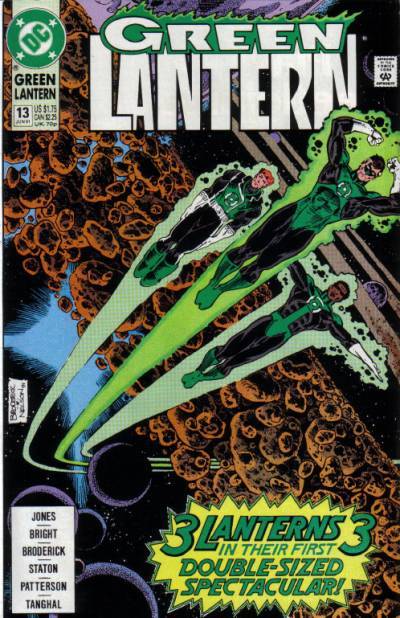
Green_Lantern_Vol_3_13Issue 13 is  dated June 1991 and is a double-sized spectacular, including all three of the Green Lanterns: Hal Jordan, John Stewart, and Guy Gardner. This issue starts with Guy Gardner in a state of depression. His internal thought bubble on the second page says, “Can’t seem to get excited about anything all of a sudden. And it bugs me.” I continue to be impressed with the level of social consciousness these older comic books demonstrated. While no one back in the 1990s would have said that Guy Gardner is depressed, he is clearly dealing with depression, as one of the symptoms is not getting any enjoyment out of normal things. He decides that he needs a fight in order to make himself feel better so he picks Kila in order to get a good fight out of someone he respects who he knows will be a fairly even match and who he can’t hurt. He then feels better, especially when he decides to leave Gnort out to dry. This all really just continues to make it harder for me to like Guy Gardner at all, but I understand what kind of character arch the writer(s) are likely going for with this.

Meanwhile, Hal Jordan is teaching fighting techniques to the new Green Lantern recruits he’s found so far. And a lot of this storyline is characters boosting Hal’s ego while he attempts to dissuade them from doing exactly that. Hal also has to deal with the different methods other cultures (in this case, alien races) deal with conflict. He starts running into questions concerning the Guardians and their motives and whether it’s best to follow orders or do what is perceived to be right. There are also questions about the “greater good” and what saving the galaxy really means. But one of the things that bothers me about Hal’s character arch and these comic books in general is that every.single.female character, regardless of planetary origin, has to be or have a romantic interest of some sort. Out of the three recruits Hal is training in this issue, the female one, Brik, is the one that appears to be the most impacted by Hal’s faked death during training and the two “male” recruits are the ones who talk about the good of the Corps and duty. Again, I could go on a rant for days about sexism in comic books, but I still don’t have the energy for it.

The story then moves to John Stewart as he attempts to build a cohesive group out of a scattering of different cities and cultures from all across the galaxy who all just want to go home. The Guardians are using John as an experiment in every way. He is the first to attempt to charge his ring off the central battery and it goes less well than it should have. John keeps trying to push the Guardians to work harder on getting all the various people and cities back to their original worlds, but the Guardians are dragging their feet and John just sort of rolls with it.

Guy and Hal show up on Oa and Guy starts talking about the attractiveness of Brik and it makes me annoyed at the sexism in comic books all over again.

Just because I understand why the characters are written the way they are doesn’t actually make me like them better, just to be clear.

Overall, I’m happy to be reading these comic books and I would probably rate issue 13 as a two on my rating scale. None of the Green Lantern characters are endearing themselves to me in any way.

Posted in Book Reviews | Tagged , , , , , , , | Leave a comment

Book Review: the Murder of Roger Akroyd by Agatha Christie

Agatha Christie’s The Murder of Roger Akroyd was a very different style of mystery than Sir Arthur Conan Doyle’s The Hound of the Baskervilles. While The Hound of the Baskervilles has a lot of build-up in order to get the story moving forward, The Murder of Roger Akroyd begins with a murder and someone who has a vested interest in being a participant in the investigation of that very same murder. The Hound of the Baskervilles continues to move at a more brisk pace the farther into the story you get, but The Murder of Roger Akroyd is rather drawn out about the ending with a distinct lack of action and violence towards the end.

Both stories also use the same method of explaining at the end how the murder was accomplished and the key factors for each series of events. The end of The Hound of the Baskervilles, however, is very short and explained between Sherlock Holmes and Dr. John Watson, but the end of The Murder of Roger Akroyd seems to go on for about half of the book. And then when I actually did get to the end of the book, it seemed like the final reveal was very abrupt and took up just about one page.

One of the other commonalities between The Hound of the Baskervilles and The Murder of Roger Akroyd involved the use of partners in these detective stories. Obviously, in The Hound of the Baskervilles, the two main characters are Sherlock Holmes and Dr. John Watson. In chapter 8, around page 131 of The Murder of Roger Akroyd, the dialogue between Dr. James Sheppard and Hercule Poirot goes like this: ‘“You must indeed have been sent from the good God to replace my friend Hastings,” he said with a twinkle. “I observe that you do not quit my side. How say you, Doctor Sheppard, shall we investigate that summer-house? It interests me.”’ The idea of partnership for the investigation in The Murder of Roger Akroyd comes up again in chapter 10 around page 150: ‘“Perhaps I’m intruding,” I said. “Not at all,” cried Poirot heartily. “You and I, M. le docteur, we investigate this affair side by side. Without you I should be lost.”’

In this way, both of the detective-style novels in the course so far have revolved around partnerships, and both of those partnerships have involved a “greater” mind and a “lesser” mind, where the “lesser” mind, in the form of Dr. James Sheppard and Dr. John Watson, are designed to function as the “average” person so that the mystery can be explained by someone who does not put all the tiny clues together automatically.

It seems as though Poirot and other detectives string along the potential perpetrators of the crime being investigated, which is like setting traps for the other characters, and some of that borders on unfair treatment and it definitely is catering to making them look smarter at the end when everything is revealed. It frustrated me, as well, because some of the lies the characters revealed were extremely personal and may not have had anything to do with the murder itself, but Poirot still insisted on revealing all the lies to everyone.

The mystery in The Murder of Roger Akroyd was also done differently, as it was fairly obvious in The Hound of the Baskervilles as to who the only real suspect was, but in The Murder of Roger Akroyd, most of the obvious suspects were ruled out.

I have to admit, though, that I suspected Dr. James Sheppard as soon as he arrived at the house where the murder took place and he was left alone with the dead body. During his narration, he never said how he passed the time while he waited for everyone else to come back and help with the investigation and based on the narration style, it seemed like he would talk about something boring if he was doing something boring.

I do agree with the Golden Age of Detective Fiction website, with the quote from Ronald A. Knox: “A detective story must have as its main interest the unravelling of a mystery; a mystery whose elements are clearly presented to the reader at an early stage in the proceedings, and whose nature is such as to arouse curiosity, a curiosity which is gratified at the end.” This story appealed more to my curiosity than The Hound of the Baskervilles did because of the unreliable narrator. Even though I suspected that the only person who could have committed the crime was the narrator himself, I wasn’t certain how common it is in the mystery genre for the narrator to actually be the perpetrator of the crime which is being investigated. It seems almost as though it would be something of a conflict of interest for the author to go through so much trouble to establish a mystery of this scale and then have the actual perpetrator be someone completely unthinkable, such as the narrator.

Dr. John Sheppard took so much time with his narration of the activities of the other characters that he avoided narrating his own feelings or thoughts about the investigation. Now that I look back and think about it, he specifically omitted any and all information that he personally had about the case and only relayed what other people said and thought about the investigation. That was a very clever way of utilizing the unreliable narrator. But he was actually a very reliable narrator in the sense that he told the reader when anything was discovered about the case, but didn’t really give the reader many reasons to question how much this particular narrator actually knew about the crime being investigated. There is nothing written anywhere that says the narrator has to tell the reader the whole truth from beginning to end. None of the other characters told the truth right from the beginning and everyone lies. The narrator of this story is the one person who actually didn’t lie; he just didn’t tell the reader everything he knew. Is that the same thing as lying? I honestly don’t know. But he is definitely a misleading narrator.

I think Agatha Christie wouldn’t be able to use the unreliable narrator who is the actual murderer in many of her other stories. This is also the first novel or story of hers that I have read, so I don’t know if this is a normal trope for her stories or if this was an isolated instance. The unreliable narrator portion reminded me of several of the murder mystery dinner games that were becoming popular while I was an undergrad. Everyone is given an invitation with a character description and we would all dress up as our characters and go to the requested destination where the game would progress and you would find out clues to the events in the game. After a bit, you might even find out that you are the murderer everyone is searching for and you have to figure out ways to cover your tracks and convince the other players that you are not actually the murderer. There were a lot of portions of the Murder of Roger Ackroyd where it felt to me as though maybe the murderer didn’t want to admit to being the murderer, just like what happened with the murder mystery dinner games.

This story reminded me a lot like the movie Clue. I kept expecting there to be a conservatory with a secret passage to the library. The number of clues and the complexity of those clues also reminded me of the movie Clue. There was certainly a lot going on in this story, but in my mind, that made the whole thing seem that much more realistic. Would I have the patience to go back and reread the Murder of Roger Akroyd to attempt to figure out if Poirot knew that Dr. Sheppard was the murderer, and if he knew, what were his clues? Every time I finish watching the movie Clue (because it’s honestly one of my favorite movies), I keep thinking about how I’m going to rewatch the movie and see which of the endings is the most accurate/possible. But I then get too engrossed in the characters and in the movie and I stop taking notes on the details. I guess one of my questions if I decided to go back and reread this novel would be to see if Caroline already knows or suspects that it’s her very own brother who is the murderer. She certainly seems to know him and his habits well enough. Sometimes, people aren’t especially keen on believing that the people who are closest to them are capable of things like murder.

Overall, though, I thought it was nicely done, and I also thought that this story did a really good job of showing how the world is often more complicated than some stories would have you believe in that there are usually events that happen which are completely unrelated to the crimes committed.

Work Cited: Christie, Agatha. The Murder of Roger Ackroyd: A Hercule Poirot Mystery. New York: William Morrow: Harper Collins, 2011. Print. Original Publication 1926.

the Golden age of Detective Fiction by R. D. Collins: http://www.classiccrimefiction.com/goldenage.htm (Links to an external site.)

Posted in Book Reviews | Tagged , , , , , , | Leave a comment

Movie Review: the Spiderwick Chronicles

After reading the entire series of the Spiderwick Chronicles books, I decided to see what the movie was like and how it compared to the books.

“From the moment the Grace family moves into a secluded old house, strange things start to happen. As Jared investigates, he discovers Arthur Spiderwick’s Field Guide and the unbelievable truth of the Spiderwisk Estate: a secret world with fantastical creatures hides within our own! Now Jared, his sister and his twin brother are pulled into an unforgettable adventure as they try to protect the secrets of the book. Based on the beloved series of best-selling books and filled with non-stop action, The Spiderwick Chronicles is ‘a terrific fantasy for all ages!'”

As with most movies that share names with books, watching this movie makes me appreciate even more that the books and movies that share a name need to be treated as completely separate entities.

I think one of the things that I liked about the books that was not dealt with in the movies was how close Jared, Simon, and Mallory actually were. The characters in the books are a lot more cohesive and the Grace children work a lot better as a team than this movie portrays. In the books, Simon helps solve the riddles and Mallory is protective and defensive of her younger brothers. Jared struggles with anger issues, but that’s not the sole focus of the reasons he behaves the way he does. Right in the beginning of the movie, Simon says he doesn’t do violence because he’s a pacifist, which is kind of true, but he never says it in the books. Jared often lashes out and yells at his family, while Mallory seems more like a normal high school teenager and less like a protective, super fencer.

Some parts of the basic storyline have been drastically altered, such as the Grace children finding and saving Hoqssqueal and Byron themselves. Instead, it seems like Thimbletack and Hoqssqueal are both straight-up good guys, but in the books, they are both motivated by things only they understand. And Thimbletack is a lot smarter in the books than in the movie. In fact, the books are a lot smarter than the movie, with puzzles and family stressed rather than the action stressed in the movie. The books had distinctive and different characters and all of those characters were named and given special skills, such as Simon’s care for animals, Mallory’s fencing, and Jared’s desire to do better.

So other than comparing this movie repeatedly to the books that share the same name, I’m now going to talk about the movie in general. It’s understandably short at 101 minutes, but most of that is likely because of the target audience. When I picked this movie up from the library, it was shelved under “Young Juvenile DVD” in a separate room for small humans elsewhere inside the library. Which is to say, I am probably not the intended target audience for this particular movie and because I’m not the intended target audience, I need to look at this movie from the way a small human or a parent of a small human would look at this movie.

The characters in the movie were designed to be relatable to small humans adjusting to changes in their personal lives, especially a family break-up and a big move from one location to another, very different location. Jared’s emotions and his anger, which he demonstrates by randomly beating the car, is seen as a symptom of his dissatisfaction with the situation between his father and his mother. I’m not positive that Mallory or Simon are even remotely named in the movie, which is a little disheartening because they both bring so much to the story and demonstrate how family and teamwork truly should work in the books. I’d say that character development was a little bit lacking throughout the movie.

The setting in this movie was a little bit limited, in that the vast majority of the movie took place in or near the house, a small section of the town, and a little bit of the forest. Even with such a limited series of settings, the settings were done very well with a great deal of imagination and intricate details.

As with many things, the books are more detailed and in-depth than the movie was and I would recommend the books for younger readers or for anyone interested in a unique way of looking at the faery world. As for the movie, I’m going to have to give this movie a very low two on my rating scale. I don’t know that I would watch it again, even if someone else was watching it or wanted to watch it.

Posted in Movie Reviews | Tagged , | Leave a comment

Comic Book Review: X-Force v1: 08-11

I’ve recently started rereading some comic books from the 1990s, and this weekend, I decided to go with some classic X-Force 08-11 due to the recent Deadpool movie. These comics actually came out while I was an avid comic book fan and I own and have read these before, but my tastes back then tended more towards the X-Men series and I remember those storylines a lot clearer than this one.

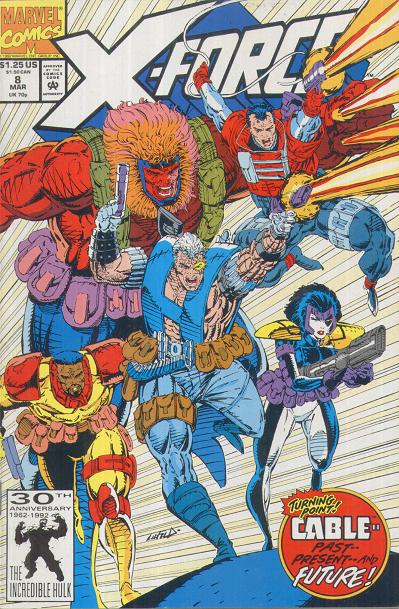
X-Force_Vol_1_8Issue number 08 starts out with the apparent death of Samuel Guthrie, also known as Cannonball. There’s a lot of history discussed just in the first two or three pages of this issue, with Cable thinking about how long ago his team ran as Wild Pack instead of X-Force.

Rereading these comics demonstrates exactly why I related (and probably even more strongly actually relate right now) to Domino as a character. One of the interesting things in this issue is the verbal play between Bridge and Domino as they are fighting their way into a Hydra installation. Bridge says, “Some rear support would be appreciated.” Domino replies by saying, “I’m not touching that one with a ten-foot pole.” And then once the team climbs to the top of the building, Cable asks, “Where’s Bridge?” To which Grizzly replies, “Under me.” And Domino says, “That’s a frightening thought.” Domino is one of those lesser known characters in the Marvel Universe, but one who is highly amusing to me for a lot of reasons. Especially her dialogue. After the team discovers a trap, she says, “Vas ees these ‘Bodyslide’ all the time? I do sooo love your funky toys, Nate!”

Two years ago or more, when I was having a discussion with another comic book enthusiast, we discussed the art work of Rob Liefeld, who has been a very popular comic book artist for some time now. I had not been paying attention to the comic book world for about a decade and my friend showed me pictures of the huge chests on all the men. The last page of this comic reminds me very heavily of that discussion, which amused me greatly.

X-Force_Vol_1_9Issue number 09 starts out exactly where 08 left off, with Cable attempting to save the life of Sam Guthrie. The battle between the new Brotherhood of Evil Mutants and Wild Pack becomes a team-on-team battle with characters like Boom Boom and Domino taking on Sauron and Thornn while Cable works to get Sam back to the medi-lab. Again, I am struck with how similarly Domino and I think and react. “And you’re toast, right? … Now get up – ’cause I’m just in the right mood to deal with you!” She then proceeds to call them all idiots while she beats the crap out of them. And then gems like this, “Just because he’s dead, doesn’t mean it’s fatal!”

One of the key differences between X-Force and the rest of the X-Men titles of this time is that Wild Pack has absolutely zero reservations about killing people. While the rest of the X-Men related titles of this time spent great effort to not kill their opponents, X-Force will kill anyone they have to, knowing that enemies left alive will come after them later or cause more harm to more people. If in the middle of a fight, they have no qualms about stabbing people through the back with their swords or shooting them in the back. I remember when I was younger and reading these stories how different this kind of behavior was for people designated as the heroes or the good guys. These comics came out at a time before the anti-hero became popular.

And, randomly, why-oh-why is Domino wearing a bikini top on the cover of this comic when that isn’t even close to what she’s wearing during the comic or what’s going on inside the comic? I could rant about sexism in comic books for a very, very long time, but this came out decades ago and I don’t have the energy to waste on this tonight.

X-Force_Vol_1_10Issue number 10 starts with the battle between Weapon X and the Mutant Liberation Front. Weapon X does a great job of kicking most of the butts of the Mutant Liberation Front henchmen until he is confronted with Stryfe, who takes off his helmet to reveal Cable’s face.

Meanwhile, Gideon is having a discussion with the other immortals concerning a newly awakened high-lord, which the last issue revealed to be Sam Guthrie. The discussion is designed to answer some questions brought up in the last two issues, as well as interest the reader in the future and encourage thoughts about what this kind of revelation might mean. In this way, this storyline is done very nicely to increase the interest of the reader and the tension of the storyline. Cable then tells Sam about how he’s an External, which is a mutant gifted with eternal life. Sam reacts to the news in a way that is much more encouraging than the way some people would have reacted. He said everyone is supposed to have their time and he kind of goes into shock, which shows the reader what kind of character Sam truly is.

The subtle humor in this comic series continues to amuse me. When Kane/Weapon X confronts Stryfe, Forearm intervenes to prevent Kane/Weapon X from attacking Stryfe and Forearm says, “He cuts our paychecks. He makes out the grocery lists. ‘Sides, all the video rental cards are in his name.” These comic books came out at a time when video rental stores were prevalent and I don’t know that future generations reading these comic books will understand that reference.

The end frame of this comic book is a drawing of Deadpool, which is not at all how Deadpool looks these days. His thighs are almost as big as his chest and his waist and head are both disproportionately tiny. The discussion about Rob Liefeld’s art work continues to be relevant here.

X-Force_Vol_1_11Issue number 11 begins with Cable and X-Force bringing the head of Masque, the former Morlock leader, into the Morlock tunnels. I am struck again by how different this style of hero or good guy team is from the standard X-Men titles of this time. I’m about to go into some major spoilers for Deadpool, so if you don’t want to know what might be coming in the actual, modern movie line for some character development, you really should stop reading right now.

Seriously. Stop reading. These spoilers are interesting and don’t bode well for the future Deadpool movies.

In this entire issue, and the one panel of the previous issue in this series, Deadpool refers to Domino as Vanessa. And then when he attacks her from behind, he refers to himself as, “Your old boyfriend, Deadpool!” As their fight continues, he says that her face belongs to someone else and he says, “‘Cause you an’ I both know … that when this gig is done … you’re still Vanessa, an’ you’re still Tolliver property.” But the real Domino is currently a captive of Tolliver and is being tortured and abused in the dungeon of Tolliver’s castle. Which shows so many things that these comic could and did with their storylines and how most of the comic books from this time were all long arches and not a one-issue stand alone. The writers of this series really did a great job with the placement of information, the character building, and the world building.

Overall, I’m really glad that I am rereading these comics. I have missed the comic books from the 1990s, mostly for the storylines that were actually part of a long-term plan. This isn’t a fractured storyline and the plot holes aren’t multiplying like tribbles. I would rate all of these as a solid three or a high three on my rating scale.

Posted in Book Reviews | Tagged , , , , , , , , , , , , | Leave a comment

Book Review: the Spiderwick Chronicles: Great Escape by Tony DiTerlizzi and Holly Black

This is a special version of parts of the second book in the Spiderwick Chronicles, which is the Spiderwick Chronicles: Great Escape (Young Adult 64 pages) by Tony DiTerlizzi and Holly Black.

“Dear Reader, One day we were doing a group signing at a large bookstore. When the signing was over a clerk approached us. He said that there had been a letter left for us. When we inquired which one of us, we were surprised by his answer. “Both of you,” he said. That letter changed our lives. It was from three children who claimed, “We know about real faeries. In fact, we know a lot about them.” What has happened to us since we read their letter is hard to describe. We have been plunged into a world we never quite believed in. One particularly thrilling part of their tale is recounted here along with a story that wasn’t discovered until after the original Spiderwick books had been published. There’s so much you need to know, so read carefully. There is an invisible world around us and we hope that you, dear reader, will open your eyes to it. DiTerlizzi and Black.”

In the first book, Jared, Simon, and Mallory Grace move to an old house with a secret library and encounter a boggart. The boggart makes things a little uncomfortable for them and they wind up making amends and learning about a Field Guide written by a relative named Arthur Spiderwick.

In the second book, Simon gets snatched by a group of goblins and Jared and Mallory work to find him and rescue him. Along the way, Jared’s temper gets the better of him again and he winds up being a bit mean to Thimbletack when Thimbletack tries to help them out against the goblins. When Jared and Mallory find Simon, they also rescue a hobgoblin named Hogssqueel who assists with their escape and provides them with goblin spit, which gives them the ability to see the fairy world without use of the Seeing Stone.

This small book gives a small portion of the second book and then an additional story about Hogssqueel and his adventure in captivity. There are also several informative pieces at the back that are designed as articles from the Field Guide itself.

This book was obviously intended for a very young audience, as the story-telling is very quick and lyrical with short, descriptive paragraphs. There’s also a selection of character portraits and drawings from the story itself, which gives the book something of a classic feel with a map in the front and continued drawings throughout the story. I liked the drawings and felt that they added a good visual depiction of the characters and events, but I learned to not look at the pictures until after I’d read all the words on open pages because the pictures gave away some of the upcoming plot or character elements in each part of the story. One of the interesting things about this series to me is that I often feel as though the faery characters described in each book so far are not exactly like the “normal” or “standard” options. The brownies, boggarts, phooka, elves, sprites, trolls, and goblins are so far mostly unique in their interactions in the Spiderwick Chronicles versus the descriptions of faery characteristics in other works.

Overall, I liked the characters and the world-building is interesting. These are really quick reads and I like reading them when I have an hour to spare, since that’s how long it usually takes me to get through them. I think this book is a low three on my scale, since they’re tons of fun for a quick read, but designed for a much younger audience.

Works cited: DiTerlizzi, Tony and Black, Holly. The Spiderwick Chronicles: Great Escape. New York: Simon and Schuster Books for Young Readers, 2007. Original print 2003.

Posted in Book Reviews | Tagged , , , , | Leave a comment

Book Review: the Spiderwick Chronicles: the Wrath of Mulgarath by Tony DiTerlizzi and Holly Black

This is the fifth and final book in the Spiderwick Chronicles, which is the Spiderwick Chronicles: the Wrath of Mulgarath (Young Adult 137 pages) by Tony DiTerlizzi and Holly Black.

“Three ordinary kids, Jared, Simon, and Mallory Grace, have entered another world – without leaving this one! Two remarkable talents, New York Times best-sellers Tony DiTerlizzi and Holly Black, have risked everything to bring this remarkable account to light. Five books – one thrilling adventure – the Spiderwick Chronicles! Their world is closer than you think.”

In the first book, Jared, Simon, and Mallory Grace move to an old house with a secret library and encounter a boggart. The boggart makes things a little uncomfortable for them and they wind up making amends and learning about a Field Guide written by a relative named Arthur Spiderwick.

In the second book, Simon gets snatched by a group of goblins and Jared and Mallory work to find him and rescue him. Along the way, Jared’s temper gets the better of him again and he winds up being a bit mean to Thimbletack when Thimbletack tries to help them out against the goblins. When Jared and Mallory find Simon, they also rescue a hobgoblin named Hogssqueel who assists with their escape and provides them with goblin spit, which gives them the ability to see the fairy world without use of the Seeing Stone.

The third book shows Mallory, Simon, and especially Jared dealing with increasing pranks around the house. Jared believes the pranks are perpetrated by Thimbletack, who Jared was extremely rough with in book two. In order to attempt to figure out how to stop the pranks and to get more information on Arthur Spiderwick’s Field Guide, Mallory, Simon, and Jared visit their Great Aunt Lucinda in the hospital. As it turns out, Lucinda is Arthur’s daughter and she is in the hospital because she was having problems with the faeries entering the house and causing her bodily harm while asking about the book. Even though she had no knowledge of the Field Guide, the faeries didn’t believe her and continued to escalate their personal attacks. Lucinda also made the mistake when she was younger of eating a piece of fairy food and can now no longer enjoy or even stomach normal food. The third book ended with Jared, Simon, and Mallory finding the elf forest and tricking them into releasing the Grace youths out of the forest.

The fourth book takes a much darker turn, as Simon, Jared, and Mallory find themselves captives of the dwarves. The fourth book ends with Mallory, Simon, and Jared barely escaping the dwarf tunnels only to witness the dwarves provide Mulgarath, the big bad guy of the whole series, with more weapons and such. Mulgarath then has all the dwarves killed by the goblins while they march a human-sized prisoner away.

This book was obviously intended for a very young audience, as the story-telling is very quick and lyrical with short, descriptive paragraphs. There’s also a selection of character portraits and drawings from the story itself, which gives the book something of a classic feel with a map in the front and continued drawings throughout the story. I liked the drawings and felt that they added a good visual depiction of the characters and events, but I learned to not look at the pictures until after I’d read all the words on open pages because the pictures gave away some of the upcoming plot or character elements in each part of the story. One of the interesting things about this series to me is that I often feel as though the faery characters described in each book so far are not exactly like the “normal” or “standard” options. The brownies, boggarts, phooka, elves, sprites, trolls, and goblins are so far mostly unique in their interactions in the Spiderwick Chronicles versus the descriptions of faery characteristics in other works.

This book starts out is a very odd place for me because Jared, Mallory, and Simon walk home after their ordeal with the dwarves, but their mom is the one who drove them all there. Why wouldn’t they first check the parking lot of the school? What kind of parent would take all that time and energy to drive all three of their children to a school fencing match and leave them there? Most parents I know would have search parties and such or not leave without their kids. So the fact that Mallory, Simon, and Jared feel as though they should walk home and not look for their mom is so weird to me.

I don’t really want to give away the climatic parts of this portion of the story, which is pretty much the whole book, so I will leave this review with just my overall summary and thoughts.

Overall, I liked the characters and the world-building is interesting. These are really quick reads and I like reading them when I have an hour to spare, since that’s how long it usually takes me to get through them. I think this book is a low three on my scale, since they’re tons of fun for a quick read, but designed for a much younger audience.

Works cited: DiTerlizzi, Tony and Black, Holly. The Spiderwick Chronicles: the Wrath of Mulgarath. New York: Simon and Schuster Books for Young Readers, 2004.

Posted in Book Reviews | Tagged , , , , | Leave a comment