Book Review: the Spiderwick Chronicles: the Ironwood Tree by Tony DiTerlizzi and Holly Black

This is the fourth book in the Spiderwick Chronicles, which is the Spiderwick Chronicles: the Ironwood Tree (Young Adult 109 pages) by Tony DiTerlizzi and Holly Black.

The summary on the back of the book is covered up with leaves so I can’t give you an accurate summary from there.

In the first book, Jared, Simon, and Mallory Grace move to an old house with a secret library and encounter a boggart. The boggart makes things a little uncomfortable for them and they wind up making amends and learning about a Field Guide written by a relative named Arthur Spiderwick.

In the second book, Simon gets snatched by a group of goblins and Jared and Mallory work to find him and rescue him. Along the way, Jared’s temper gets the better of him again and he winds up being a bit mean to Thimbletack when Thimbletack tries to help them out against the goblins. When Jared and Mallory find Simon, they also rescue a hobgoblin named Hogssqueel who assists with their escape and provides them with goblin spit, which gives them the ability to see the fairy world without use of the Seeing Stone.

The third book shows Mallory, Simon, and especially Jared dealing with increasing pranks around the house. Jared believes the pranks are perpetrated by Thimbletack, who Jared was extremely rough with in book two. In order to attempt to figure out how to stop the pranks and to get more information on Arthur Spiderwick’s Field Guide, Mallory, Simon, and Jared visit their Great Aunt Lucinda in the hospital. As it turns out, Lucinda is Arthur’s daughter and she is in the hospital because she was having problems with the faeries entering the house and causing her bodily harm while asking about the book. Even though she had no knowledge of the Field Guide, the faeries didn’t believe her and continued to escalate their personal attacks. Lucinda also made the mistake when she was younger of eating a piece of fairy food and can now no longer enjoy or even stomach normal food. The third book ended with Jared, Simon, and Mallory finding the elf forest and tricking them into releasing the Grace youths out of the forest.

This book was obviously intended for a very young audience, as the story-telling is very quick and lyrical with short, descriptive paragraphs. There’s also a selection of character portraits and drawings from the story itself, which gives the book something of a classic feel with a map in the front and continued drawings throughout the story. I liked the drawings and felt that they added a good visual depiction of the characters and events, but I learned to not look at the pictures until after I’d read all the words on open pages because the pictures gave away some of the upcoming plot or character elements in each part of the story.

One of the interesting points of this book is that from the first book through this book, Jared continues having a problem controlling his temper and using violence to resolve issues in his world. This continues to have negative consequences for him and also brings negative consequences to the other people around him as well. His treatment of Thimbletack in book two has lead to increasingly uncomfortable living situations within the house and in a number of small pranks that cause him a variety of minor injuries.

Simon’s interest in animals is extremely fascinating for the sole purpose that he truly wants to help and save all the animals and he may or may not realize that the animals are probably better in their natural habitat. I find his level of enthusiasm and his fearlessness in dealing with animals inspiring, even and especially Byron, the wounded griffin they rescued from the goblins in the second book.

This story takes a much darker turn, as Simon, Jared, and Mallory find themselves captives of the dwarves. One of the interesting things about this series to me is that I often feel as though the faery characters described in each book so far are not exactly like the “normal” or “standard” options. The brownies, boggarts, phooka, elves, sprites, trolls, and goblins are so far mostly unique in their interactions in the Spiderwick Chronicles versus the descriptions of faery characteristics in other works. I also enjoyed the play on Snow White in this particular book because of what happened with Mallory and the six dwarves.

Unlike the other books in this series so far, this one ends with a cliff-hanger and a very unhappy breaking point. If you look at this entire series as one book, then the character arch makes a lot more sense because we’re getting close to the end, so the action and the tension are both building. The conclusion is the next and final book and this book does a great job of motivating you to grab the next book and just keep reading.

Overall, I liked the characters and the world-building is interesting. These are really quick reads and I like reading them when I have an hour to spare, since that’s how long it usually takes me to get through them. I think this book is a low three on my scale, since they’re tons of fun for a quick read, but designed for a much younger audience.

Works cited: DiTerlizzi, Tony and Black, Holly. The Spiderwick Chronicles: the Ironwood Tree. New York: Simon and Schuster Books for Young Readers, 2004.

Posted in Book Reviews | Tagged , , , , | Leave a comment

Book Review: the Spiderwick Chronicles: Lucinda’s Secret by Tony DiTerlizzi and Holly Black

This is the third book in the Spiderwick Chronicles, which is the Spiderwick Chronicles: Lucinda’s Secret (Young Adult 109 pages) by Tony DiTerlizzi and Holly Black.

The summary on the back of the book is covered up by a scrap of notebook paper that says, “Let the story of my niece and nephews be a warning. The more you know, the more danger you’re in. And trust me, you don’t want to meddle with the Little People” so I can’t give you an accurate summary from there.

In the first book, Jared, Simon, and Mallory Grace move to an old house with a secret library and encounter a boggart. The boggart makes things a little uncomfortable for them and they wind up making amends and learning about a Field Guide written by a relative named Arthur Spiderwick.

In the second book, Simon gets snatched by a group of goblins and Jared and Mallory work to find him and rescue him. Along the way, Jared’s temper gets the better of him again and he winds up being a bit mean to Thimbletack when Thimbletack tries to help them out against the goblins. When Jared and Mallory find Simon, they also rescue a hobgoblin named Hogssqueel who assists with their escape and provides them with goblin spit, which gives them the ability to see the fairy world without use of the Seeing Stone.

This book was obviously intended for a very young audience, as the story-telling is very quick and lyrical with short, descriptive paragraphs. There’s also a selection of character portraits and drawings from the story itself, which gives the book something of a classic feel with a map in the front and continued drawings throughout the story. I liked the drawings and felt that they added a good visual depiction of the characters and events, but I learned to not look at the pictures until after I’d read all the words on open pages because the pictures gave away some of the upcoming plot or character elements in each part of the story.

One of the interesting points of this book is that from the first book through this book, Jared continues having a problem controlling his temper and using violence to resolve issues in his world. This continues to have negative consequences for him and also brings negative consequences to the other people around him as well.

Simon’s interest in animals is extremely fascinating for the sole purpose that he truly wants to help and save all the animals and he may or may not realize that the animals are probably better in their natural habitat. I find his level of enthusiasm and his fearlessness in dealing with animals inspiring, even and especially Byron, the wounded griffin they rescued from the goblins in the last book.

As an adult reading about Lucinda Spiderwick and what kind of life she’s had because of the faeries made me sad, but it also made me think about people in hospitals or who are supposed to have mental health issues. I wonder all the time if those people who the rest of society puts into special facilities can actually see things or have seen things the rest of us have not. The entire world is a matter of perception and honestly, I’m to the point in my life where I know that there is a lot going on in the world that I don’t know about and I learned that I don’t actually want to know. I used to think I did want to know everything about the world, but after everything I’ve been through, I’m content to just live my life as I see fit.

Overall, I liked the characters and the world-building is interesting. These are really quick reads and I like reading them when I have an hour to spare, since that’s how long it usually takes me to get through them. I think this book is a low three on my scale, since they’re tons of fun for a quick read, but designed for a much younger audience.

Works cited: DiTerlizzi, Tony and Black, Holly. The Spiderwick Chronicles: Lucinda’s Secret. New York: Simon and Schuster Books for Young Readers, 2003.

Posted in Book Reviews | Tagged , , , , | Leave a comment

Book Review: the Spiderwick Chronicles: the Seeing Stone by Tony DiTerlizzi and Holly Black

This is the second book in the Spiderwick Chronicles, which is the Spiderwick Chronicles: the Seeing Stone (Young Adult 108 pages) by Tony DiTerlizzi and Holly Black.

The summary on the back of the book is covered up by a scrap of paper with a hanging upside-down cat that says, “We said no, still you looked, now instead, someone gets cooked” so I can’t give you an accurate summary from there.

In the first book, Jared, Simon, and Mallory Grace move to an old house with a secret library and encounter a boggart. The boggart makes things a little uncomfortable for them and they wind up making amends and learning about a Field Guide written by a relative named Arthur Spiderwick.

This book was obviously intended for a very young audience, as the story-telling is very quick and lyrical with short, descriptive paragraphs. Most of Thimbletack’s dialogue is done with rhyming and it makes his speech pattern very distinctive and there’s a lot of rhythm to the story. There’s also a selection of character portraits and drawings from the story itself, which gives the book something of a classic feel with a map in the front and continued drawings throughout the story. I liked the drawings and felt that they added a good visual depiction of the characters and events, but I learned to not look at the pictures until after I’d read all the words on open pages because the pictures gave away some of the upcoming plot or character elements in each part of the story. This book also had a color photo of the newspaper article found in the carriage house, which I think might add a bit of perceived authenticity to this book and story.

One of the interesting points of this book is that from the first book through this book, Jared continues having a problem controlling his temper and using violence to resolve issues in his world. This continues to have negative consequences for him and also brings negative consequences to the other people around him as well.

I did appreciate how this story continues to move forward with the different characterization of Mallory. She is competitive in the sense that she takes her fencing very seriously, she uses her skills to attack the goblins even though she can’t see them, and she rushes to help instead of running away. It’s not very often where I’ve read stories with a female character who is more of the skilled protector and defender than her male counterparts, especially not in stories designed for a much younger audience.

Overall, I liked the characters and the world-building is interesting. These are really quick reads and I like reading them when I have an hour to spare, since that’s how long it usually takes me to get through them. I think this book is a low three on my scale, since they’re tons of fun for a quick read, but designed for a much younger audience.

Works cited: DiTerlizzi, Tony and Black, Holly. The Spiderwick Chronicles: the Seeing Stone. New York: Simon and Schuster Books for Young Readers, 2003.

Posted in Book Reviews | Tagged , , , , | Leave a comment

Book Review: Kitty Saves the World by Carrie Vaughn

So my first trip to the bookstore was to find Kitty Saves the World (Urban Fantasy 318 pages) by Carrie Vaughn.

“It’s all come down to this. Kitty and her allies have decided to take down the ancient vampire Roman once and for all. But when their attempt fails, Kitty finds herself running out of time. The elusive vampire lord has begun his apocalyptic endgame, and Kitty still doesn’t know where he will strike. Meanwhile, pressure mounts as Kitty and her pack realize that not even Denver is safe as they begin to experience the true reach of Roman’s cult. Outnumbered and outgunned at every turn, Kitty will have to call on allies both old and new to save not just her family and friends, but the rest of the world.”

Since this is the last book in the series, I’m going to talk about the series as a whole, as well as the individual book.

This is thought to be the last installment of the Kitty Norville series, which is both sad and kind of neat at the same time. I do sometimes get frustrated at some authors when their books just keep going on and on and on and don’t seem to have an end in sight. I am a huge fan of stories that have a fully developed story arch, with consistent character development, and settings that make sense. I am firmly of the opinion that this book does a fantastic job of wrapping up the series without being unbelievable in any way.

One of the things I’ve really enjoyed about this series is that Kitty is one of the most compassionate characters out of most of the books I read. She isn’t a stereo-typical lead female character wearing stilettos, sleeping with every guy in the story, and using unrealistic violence to solve her issues. When things in her life get rough, she asks for help from her friends and family. She tries to talk her way out of all the trouble she gets in and if she can’t talk, then she’ll either fight or attempt to retreat. For Kitty, there is no shame at all in changing into her wolf form in order to run faster and farther to escape bad situations. There is no shame in being a smaller person and not participating in violence unless she has no other options. She is not the fastest, not the strongest, and not the best when it comes to physical violence. But she is the best at talking and providing information to people in order to help convince them to look at other options when faced with less-than-ideal situations. She is not a solo heroine who feels the need to do everything by herself. If anything, she knows that most issues are more easily solved with help. And that’s a huge thing for a heroine to do in fiction these days – ask for help.

I think this review is going to be shorter than I originally expected, as I am suddenly very tired. Overall, I think this book is a solid three on my rating scale. I like the story and the characters and I feel as though this was an adequate ending to the Kitty Norville series. I’m happy that I own all the books in this series.

Posted in Book Reviews | Tagged , , , | Leave a comment

Book Review: the Iron Trial by Holly Black and Cassandra Clare

This weekend’s book was the Iron Trial (Young Adult 295 pages) by Holly Black and Cassandra Clare.

“Friends and foes. Danger and magic. Death and life. Most kids would do anything to pass the Iron Trial. Not Callum Hunt. He wants to fail. All his life, Call has been warned by his father to stay away from magic. If he succeeds at the Iron Trial and is admitted into the Magisterium, he is sure it can only mean bad things for him. So he tries his best to do his worst – and fails at failing. Now the Magisterium awaits him. It’s a place that’s both sensational and sinister, with dark ties to his past and a twisty path to his future. The Iron Trial is just the beginning, for the biggest test is still to come …”

One of the interesting things about reading this book right now is that I am currently working on my Readings in the Genre: Mystery Classics for my Master of Fine Arts in Writing Popular Fiction from Seton Hill University and I’ve noticed that there are elements of mystery in a variety of genres that are not specifically classified as mystery. This story has a lot of elements of mystery woven throughout the main plot. I think one of the key points of mystery is getting the reader curious and asking questions about who the characters involved in the story are, why the characters behave the way they do, and how are specific scenes in the story accomplished? For mystery, it’s the curiosity and the questions that drive the story forward.

The same principles of mystery can be used in this story. I spent most of the story curious as to what was truly going on and what the motivation for each of the characters is. Why doesn’t Callum have any control of his magic? What isn’t Call’s father telling him? There were a lot of mysterious elements strewn throughout this story and I enjoyed the questions this story presented.

I was particularly interested in the portrayal of friendship in this story. Call finds himself in so many situations where he is ridiculed because he doesn’t fit in well with any of his peers. He seems to have no redeeming qualities that any of his peers would seek out. And yet, he finds himself partnered with two other people who turn into friends that he can count on. I think part of this is because they are put in a situation where the three of them are required to learn how to deal with, live with, and work together with each other in order to make it through their training. I think this is something that is sometimes lacking in the interpersonal relationships I see in the world around me today – the ability to work through issues, concerns, or problems instead of just ditching when things get uncomfortable. When people are forced to be in a situation and to work together, they learn more about each other and learn to see the good in each other instead of seeing the problems. I am of the opinion that all problems are solvable if those involved would only take the time to attempt positive communication, but that’s just the hopeless idealist in me.

To the best of my knowledge, this book is the first in a series of five and it looks a lot to me as though this entire storyline is going to question what makes someone a villain and what makes someone a hero. I’m intrigued enough by the way that this first book was done that I am considering investigating the next four books in the series.

I would probably rate this book as a low three on my rating scale because it was well-written with interesting characters but I am not so deeply ingrained in the story that I simply must find the next books in the series and read them immediately.

Posted in Book Reviews | Tagged , , , | 1 Comment

Movie Review: Star Wars: the Force Awakens

One of my very first actions upon returning home on Friday was to catch the first showing of the day of Star Wars: the Force Awakens. I am absolutely happy that I did because I enjoyed this movie very much.

I felt as though this movie was a true sequel to all the movies that have come before, but I know there are a few of the more dedicated fans of the Star Wars franchise who are not as forgiving as I am because of all the Star Wars lore located in the books and games that doesn’t all exactly add up with the new movie. The new movie apparently does not follow the storylines and canons established throughout the games and the books, but as I have not played the games and I have not read the books, all I can talk about is the movie itself.

Even though the movie was maybe a little over two hours long, I kind of felt as though it moved very quickly and felt at least partially rushed in some cases. There was a lot of interstellar space travel and a lot of events that happened in what seemed like a small matter of days, if not on the same day in general. The characters never seem to rest and it feels a lot like they all go straight from one action scene to the next without getting or taking any pauses. I would think that kind of pace would be rather physically exhausting, but I think it’s more likely that a greater length of time actually passed than what is indicated in the movie.

I am going to go out on a limb at this point and guess that most people who are reading this review have already seen the movie. If not, I’m probably going to start talking about some spoilers, so you should probably stop reading here.

I am extremely impressed by the amount of social commentary that is possible because of this movie. The main characters in this movie are a gentleman of color who appears to be an empath or some other extremely caring person and a kick-butt woman who is extremely mechanically inclined and can fly just about anything. These two characters alone broke so many of the gender-based stereotypes that I was thoroughly impressed with everything about these characters.

I’ll even go a couple of steps farther. It appeared to me, very strongly I might add, that Rey had absolutely zero inclination towards romance in any part of the movie. In fact, the strongest potential romantic element in the movie was between Poe and Finn, which would be really fantastic because those two characters felt very well connected to me. I’m going to be extremely upset if Rey winds up being some sort of romantic interest and that she loses her ability to get the job done because some guy needs to feel justified by having her end up with someone in order for the series to be complete. That’s what has happened with so many heroines throughout movie history. The female character starts out as a completely competent, kick-butt super human, and then some pathetic guy comes along and suddenly, that female character is a pathetic, whiny, unnecessary character who is only used to move the male character’s plot forward.

I am particularly amused by the fact that the bad guy is an emo white boy who throws temper tantrums whenever things don’t go exactly his way. He is so desperate to gain the approval of Smoke, who he treats as a father figure, that he ignores his actual father and the teachings that he could received therein.

Which brings me to Smoke. I totally, absolutely, without a doubt, do not understand what the deal with this giant grey alien is. I’m not convinced that Smoke has any ability to use the Force whatsoever, since Kylo is so ridiculously untrained. Kylo strives to earn Smoke’s approval and he swears he will be as powerful as his grandfather, but I’m pretty sure no one told Kylo that Vader turned on the Emperor in the end, which saved the galaxy. If Kylo knew that Vader had chosen to follow the light instead of the darkness then he would likely have a very different view of his own role in the universe. But Smoke doesn’t seem to have any ability to actually provide training for Kylo. If Smoke was actually training Kylo, I think Kylo wouldn’t have so many instances throughout the movie where he participates in random destruction of the property around him.

I think one of the most discussed topics concerning the movie is the origin of Rey. I am under the impression that she is being set up to be Luke’s daughter. For me, this is because of how Rey reacts whenever anyone mentions or talks about Luke and also the way she looks at Luke when she attempts to deliver his light saber at the end of the movie. She seems more connected to him than anyone else in the movie. I swear, if she becomes a romantic interest as the movies progress, I will be incredibly unhappy with the franchise as a whole.

Overall, I enjoyed the movie greatly and I look forward to the next installments. I would probably only rate this movie as a high three on my rating scale, though, because I don’t know what they intend on doing with the characters.

Posted in Movie Reviews | Tagged , , | Leave a comment

Movie Review: Deadpool

I went out and saw Deadpool for the first showing at the giant, super nice theater nearby today and I am absolutely glad I did. This movie was probably the most I’ve laughed during any movie in a really long time and I was honestly not expecting to enjoy the movie as much as I did.

The first thing you need to know about this movie is that it is rated R for a reason. Actually, it’s rated R for a lot of reasons. It’s a Deadpool movie. And, oddly, it’s actually a Deadpool movie that stays true to the character and is a very accurate representation of Deadpool. I was honestly surprised at how well this movie did in staying true to the character. But that character is a loud-mouthed mercenary who uses a lot of vulgar expressions and provides a fantastic selection of graphic descriptions of things some people might consider inappropriate or gross. You’ve been warned. And if you think you’re getting anything other than that in a Deadpool movie, I’m not really sure what kind of character you think Deadpool would be.

From the very first opening scene with the credits, I laughed. For those of you who haven’t seen the movie yet, I strongly encourage you to actually pay attention to the opening credits because they are not at all what you would expect from any sort of opening in a movie. The way the opening credits were done made me laugh throughout the entire beginning scene.

I also enjoyed the music and the slow-motion action at the beginning of the movie. The music throughout the movie was definitely a positive addition and made me laugh even more during the movie. The music was obviously used with purpose and it added to the mood for many of the scenes.

I think the parts of the movie that made me laugh the most involved all of the puns and references to Ryan Reynolds and the live-action Green Lantern movie. Wade Wilson even specifically requests that when his super hero costume is being created that it not be green or animated. There was also a scene with a Green Lantern comic book card which made me laugh. And multiple references to Wolverine and the movies which Deadpool showed up in that ruined the character before this movie. This movie has so many sidebar jokes and references that I was highly amused at places I don’t think many people in our sold-out theater for the showing of this movie understood. That didn’t stop me from getting the jokes and laughing, though. Because, really, when don’t I do my own thing?

What else can I say about the movie? It was violent and hilarious and still had a good storyline and fun characters. The only thing in the movie that I will probably remain 50/50 on is the portrayal of my all-time favorite comic book character (who is not Deadpool, but who makes a guest appearance in the movie). I am seriously uncertain if I think that was an accurate or adequate representation of my favorite character, but I will admit that the role was accomplished nicely for this movie. I just don’t think it showed the best aspects of my favorite character.

I’d say this movie is easily a four on my rating scale, as I’m happy I paid for us to see it and I also suspect that I will purchase the movie when it comes out.

Posted in Movie Reviews | Tagged , | Leave a comment

Book Review: The Hound of the Baskervilles by Sir Arthur Conan Doyle

I have to admit that this is the first book I’ve ever read about Sherlock Holmes. I know that Sherlock Holmes is an extremely popular character and that the character shows up in a variety of movies and television shows even now. For whatever reason, I’ve never taken the time to read any of Sir Arthur Conan Doyle’s works.

The story is written from the point of view of Dr. John Watson, a friend and colleague of Sherlock Holmes. As it is pretty much a given that Holmes will solve whatever mystery will present itself in this story, having the story written from the perspective and point of view of Watson is a very clever way to give the reader details and information that may or may not have anything to do with the presented mystery. Watson admires Holmes and his intellect and believes himself inferior to Holmes. In this way, he presents himself as the “average man” and one who believes himself lucky to be able to study with and learn from someone as prestigious as Holmes.

An article in the Baker Street Wikia discussed at length the similarity between Edgar Allen Poe’s character of C. Auguste Dupin and Sherlock Holmes, but the article makes it clear that Holmes believes himself superior in all ways to any other potential detective or intellectual mind before him. Watson comments on this similarity in The Murders in the Rue Morgue and Holmes responds with disdain by discussing “that trick of his of breaking in on his friends’ thoughts with an apropos remark after a quarter of an hour’s silence is really very showy and very superficial.” And yet, the Hound of the Baskervilles begins with Holmes doing the exact same thing to Watson, as they sit and contemplate the walking stick left in their office.

While I may not have read or watched any of the Sherlock Holmes stuff before, I think that I remember someone telling me once that all of the Sherlock Holmes mysteries are solved through Holmes’ intelligence and always had completely logical explanations for everything. Even knowing that, however, I still believe there was enough evidence presented at the beginning to allow me to believe that the Hound of the Baskervilles was the real, supernatural deal. I wasn’t trying to come up with logical explanations for the presence of the Hound because I read mostly horror, science fiction, and fantasy. With those kind of tastes, I’m usually willing to accept just about anything in the story. Scary glowing dogs, aliens, serial killers, escaped convicts, whatever.

I think Sherlock Holmes is interesting because it really does feel as though he is very pretentious and that he solves things because the people around him don’t pay as close of attention as he does. It’s very interesting to me that it’s been indicated that in the modern usages of Sherlock Holmes that he is not really made out to be a super genius so much as the people around him are made out to be much less intelligent than him.

Though Watson gives most of the credit to Holmes for solving mysteries, Watson is actually the one who does the leg work for this particular case. Watson doesn’t appear to get any responses to his letters once he arrives at Baskerville Hall with Henry Baskerville and so he is forced to do the best he can on his own. But Watson is actually very astute because he resolves the concerns with Mr. Barrymore’s creeping around the hallway at night without any assistance from Holmes. Between Watson and Baskerville, they find out that the escaped criminal living on the moor is Mrs. Barrymore’s brother, Selden. Watson also figured out that Mrs. Laura Lyons was involved in the mysterious death of Sir Charles Baskerville in that she had set up the appointment with Sir Charles Baskerville that night in order to get him out in the moor and that there were a number of interested parties in how she conducted her business.

From my perspective, the only parts of the mystery that Holmes put together that Watson didn’t was that Stapleton was married and that he was another heir to the Baskerville fortune and estate. Though, it was obvious to an astute reader that the chances of the Stapletons being siblings was extremely slim because of how those two characters interacted with both Watson and Baskerville, and even with each other. Right from the initial meeting between Watson and the lady Stapleton, whose true name is Beryl Garcia, it’s obvious that the Stapletons know more about what’s going on and who the key players are then they initially let on.

Holmes also connected the use of the real-life hound with the myth from the Hound of the Baskervilles. The Baker Street Wikia also discusses Holmes by saying, “he does not allow superstition (as in the Hound of the Baskervilles) or grotesque situations to make him afraid; and he intrepidly confronts violent murderers.” Holmes knew when Baskerville’s boot was stolen in London that a real hound was likely involved and kept somewhere in the moor in order to frighten Sir Charles Baskerville to death on the night of his murder. Holmes also concluded that the same hound would likely be used against Sir Henry Baskerville in order to remove all other contenders for the Baskerville estate and fortune.

Other than those instances, the rest of the work in this case was provided by Watson. Watson’s point of view helped to provide the mysterious part of this story without allowing everything to be revealed as it happened, which would have been the case had Holmes provided the narration for this story.

I have to admit that I am not a fan of Sherlock Holmes himself and I relate a lot stronger to Dr. Watson because of his character. Overall, I would say that this story is a good introduction to classic mystery novels, settings, and characters because the clues are there for the average, non-mystery reader such as myself to pick them up, while the later parts of the story have enough action and excitement to move the characters and the story forward without becoming unbelievable or ridiculous.

I have to say that I am that reader that did not grow up with Holmes and the Hound. This is my first reading of a real mystery story (because I don’t count In the Woods by Tana French, which was required reading for one of my SHU residencies many, many years ago, as a mystery because nothing was ever resolved and I felt cheated. But that’s another story entirely). So while I am familiar with the existence of Sherlock Holmes and I am fully aware that he is supposed to be a great detective, I’ve never read any Sherlock Holmes stories, I haven’t seen the movies or the television series, and I have absolutely zero background in mystery. With all that in mind, I’d say the ending was fairly predictable, and I suspect most of that is because there weren’t any other suspects.

The Barrymore’s were cleared very early in the story with Watson finding the secret window messages and revealing Mrs. Barrymore’s brother, Seldon. Seldon was cleared because he was in prison when Sir Charles Baskerville died. That really just left the Stapletons. So even though we, as readers, were given all the clues early upon the arrival at Baskerville Hall as to *who* was involved, the question remained as to *why*, which I think is a lot more interesting of a question. Why would someone murder a man that appeared respected around the region? What was there to gain? And it was the *why* portion of the novel that drew me forward into wanting to know the *how* as well as the *why*.

Even though I know very little about the mystery genre as a whole, the question of why is always something that creates interesting motivation in most everything I read. Why do characters behave the way they do? Why would they risk everything for a specific event? Why do they do what they do? These questions are far more valuable to me as a writer because most of what I write is horror, and the serial killers, sociopaths, deadly aliens, and hungry demons occupying most of my reading and writing time are always followed by the question of *why*.

To me, that’s what makes mystery interesting.

The most effective parts in creating the spooky and foreboding sections involved the detail to which Doyle described the Moor. While I read this book, it felt a lot to me as though Doyle, through Watson, spent most of his time with descriptions of the Moor and the surrounding area. As soon as they approached the Moor in the carriage, the setting turns from images of a normal street in London and then interesting travels through the countryside to a dark and dismal turn into the clearly nefarious Baskerville Hall. He described what was necessary and removed all the frivolous aspects of things which were not necessary to move the plot forward.

I was actually torn about how to put that into words with my own thoughts on the descriptiveness of the setting. For me, the setting actually reminded me of the computer games I played as a kid, the King’s Quest series. In those games, there were a lot of dark and dangerous swamp areas, areas with poisoned water (which was a lot like the Moor in the Hound of the Baskervilles to me), and even a very Gothic inspired castle. It was those images which immediately came into my head when I read about Baskerville Hall.

The set up for Baskerville Hall was very well done, with the beginning of the story spending so much time building up the negative qualities of the area and of Baskerville Hall that I felt predisposed to see the darkness in the Moor and not the potential beauty. The Moor is set up to be a very unpleasant place, which furthers the atmosphere of foreboding.

I reminded myself repeatedly that this book was written quite some time ago and that there were different social norms, different customs and courtesies, and even different social classes. “Ill-usage” was such an awkward thing to read when Doyle clearly meant that Beryl Garcia had been physically abused.

One of the things I learned later in my semesters at SHU was that matching the tone for the target audience is a fairly important thing. And while we learn the proper spelling, grammar, punctuation, and writing styles, we also learn that not every rule-following story is well-written and some of the non-rule-following stories are either better sellers or vastly more popular. Doyle obviously knew the target audience he was writing for and used syntax that was familiar and comfortable for his readers at the time. His stories are so solid that they are still popular with many additional offshoots to this day.

Posted in Book Reviews, MA in Writing Popular Fiction, Readings in the Genre | Tagged , , , , , , | Leave a comment

Comic Book Review: Green Lantern v3: 09-12

This is the same introduction I posted when I posted my comic book review for Green Lantern v3 01-08. I left the introduction because I think it’s important to show where I’m at with the reading so far, which means understanding why I’m reading these and what kind of background (or lack thereof) that I have with the Green Lantern storyline.

I’ve recently started reading some comic books from the 1990s, and I started with the reboot of Green Lantern which started in June 1990. These comics actually came out while I was an avid comic book fan, but my tastes back then tended more towards the Marvel Universe and the X-Men series. Just over two years ago, a very good friend of mine introduced me to the Green Lantern universe. She was so adamantly passionate about Green Lantern that I started reading some of the later Green Lanterns and we watched the Green Lantern animated series on Thanksgiving of 2013.

There’s a lot going on in my life right now, but I found some of the comic books from the reboot of the Green Lantern series in 1990. I’ve been spending some time reading those and it’s been a really good experience.

As I begin my reading journey of these classic comic books, I have to say that I only have a very rudimentary knowledge of the Green Lantern and DC Comics Universe in general. I know that the Green Lanterns have rings they receive from little blue guys and that their rings can be used to do anything their imaginations can think of, so long as their rings are charged from their lantern every 24 hours. Their rings are powered by Will power, which means that they have to have the will to do what is required to solve their issues.

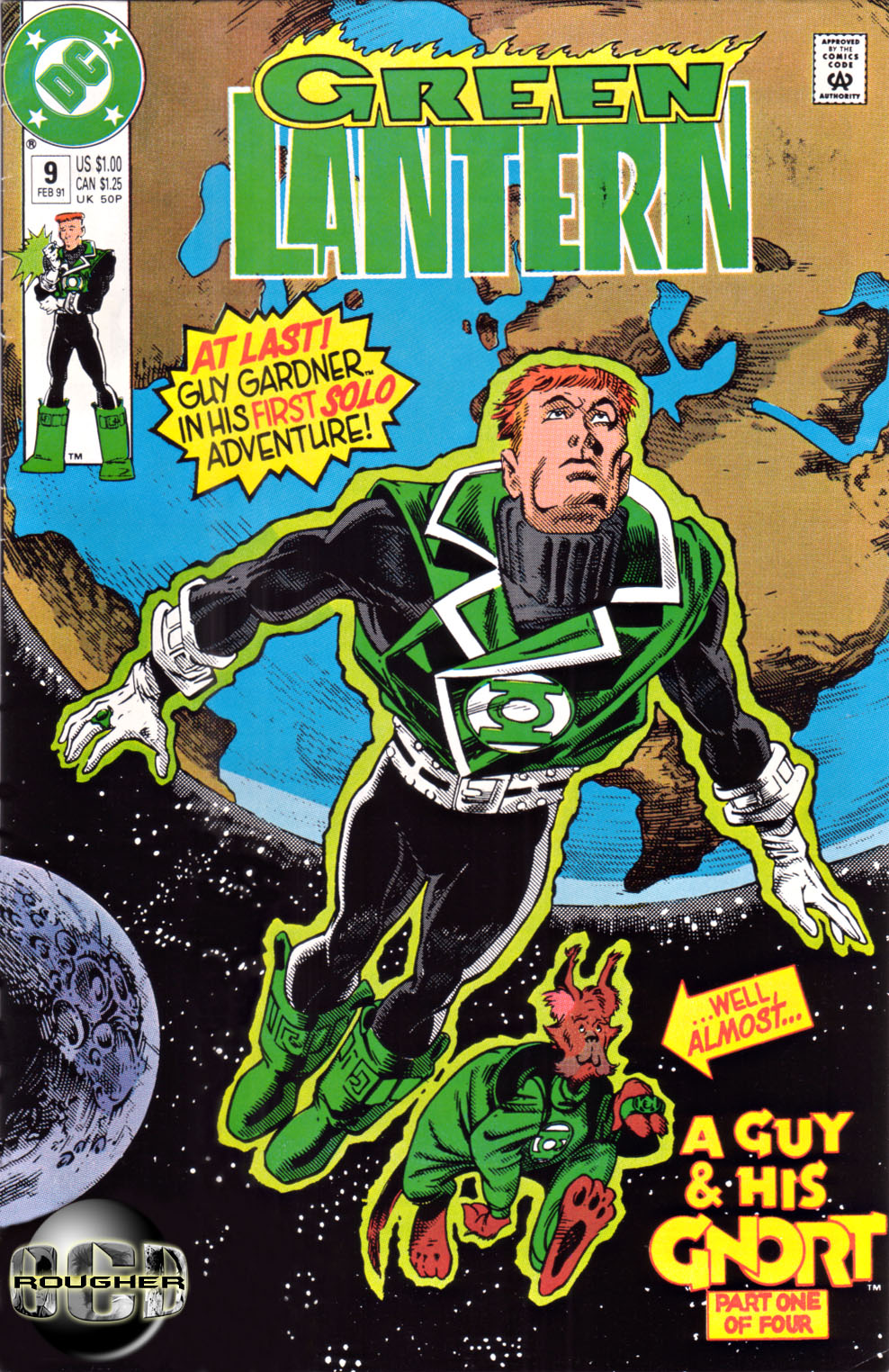
GreenLanternV3-09Issues 09-12 are dated February through May of 1991 and this is a four-part series that focuses mostly on Guy Gardner, who is currently my least favorite of the Green Lanterns we’ve so far been introduced to in these comic books. Guy Gardner starts out this “solo” adventure by finding Hope Springs, which is an American town that has been transplanted to Oa, the home planet of the Guardians, because one of the Guardians (I found out that the little blue guys that give people their rings are called Guardians) went stark raving mad and pulled a bunch of places from all over the universe to his planet so he wouldn’t be lonely.

Guy Gardner lands in Hope Springs and steals a whole bunch of munchies from the general store. He runs into Rose Hardin, the woman who owns her own farm and is struggling to make ends meet. Only now, her farm and her son, Toby, are part of the groups that are stranded on Oa. I think I agree with Rose completely when she describes Guy by saying, “I cannot believe that any mortal soul could be so prideful, so lewd, so arrogant, so altogether dad-blasted barbaric.” And that sums up my ideas about Guy very, very nicely. He is just the kind of entitled jerk that I would very much like to treat like a glow stick where I snap him and shake him until the light comes on.

One of the interesting things about these four issues is that Guy continues to reference Streisand, which I assume to mean Barbara Streisand. This is interesting to me because of the study and implications of what happens when you include modern references in your popular culture or popular fiction. While I know I’ve heard of Barbara Streisand, I can’t actually think of any of her songs or the lyrics off the top of my head. I am positive that she was very popular in the 1980s and 1990s in the U.S., but I wasn’t really focused on music at that stage in my life. So there is some sort of pop culture undercurrent that I am missing with these comics by reading them now, 25 years after they were originally published. And I don’t think there are many people who would read this series for the first time and understand the implications of Guy’s use of the word “cowabunga.”

Guy gets the position as *the* Green Lantern of sector 2814, which is Earth. When Guy shows back up to the Justice League, they don’t treat him with the level of respect or reverence he feels as though he deserves and he acts like a spoiled child who doesn’t understand responsibility at all. This is actually pretty standard behavior for him, as evidenced by the fact that he goes out to patrol the world and just causes more damage and more trouble than he could have possibly prevented.

Guy becomes partnered with Gnort, who looks and acts a lot like a dog, in order to investigate supposed false Green Lantern recruiting. Gnort is a big-hearted person and he wants to do good things in the world and Guy treats him with disdain and disgust. I strongly dislike the way that Guy treats people, especially people like Gnort.

Admitting to himself that he’s in a little bit over his head, he tracks down Hal Jordan and asks for his assistance in tracking down the location and personnel behind the non-Guardian supplied ring that gives Gnort his powers. Hal helps Guy out on his journey, but Guy still treats Gnort badly, which makes me continuously annoyed at this portion of the Green Lantern comic books. Gnort demonstrates that he’s far more of a hero than Guy is because he is loyal to his friends and the other Green Lanterns, he’s willing to sacrifice himself in order to save others, and he very much wants to help and protect people. I feel like Gnort is the exact opposite of Guy and I think that’s the point that these comics are working to show to readers. Guy isn’t supposed to be a likeable character and Gnort is supposed to show how even a “simpler” person with the wrong background can be a super hero.

Just because I understand why the characters are written the way they are doesn’t actually make me like them better, just to be clear.

Overall, I’m happy to be reading these comic books and I would probably rate issues 09-12 as a two on my rating scale. Guy Gardner is not a character who is endearing himself to me in any way and I’m slightly annoyed that I have to continue reading about him in order to understand where the story goes from here.

Posted in Book Reviews | Tagged , , , , | Leave a comment

Comic Book Review: Green Lantern v3: 01-08

I’ve recently started reading some comic books from the 1990s, and I started with the reboot of Green Lantern which started in June 1990. These comics actually came out while I was an avid comic book fan, but my tastes back then tended more towards the Marvel Universe and the X-Men series. Just over two years ago, a very good friend of mine introduced me to the Green Lantern universe. She was so adamantly passionate about Green Lantern that I started reading some of the later Green Lanterns and we watched the Green Lantern Animated Series on Thanksgiving of 2013.

There’s a lot going on in my life right now, but I found some of the comic books from the reboot of the Green Lantern series in 1990. I’ve been spending some time reading those and it’s been a really good experience. 

As I begin my reading journey of these classic comic books, I have to say that I only have a very rudimentary knowledge of the Green Lantern and DC Comics Universe in general. I know that the Green Lanterns have rings they receive from little blue guys and that their rings can be used to do anything their imaginations can think of, so long as their rings are charged from their lantern every 24 hours. Their rings are powered by Will power, which means that they have to have the will to do what is required to solve their issues.

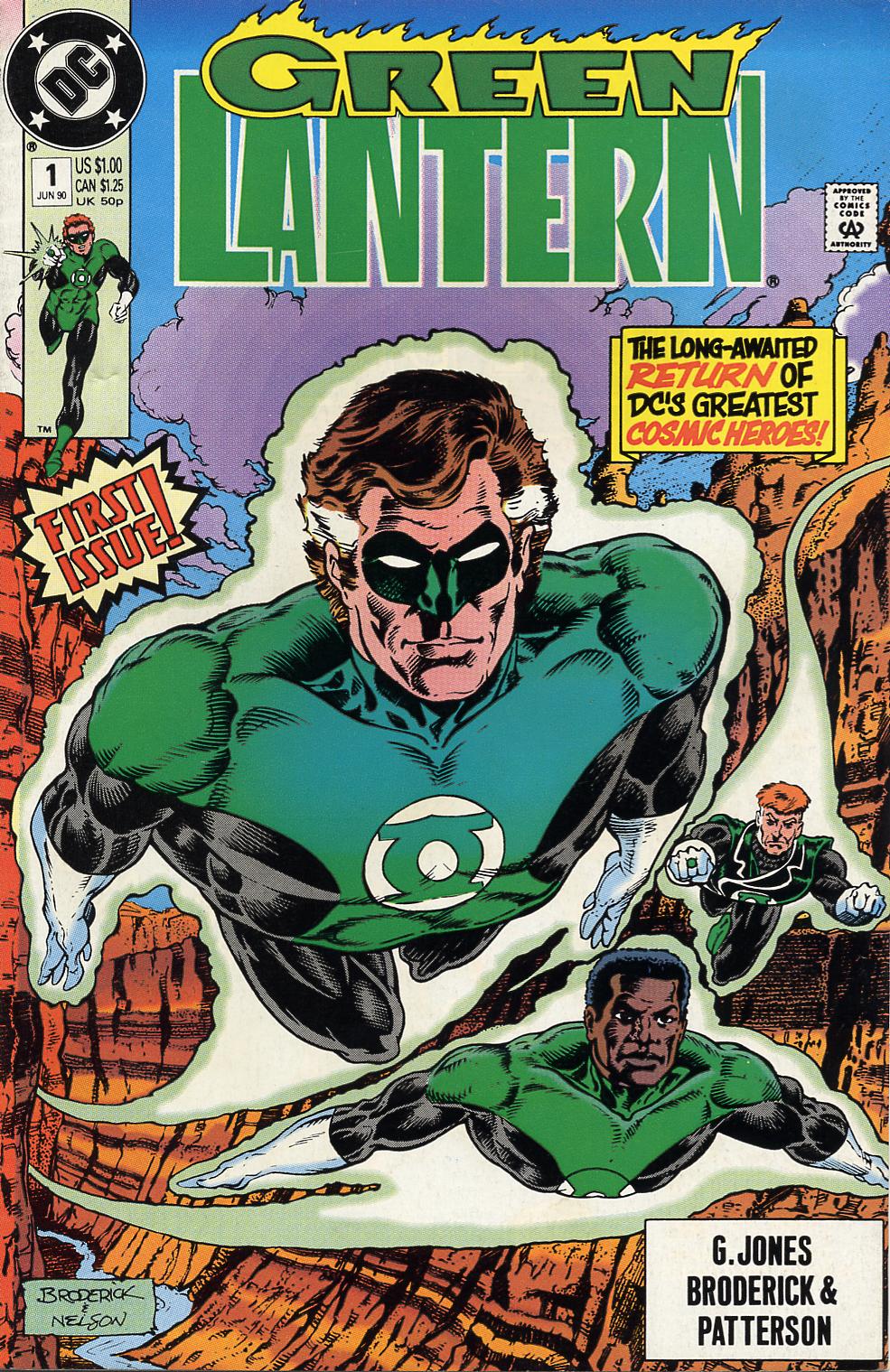
GreenLanternV3-01The cover of the first issue of the new Green Lantern comic books features Hal Jordan, John Stewart, and Guy Gardner. The three of them are very different personalities and the story begins with Hal Jordan in regular clothes, talking about a journey he’s taking across the United States on foot. I have no idea what’s happened prior to this issue, but there’s clearly some massive things that happened in Hal Jordan’s past. So Hal Jordan jumps off a cliff and then his Green Lantern part kicks in and he transforms into his costume at the last second and flies away, disrupting the camp site of several gentlemen on the ground.

Hal Jordan and Guy Gardner obviously don’t get along, and Guy Gardner isn’t really is a people person. Hal Jordan is shown as the ideal for the series, showing resourcefulness and is something of a ladies man, always focusing on the women around him. Guy Gardner is the typical male ego from that time, with the posturing and calling everyone names. This introduction comic book also shows some of the trauma of John Stewart and how he’s clearly suffering from Post-Traumatic Stress Disorder of some sort, where he holds himself responsible for the mistakes of the past.

Hal Jordan wanders to a farm and it feels like he’s not sure about who he is as a person without being Green Lantern. He stops at a selection of much quieter environments where he works for room and board and does what he can to have a simple life.

One of the things that really reminded me of my youth was the last page of this comic book, where it has a picture of Superman standing in space with the Earth in the background. The page says: “Be a Hero. Save the World. EARTH DAY 1990.” and then it gives an address to write to. This really struck me because I remember how the comic books I read as a younger person always seemed to focus on trying to subtly teach us how to be better people to each other and how to make the world a better place. The X-Men comics were designed to represent diversity and to help people see the similarities of the people around them instead of the differences. I was always a fan of the Marvel Universe as a younger person because Marvel took a lot more average people and gave them extraordinary powers. It always felt like the DC Comics Universe demonstrated people who were already extraordinary doing things to help other people, which didn’t resonate as well with me. With the notable exception of Green Lantern, which did take more average people and give them special gifts in the form of a ring of power.

Now, as an adult, there are a lot of good messages in these comics that I don’t know if I would have been ready for if I had been reading them when they first came out. These first eight issues of Green Lantern, from June 1990 through January 1991 mostly deal with the interpersonal relationships between Hal Jordan, John Stewart, and Guy Gardner. They show how some people attempt to deal with their issues by confronting everyone about everything and by attempting to use violence to solve all your conflicts, as is the case with Guy Gardner. They show John Stewart who attempts to bury his past and runs away from the memories of his mistakes only to find himself in a much worse situation with a being who granted him his Green Lantern ring. They show Hal Jordan and his continuous search to be a part of something, but how all he really does is form temporary connections with people who affect change through different interpersonal interactions on their own; how he is more likely to focus on his own issues, rather than help other people first. 

All three of these characters are distinctly different in the methods they use to enact change in their world, and all three of these characters have different story archs through the first eight issues where they are attempting to solve the issue of a Guardian gone rogue, who is lonely and therefore attempting to build his own eclectic planet of all the places he has fond memories. These first eight issues address what happens on an individual level and on a universal level when power starts corrupting those who wield it. In these first eight issues, Hal Jordan and Guy Gardner abandon their Green Lantern rings in order to participate in a macho fist-fight and their rings are then used by people without their sense of duty to cause destruction. The Guardian named Old Timer uses his power to gather cities from all across the universe to build a place where he won’t be alone anymore. Guy Gardner is seen to use his ring to open beer cans and pick on reformed criminals.

Even the best, when presented with enough power or specific circumstances, can be corrupted by the power they wield. The underlying message of these first eight comic books is along the lines of what having power means and what that power shouldn’t be used to accomplish. It’s about people’s intentions and what motivates them to take action that will benefit themselves, but harm other people.

Overall, I’m happy to be reading these comic books and I would probably rate issues 01-08 as a three on my rating scale. The story is mostly interesting and the characters are all reasonably different and reasonably flawed.

Posted in Book Reviews | Tagged , , , , , | Leave a comment